
World Sailing measures environmental impact of the sport's Olympic equipment
by World Sailing 15 Jul 11:44 BST
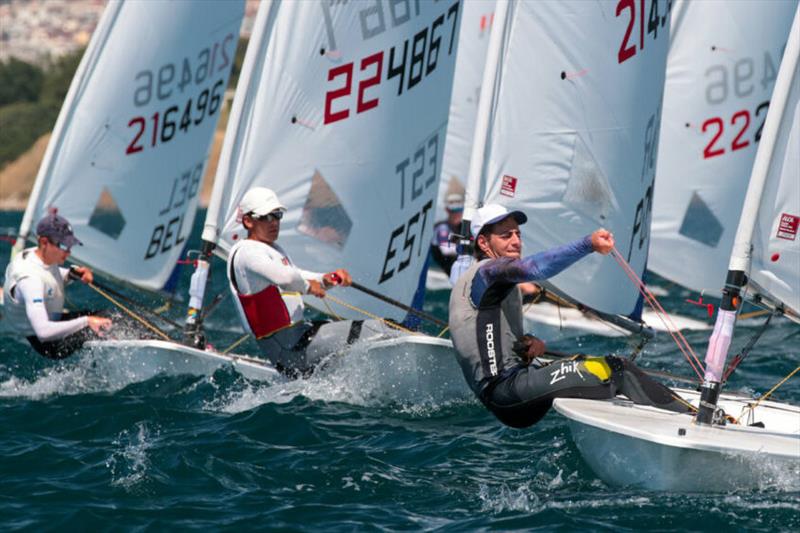
Day 2 - ILCA 6 Youth European Championships and Open European Trophy in Thessaloniki © Thom Touw /
www.thomtouw.com
The governing body for sailing is looking at how the sport's Olympic-class equipment is made, used and discarded, to eventually make changes that will reduce its environmental impact.
Alexandra Rickham, director of sustainability at World Sailing, said this first-of-a-kind life cycle assessment project will give the organisation the evidence it needs to make smarter choices and shape the future of Olympic equipment.
"Sailing naturally has a close relationship with nature, with the environment. It's seen very much as this clean, green sport using the wind," she said. "But the reality is that our equipment has an impact. It goes through some major industrial processes." Rickham said the project could be useful not just for Olympic sailing but for the broader sailing community and potentially other sports.
Competitive sailing, an Olympic sport since 1900, involves racing boats powered by only the wind and the waves.
In the 2024 Olympics, one- and two-person crews sailed boats with hulls measuring as long as five metres around a course marked by buoys in the Bay of Marseille. Outside the Olympics, competitive sailors race throughout the year in local events and larger regattas. The boats are commonly made of carbon fibre, fiberglass and PVC foam, which take a lot of energy to produce in processes that emit carbon pollution.
Furthermore, these materials don't decompose and are challenging to recycle. So when elite sailors are done with them, the boats would need to be sold, passed onto junior sailors or sent for specialised recycling to avoid landfills. As part of World Sailing's initiative, the sustainability consultancy Marine Futures is collecting data from boat builders about their operations and surveying athletes about how many boats, sails, masts and other gear they use, how often they replace their equipment and how they travel with their vessels.
By the end of this year, the goal is to capture the environmental impact of a four-year Olympic cycle and identify which interventions by World Sailing could make the most difference, said Ollie Taylor, director of Marine Futures.
Taylor said those could include encouraging builders to incorporate reusable materials, redesigning boats, shifting competition schedules to minimise travel and boat transport, or taking steps to ensure equipment is reused.
The goal is to remove guesswork and put data behind every decision, Taylor said.
Michelle Carnevale, president of the environmental organisation 11th Hour Racing, said the effort shows how much progress has been made in recent years. Sustainability wasn't talked about much in the sailing world a decade ago, and now environmental monitoring and benchmarking could become embedded into the rules of the sport, said Carnevale, whose organisation sponsored the development of software being used in the project.
Walker Ross, an expert on sport ecology and sustainability at the University of Edinburgh, said he loves World Sailing's leadership on sustainability and wishes more sports organisations were as thoughtful.
"Many sports have specialised equipment that can be quite resource intensive to produce and which are therefore difficult to recycle at the end of their useful lives," he wrote. Stuart Parkinson, executive director of Scientists for Global Responsibility, commended World Sailing for tackling the environmental impacts of boat construction.