
Single-Handed Foiling Dinghy welcomes proposal submitted for Olympic Review
by International Switch Class 27 Apr 14:18 BST
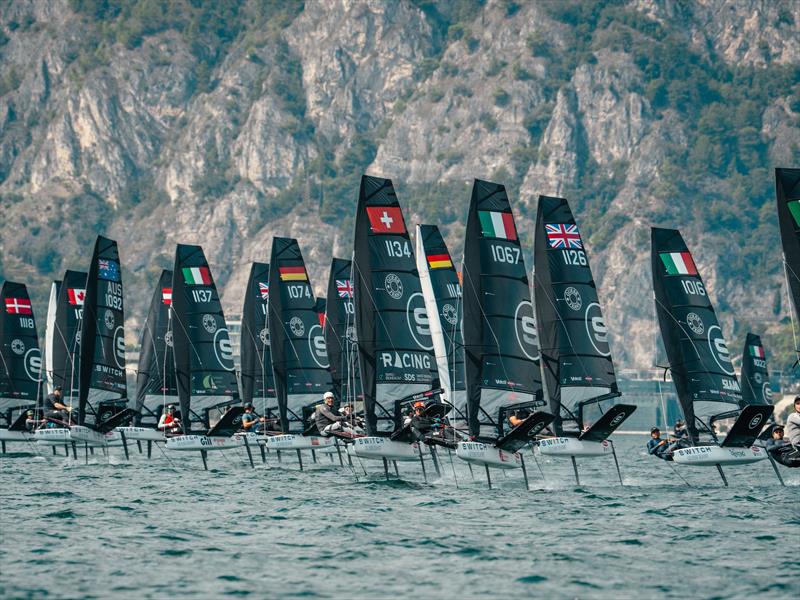
Switch Global Championships at Fraglia Vela Malcesine Day 2 © CodeZeroDigital
The International Switch Class has welcomed a recent proposal submitted by the Swedish Sailing Federation under World Sailing Regulation 11.5, which explores the introduction of a single-handed foiling dinghy event for both women and men within the Olympic programme.
The proposal signals a clear direction of travel within the sport towards modern, high-performance foiling disciplines that combine speed, athleticism and accessibility in a format suited to both athletes and global audiences. At its core is the concept of short, dynamic racing in single-handed foiling dinghies — a format that is already gaining traction across the sailing world. While the World Sailing Regulation 11.5 process is a very involved one and this proposal is simply one of many, it is a sign of recognition for both the boat and the Class.
Beyond the Olympic context, the proposal highlights the broader potential of single-handed foiling dinghies as a platform for the future of the sport. Their versatility allows for a wide range of racing formats, from short, high-intensity fleet racing to knock-out competitions, relay formats, long-distance challenges and speed-focused events. This flexibility offers new opportunities to evolve competition formats while maintaining strong spectator appeal.
Importantly, this is not a theoretical concept. Single-handed foiling dinghies already have huge worldwide presence. A global ecosystem of foiling dinghy sailing already exists, with established classes, growing fleets and an expanding international calendar. This is due to the large grassroots movements in classes like the Waszp. Supplementing the top-end with all the razzle and dazzle is the Moth class which is very high-performance and has been a proven pathway to the America's Cup and SailGP. Singlehanded foiling dinghies are actively sailed in over 45 countries globally. Within this space, the Switch Class reflects many of the characteristics outlined in the proposal.
The class has developed into a global fleet of over 200 boats across more than 20 countries, with the first Global Championship attracting a fleet of nearly 60 competitors. Its one-design platform delivers high-performance racing while maintaining strict equipment parity, and its durable construction is designed to withstand repeated use without significant performance degradation.
A defining feature of the platform is its modular and transportable design. Over 20 boats can be shipped in a single 20ft container, while key performance components such as rigs and foils can be transported by sailors themselves, including by air. This enables a travel-light approach to international competition, significantly reducing both logistical complexity and environmental impact. This model is further supported by the Class's developing charter system, which allows sailors to compete at international events without transporting full boats. The system was designed for sailors to travel with their foils and rigs, and to be able to charter a hull at the end- no other class has a model on this scale. Together, these elements create a more accessible and cost-conscious pathway into high-performance foiling competition.
The platform also supports a wide range of sailors through interchangeable rig configurations and a single adaptable hull, allowing progression from youth categories through to senior competition. This creates a clear and scalable pathway, aligned with the broader objectives of increasing participation and accessibility within the sport.
As the proposal moves forward through the World Sailing review process, it highlights the increasing relevance of single-handed foiling dinghies within the global sailing landscape. The International Switch Class has expressed its support for this continued evolution, recognising the opportunity to develop formats and equipment that are both high-performance and widely accessible.
What can you do to help? If you're a foiling dinghy sailor, talk to your local clubs, your class associations, and your MNAs. Get them talking. Tell them what you love. Encourage others to get into the boat, get them to experience what your already know. Share the stoke.
For any further information, please contact