
Pom Green: Born into Boatbuilding
by Mark Jardine 25 Feb 12:00 GMT
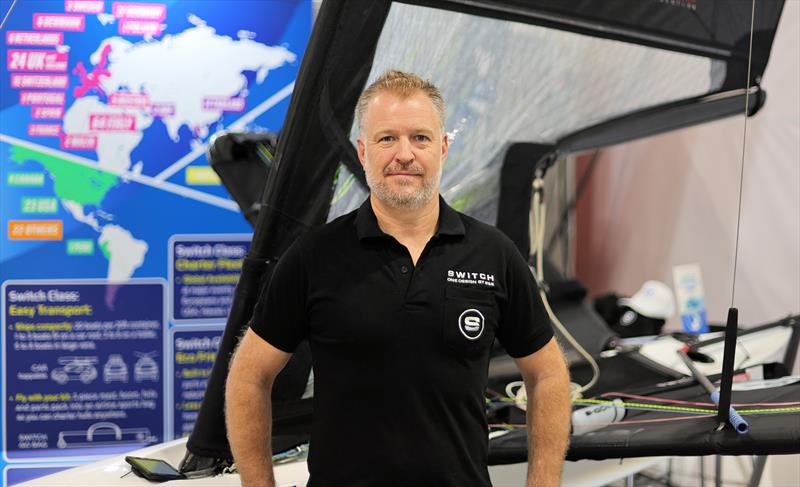
Pom Green © Mark Jardine
The Switch revolution, and the ethos behind Element 6 Evolution
Pom Green has a family heritage in boatbuilding, growing up in the heyday of Green Marine, and has gone on to establish Element Six Evolution. While he has learned from legendary designers such as Doug Peterson, he has gone on to define his own legacy.
The all-carbon Switch One Design foiler is an example of his ethos, balancing performance and affordability, and across the range of boats that Element 6 produces, standardisation of production processes, consistency and accuracy are the watchwords.
The E6e ILCA is an example of this, where producing the same dinghy time and time again is vital to ensure that every boat which goes out of the factory is identical.
In a wide-ranging interview, I talked to Pom about where sailing is heading, efforts to make foiling accessible, why a strong class culture is important, and how the business, and the wider sailing world, is addressing environmental responsibility.
Mark Jardine: Pom, you come from a family which has got a huge heritage when it comes to boatbuilding, growing up around the yacht building industry, with the highest of technologies which were available at the time. Did you ever think this was where you were going to head in your career?
Pom Green: I think it was destiny. I've been drawing boats since I was four, and was six years old when I decided I was going to be a yacht designer; I didn't quite do that in the end, but I'm not too far from it. I've got a good photo of me longboarding an IOR 50 in 1984 when I was six, so yes, it was my destiny and I had no chance of doing anything else!
Mark: That time in the 1980s, Green Marine were building some of the great yachts that we saw on the IOR circuit. How did Element 6 come about from this background?
Pom: I obviously spent a lot of time at Green Marine in my youth and was lucky enough to do several projects with them in my twenties (early/ mid 2000s). Green Marine had always got by with a very experienced and talented team keeping them at the forefront of custom boatbuilding but needed to modernise, invest in plant etc; succession wasn't a family expectation, and I really felt I had to do something myself from scratch with all that I had learnt, which my family supported.
Mark: So, creating your own legacy in effect, rather than continuing what had been done before? Using the experience that you'd earned and gained, but creating something that you could call yours?
Pom: Definitely, and I think I'm incredibly lucky to be in the position to do so, because I learned so much from so many people - I had some of the greatest mentors the marine industry and sport could ever give me - my parents, sister, Ian and Diane King and the people and associates of Green Marine. I will forever be thankful for them.
The sad thing is that when you get older, you wish you could talk to these people more, as well as my parents, who aren't with us anymore.
The mentors that I had were extraordinary, such as Doug Peterson who I spent a lot of time with - a true genius who taught me so much. Ian King, a hugely understated technical wizard, who gave me a lot of his time, and patience... Gio Belgrano, like Ian; had in innate feel for engineering structures and who many of the top marine composite engineers would acknowledge as having huge influence on their careers. To name a few.
Mark: It's often only when you get older that you realise just how much you gained at the time and realise just how extraordinary they were, pushing the boundaries with materials and other innovations that happened during that time. But that must be a driving motivation for you at Element 6, pushing what is possible in carbon production in the one design dinghy sector, doing what was previously only feasible for custom projects.
Pom: We've been fortunate in that we've done a lot of production boats, and in the past I've worked on America's Cup campaigns, where you learn the very top end of composites, and also with J&J Design (Japec and Jernej Jakopin), who designed the Bavaria yachts which were massive at the time - the biggest builder in the world by miles - and it was so interesting learning processes from the two different ends of the industry. You learn by absorption almost, gaining so much experience.
Everything is price-driven, and you have to decide what adds value to the product, and that's how the Switch came about. We could dumb it down, or we could high tech it up, but you've got to find that sweet spot. Dumb it down too much and it's not the boat it needs to be. Go too high tech and you price yourself out the market. It took all the experience from everything that we ever did to get to where we did with the Switch, and I'm so proud of it.
Mark: The feedback I've had from people who've sailed the Switch is that they've found it to be a hugely addictive boat, giving you the feeling of what you get from sailing a Moth, but without the feeling that your investment is going to be outdated six months down the track.
Pom: If you're going 21.5 knots or 20 knots upwind, you're still going pretty rapidly, and that's just fine for most people. It was all about finding the balance, and that's what the huge amount of development was all about.
Mark: Having toured the Element 6 Evolution factory to see how the composite structures are manufactured, I saw that it is an extremely high-tech facility that you have there. The main thing I really noticed though, talking with John (Higham) and the team, was that you are producing the same product time and time again. The templates, the way that everything is cut, measured, weighed and logged, was extraordinary. That strict one design ethos is hugely important to the Switch.
Pom: The ethos comes very much from every product we do. The Nacra 17, being an Olympic boat, has to hit the highest accuracies, as we're producing a boat for people who will put four, eight, maybe twelve years of their lives into a campaign, and if the boats are different then it's totally unfair, and we're very aware of that.
When we got to Thailand and started setting up the company, the country didn't have a history of boatbuilding. Yes, there are good carpenters and good teams, but composite boatbuilding wasn't prevalent, so we very much had to standardise every process. We had to teach snippets to people; not saying, "I'm going to teach you to build boats," but instead, "I'm going to teach you how to laminate."
Fortunately for us, the Thai people in general care about what they do and are incredibly nice, friendly, positive people. When they learn a process, they seem happy to stick with it, rather than move around processes, departments etc, they become phenomenally good at it, and I think we're so blessed to work with our team.
Mark: How much do these builders understand how their product is then used? Do they get to see the boats sailing in competitions?
Pom: That's an interesting question as we took the staff to a restaurant and I put on the Women's Singlehanded Dinghy medal race at the 2024 Olympics and showed them the ILCA dinghies they'd produced. Most of them know nothing about sailing, but we do encourage them to try it. We had the whole team turn up, around 140 people; and it was really nice that they could see the top sailors using their product at the games, seeing the medallists on the podium using boats they'd built.
Mark: You've been very careful as to how you've positioned the Switch One Design, looking at the learning process and the kind of racing that you do. Was that a conscious decision from even before you built the boat?
Pom: Initially we wanted to set up a system, as you do in most things, where you design a boat, or get it designed, produce it, have a dealer network, ship it out, and you're done very quickly. We realised though that the sport is changing; the age dynamic of what younger people want to do, and how to keep them interested, is changing.
If we built the boat, let it run, but thought it wasn't going in the right direction, what were we going to be able to do about it? So we knew we had to do it from start to finish. We have to run events, we have to have charter fleets, we have to have coaching organised, we have to have a simulator. This is part of the process of building the class, and it is super important, because everything from standardisation to coaching has to be covered by us; if a sailor breaks something, we have knowledgeable dealers with stock parts; meeting coaches on Teams, so they can fast track learning.
It starts with the sailor's first steps and goes all the way through to running events. At the end of the event, you get the winner to talk to the sailors, implement a buddy system to get everybody to a level, as it can be hard to learn to sail a foiling dinghy; if you can fast track, that it's got to be better for everybody.
Mark: Effectively making foiling accessible and the class approachable?
Pom: Absolutely. The great thing is we have the sort of situation where younger sailors see their heroes, and the heroes in the class, and they look up to them, and they come and chat to them and say, "Hey, how about you do this?" People then learn really quickly and enjoy the learning process so much more.
Mark: Going back to the ILCA, standardisation and repeatability is again vital, but the construction materials are locked into those from 1972 when the state of the art was very different. When I toured your factory, I noticed the checklists and tolerances for all your boats - be that the Nacra 17, ILCA, Formula 18 or Switch - the templating, weighing and measuring, was exactly the same regardless of how hi-tech the construction is.
Pom: Our team was already used to the accuracy required on a Nacra 17, which is a foiling boat with two hulls, where there are so many geometric things that can be wrong. With the ILCA they brought that accuracy ethos and mentality into ILCA-style construction, which is radically different technology. In the end, the sailor wins, because they know they're going to get an ILCA that feels the same, weighs the same, the CofG is the same, all dimensions, everything's the same, and that's something that the workforce is incredibly good at, and the QC department are very diligent about.
Mark: I know the ILCA class are currently looking at different materials they could use so that boatbuilding continues to comply with environmental laws. If this happens, it will be a fundamental shift as to how the boats are built. How will it retain that one design ethos?
Pom: That's a fantastic question. The only way really is to do a huge amount of testing to make sure the boat feels and performs the same. It's certainly a big thing to take on and is something we would very much encourage.
At Element 6 Evolution we're starting to use MarineShift360 software to measure, highlight and reduce our environmental impact. It can be really useful to us when we start a new project, so you can see what the focal points are, where the high carbon footprint points are, and which materials you use, and then you can make an informed decision.
ILCAs because it's built using a 50-year-old manual that must be adhered to and hundreds of thousands of boats that can't be made obsolete. So it's a more complicated to change, but I'd love to be involved in that process, because it's so very important.
Mark: Project management software such as MarineShift360 looks at every single step of a build process, and I know you're continually looking at how you can reduce waste or use offcuts for different products. Is this a pet project of yours, or is it something you think commercially is your environmental responsibility?
Pom: A bit of everything, but certainly it's close to my heart. You go sailing, and some places are just a horror show of plastic waste. We do a really nice plastic offsetting program with Starboard, Svein Rasmussen and his team are a real inspiration and positive drivers in plastic and 'real' carbon offsetting. Every boat we sell, 'we' collect that amount of plastic out of the sea, so indirectly we're not putting any more plastic into the sea, and it's all recycled right through to end use and made into clothing and other products. It's a completely controlled programme from start to finish as it's very easy to greenwash otherwise. Boatbuilding is quite hard to make good ecologically, however there are ways we can look at materials, working with people to make things better or with a lower footprint. The big one is making boats of the highest quality so that they last longer.
Mark: One of the great advantages of composite construction is the boats can last a huge amount of time. That means classes like the Switch One Design can just continually grow, as when you make new boats, the old ones don't become uncompetitive or obsolete. Where would you like to see the Switch class in five, or maybe even ten years time?
Pom: Great question! Obviously the Olympic side, which is interesting, but the Olympics can be good and bad for classes. What I do like is the ILCA model, because you get youth, masters, and everyone in between, and they all turn up in great numbers. Whatever you say about an ILCA / Laser, it is a fantastic class and is one of those timeless designs which doesn't look as old as it is, and you have this massive span of ages. You can go sailing with your kids, and they can sail an ILCA 4, you can sail an ILCA 7, and the kids' grandpa can also sail them. It's just fantastic, and with the range of events, it's so positive for sailing.
Mark: So effectively trying to draw on the easily accessible dinghy ethos, when Bruce Kirby drew the sketch of Weekender (as it was originally named). Making the Switch the easily accessible performance boat for the foiling dinghy era?
Pom: Absolutely. The performance parameters we had to achieve meant we couldn't do exactly what Bruce Kirby did so amazingly back then, but we can at least aspire to be as close as we can possibly be to that. During so many steps of the Switch development process we timed how long things took to rig and questioned how we could simplify the rigging and launching process. We wanted to make it all as easy as possible.
Mark: Sailing needs wind, and I know that you are looking at ways to bridge the gap that we suffer in sailing - the zero to five knot range - where a foiling dinghy doesn't really work. There are now technologies out there which can get you foiling and then you start to use apparent wind. What ideas are you looking at to try and reduce non-sailing days?
Pom: Very early on we looked at the different weight ranges of sailors. And one thing that came out is the bigger sails developed with Quantum and Mike Lennon - a really lightweight, large sail - and we thought, "Where do we go with this?" It's incredibly deep, gets someone of my weight, 80+ kilos, foiling in 6 knots of wind, which is pretty light, but then we looked at other options, and started pushing boats with RIBs, seeing at what point we could actually sustain foiling, and we were down to not much over 4.5 knots.
I've got some amazing videos of us flying around on millpond-like water; if you fall off the foil then you're not getting up again, but you can sail just fine. Then we thought, if the class was to own big sails, and the class was to look at foil drives, would that be a way of getting people racing in ultra light winds - regardless of whether it's a counting race or not - rather than just being sat there having coffee all day?
So that's something we're very much looking at moving forward: lending big sails and foil drive systems at events to cover those boring days, which happen all too often, and making them fun again.
Mark: E6e seems to be taking a very different approach in that regard, innovating almost like we're seeing SailGP do in trialling new technologies and approaches.
Pom: That's a big comparison, but I think the important part for us is we want to create the culture that the class will run with. We might end up doing that forever, or we might just hand it off once we're there, but we think it's very important to set the original path and programme of the class - create the ethos and drive that we all had going into it. Set it in motion far enough that it will run and maintain a form of equilibrium, defining the culture of how we want this to grow. All the way from when you first turn up at an event, holding your hand to get you on your way, and give you a welcoming feeling from day one. That's what we're bringing together.
Mark: It is remarkable when you set an ethos and a culture, how the momentum for that class continues. Pom, thank you so much for your time and the insights into the culture at Element 6 Evolution, and the exciting future for the Switch One Design dinghy.