
An interview with O.H. Rodgers about the 2026 International A-Class Catamaran World Championships
by David Schmidt 4 Nov 16:00 GMT
November 9-14, 2026
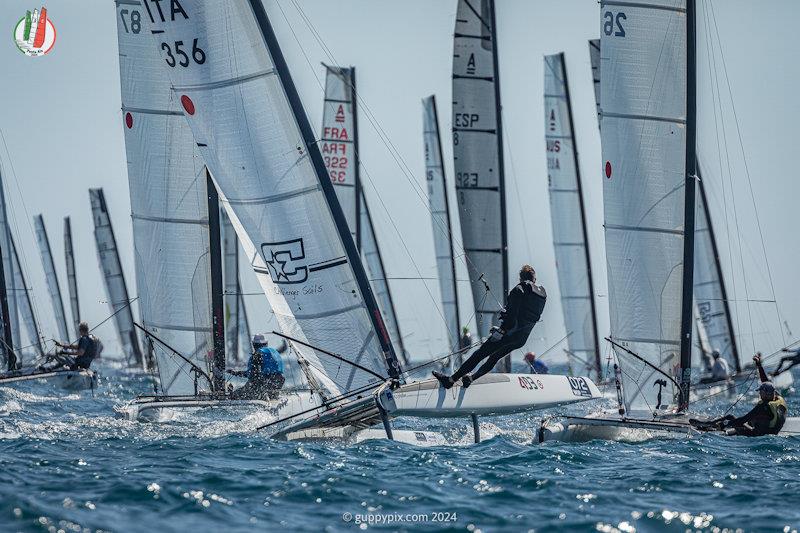
The Classic fleet round the top spreader on the first lap, race 3 - A Class Cat Worlds at Punta Ala day 2 © Gordon Upton /
www.guppypix.com
When it comes to high-performance, singlehanded multihulls, International A-Class Catamarans are hard to beat. The class formed in the 1950s, and after some evolutions there are now two types of box-rule boats, namely Open and Classic divisions. Both will contest their world-championship titles from November 9 to 14 at the 2026 International A-Class Catamaran World Championships (November 9-14), which will be hosted by the Davis Island Yacht Club (DIYC), in Tampa Florida, and which will be contested on the waters of Hillsborough Bay.
A glance at the regatta's registration reveals that this is a popular regatta, with 61 skippers competing in the non-foiling A-Cat Classic Division, and 18 skippers registered to compete in the A-Cat Open Division, the latter of which uses hydrofoils.
All told, the event is expected to see almost 79 sailors from 11 international associations competing for two world-championship titles.
I checked in with O.H. Rodgers, who serves as DIYC's regatta coordinator for 2026 A-Class Worlds, via email, to learn more about this world-championship-level regatta.
In the ideal world, how many races do you and the other organizers hope to score over the course of the regatta?
The A-Cat World Event Association limits [us] to two races a day for both divisions. Six days of racing, so 12 races for each division.
Will the world-championship regatta be using any electronic starting and race-management systems? Or, if everything will be done the traditional/analog way, how tough a job with the RC have with 61 A-Cat Classics on one starting line and 18 A-Cat Opens on the other?
The class voted not to use any electronic systems. As to accuracy [judging OCS starters], the race committee for each course have experience with this type of boat and this number of boats.
The NOR says that the Open and Classic divisions will race on separate courses or at separate times. Can you please walk us through the reasons for this? Also, from a racecourse management perspective, how difficult is it to mange courses and racing areas that involve both foiling and displacement boats?
The A-Cat Worlds request we do separate races for each division, because the sailing performance for each division is different. This causes problems on the racecourse that competitors should not have to consider for this type of event.
The NOR also mentions that the Open division will use an Early Finish Concept. Can you please explain what this is and what it will mean for the racers?
In the open division there can be a large difference in finish times, which prolongs the time on the water for competitors and influences the sailing conditions. This rule will allow the race committee to finish the slower boats at the last leeward gate in place so as to shorten the race's duration.
Generally speaking, what kinds of conditions (winds, sea state, etc.) can sailors expect to encounter on Hillsborough Bay in early-to-mid November? Generally speaking, what are the best-case and worst-case scenarios?
The worst conditions range from no wind, to squalls from frontal passage or hurricanes
Hillsborough Bay is shallow so when the wind is up competitors can expect choppy sea state. As to wind conditions the bay can have light conditions under 5 knots, and as high as 18 knots of wind for thermal conditions.
In November, the bay can have frontal wind conditions of 10 to 22 knots.
How much of a factor do you see local knowledge playing at this high-level regatta? Also, if you could offer one piece of advice to visiting (and local) sailors, what would it be?
Local knowledge is important, but there are not that many local competitors racing.
[My advice is] to give the thermals time to settle in. When sailing in a western thermal be leery of the left. Conditions are very fluky when wind comes out of the north and northeast.
Do you have any thoughts on which division—Classic or Open—will be more competitive, once the starting guys begin sounding?
The Classic division has the most boats (+60) [racing], and [there will be] multiple past-World Champions competing.
Aside from the Open and Classic World Championship titles, the event will also be awarding prizes for Junior Champion (under 25), Woman Champion, Master Champion (ages 45-50), Grand Master Champion (51-55), and Great Grand Champion (56 years and older). Of these five additional titles, which do you think will be the most competitive and why?
I have no idea, but watch the seniors!
Is there anything else about this year's A Class Catamaran World Championship that you'd like to add or tell us about, for the record?
Davis Island Yacht Club members have stepped up in helping to organize the event, especially helping with getting the club ready after all the damage from Hurricanes Helene and Milton that hit Tampa in 2024.