
What next for Olympic sailing? We speak to Sailingfast's Duncan Hepplewhite
by Mark Jardine 18 Oct 18:00 BST
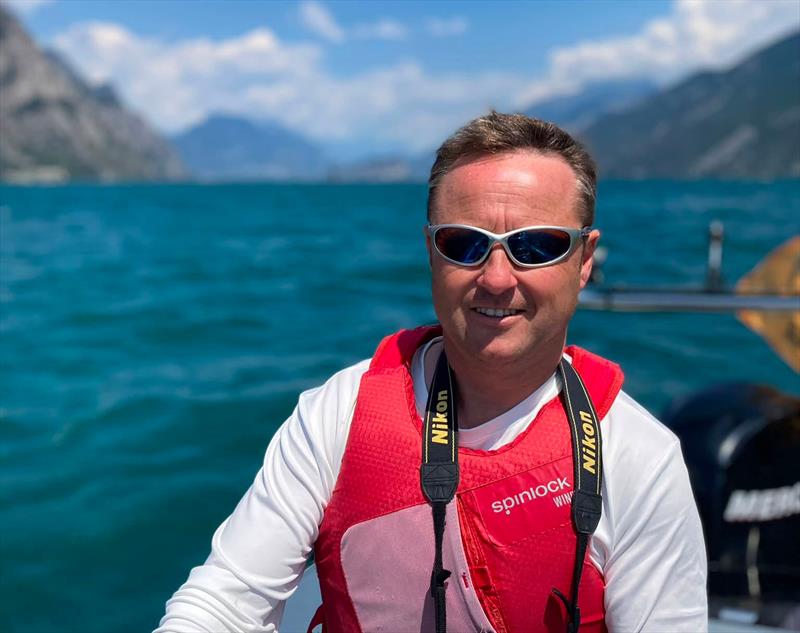
Duncan Hepplewhite on the water at Lake Garda © Sailingfast
If there is anyone in the UK who gets to see exactly what is happening in the UK sailing scene and what is attracting sailors to the sport, then it's Sailingfast's Duncan Hepplewhite.
He travels up and down from their Scottish base to the main boatbuilders and distributors, delivering and fitting out boats for clubs and individuals, whilst also supporting events large and small.
This weekend he's at the WPNSA with the ILCA classes, having already visited Itchenor Sailing Club on Thursday. I managed to get a few moments of his time to get his thoughts on what is working, and what is not.
Mark Jardine: You have seen so many people coming through the youth system, what's it like watching their growth in sailing?
Duncan Hepplewhite: It's very rewarding watching sailors come through and progress, whether it be Toppers, Fevas or any kind of junior classes to the youth classes and then on potentially through to adult classes, or foiling classes and then onto potentially the America's Cup and SailGP side of things. I don't think I have an integral role in their achievements, but it's still nice to witness and watch their journey.
Mark: Sailing isn't alone in this, but it has a problem with a drop off of participation in the sport at between 16 and 18 years old. Some due to going into further education, but what have you seen as the main barrier for continuation in the sport?
Duncan: I think you've hit the nail on the head there. There's this huge drop off in participation and there's a bit of an issue. I don't think it's just sailing - I think it's sports in general, but the education side of things is relevant.
I think the other key element that is slightly overlooked is that people maybe recognise that they're not going to progress to that adult Olympic side of things, and they lose interest, not necessarily overnight, but their enthusiasm and passion, whether it be an ILCA, 29er or another youth class, their interest just starts to dwindle over the the final five or six months of their sailing, and then they they go to university and they find other things and they get sidetracked.
At that time, with their independence, they're less likely to have parents bundling them into a car on a Friday night and driving the length of the country to go to an event, managing their programme. So, in order for them to carry on sailing, it takes something not necessarily special, but it takes a different type of boat to reinvigorate that enthusiasm, and I think that's where where the sport really needs to recognise, putting its resources into helping those sailors look at the opportunities and make that change from from the traditional youth classes.
Mark: You have been at the vanguard, in the UK especially, of the Waszp class, which was the first real class to bring accessible foiling to sailors, and you had a major part in the organisation of the hugely successful Waszp Games 2025, and you see people who may have otherwise left the sport carry on because they're finding the fun in foiling.
Duncan: You're right. We've witnessed the growth and evolution of the Waszp class. In the early days it was very much middle-aged men with a disposable income, and gradually over the years, the appeal has filtered through to all demographics. We now have a real spread of people involved in the class, and the key people that really stand out are those youth sailors who were losing interest in their youth classes, and were inspired and reinvigorated, as we mentioned before.
Not that the wasp is necessarily the answer, but we certainly have examples of sailors who have moved away from the traditional pathway classes, jumped in a Waszp, and gone back to full time campaigning, and it's fully reinvigorated their sailing. To name some names, you've got Rory Hunter, who was full time 49er sailing, drifted away, stopped sailing, got involved in triathlon for two or three years, and the Waszp brought him back, and he went on to win the Waszp Games and really dominate the class for a couple of years. Then sailors like Hattie Rogers, Ross Banham, Arthur Fry - these sailors were all coming to the end of their youth career and were reinvigorated and ended up campaigning Waszps for quite a number of years, and they've then gone on to do other things in their sailing career, which is really encouraging.
Mark: So much is said about pathways in sailing, and there are now so many different routes that can be taken. But the routes which are leading through to the really marquee events in sailing, SailGP and the Americas Cup, seem to be attracting a combination of skiff and foiling dinghy sailors. Would you see those as to where the real future of the sport lies?
Duncan: If you look at the classes that are drawing media attention, look through Instagram and at social media posts from both youth and adult sailors, it's about boats going fast, looking exciting and dramatic in great venues, and whether it's the Waszp Games next year in Garda, SailGP, 49ers, FXs, or the Switch Globals last week. That's where the media bandwidth is, and that's what the youth sailors are aspiring to, and we need to embrace that.
Mark: World Sailing has a huge set of decisions to make with regard to classes in the Olympics, going into the World Council meeting in mid-November. The classes which are up for debate as to whether they stay or a new class comes in are the mixed double hand hander, which is the 470, the mixed multihull, which is the Nacra 17, and kite foiling.What are your thoughts on the choices?
Duncan: Well, it's quite interesting Mark, because those three disciplines that you just described are all very different. I mean the 470, Nacra 17 and Kite foil are just entirely different and suit different athletes as well.
The Nacra 17 is a phenomenally exciting boat to watch. A foiling catamaran with twin wiring asymmetric is very impressive and the jeopardy, particularly when you see them racing in Palma in big waves is exciting.
I was a 470 sailor many years ago. I did 420, and then went on to the 470 and it's one of my all-time favourite boats. It's a beautiful boat to sail, but I'll be honest, it's a very different style of sailing to the way it was when I sailed it. It's an interesting one because it is a conventional double hander, a fast planing boat, but does it draw the media attention? I keep hearing about the Olympics, TV coverage and trying to grow and develop that. Is the 470 as exciting to watch as the Nacra?
The kites converting over to the wing will be an interesting one. I didn't really get into the kite side of things during the Paris Games - it's not a part of the sport that I've ever really followed.
Mark: A one design foiling single hander has visual appeal, like we saw at the Switch Global Championship, and I've got to say, it was some of the best sailing I've ever watched. Getting that out to the masses could attract new people into the sport. If you had a straight choice between watching 470 sailing or a foiling single hander which one would you choose?
Duncan: 100% the foiler. I think sailing has been pretty good at attracting new people to the sport. I think where we're really poor is retaining and holding onto them. I think if we wanted to drag back some of those sailors who had been participating in sailing and get them involved in the sport, then a one design single-handed foiler would draw that media attention. It would be well presented through the various media channels, and I'm pretty sure that would inspire, attract, and bring people back to the sport and retain those who are already in it.
Mark: The big question, though, is: 'Will world sailing be brave enough to do so?
Duncan: I hope so. To give the other side of the argument a little bit of a chance, we're blessed in the UK, where foiling is not quite mainstream, but it's certainly out there. Everybody can see it, whether it be the Switch, the Moth, or the Waszp, but there are many countries around the globe that aren't yet involved in the foiling world. So, is foiling a true reflection of sailing from a global perspective?
Possibly not, but we can aspire to that, and I think World Sailing should certainly be leading the charge. Rather than being reactive they should be proactive, and if that means some of the builders, the retailers, the class associations have to help invest to develop that foiling fleet around the globe then so be it.
Mark: Then on the other end of the spectrum, from the point of view of universality, you've got the ILCA, which seems to be a timeless design.
Duncan: Very much so. I'm sitting in Weymouth on this call with you Mark, and getting set up for one of the ILCA National Opens. There's going to be the region of 200 boats turning up this weekend, from the junior ILCA 4 sailors through to aspiring Olympians and ex-Olympians in the ILCA 6 and ILCA 7 fleets and everything in the middle, so you know it's very strong. I can't see it coming out of the Olympics anytime soon because it is a real reflection of what's going on globally.
Mark: Possibly the biggest growth area has been in that ILCA 4, where you've got the youth sailors now choosing that pathway quite early on. The boat is an old design - let's face it; it's older than me! - but it is still bringing people in, and they are generally staying in the class. What do you think it is about the boat that is attracting so many people now?
Duncan: I have a philosophy that success breeds success. So if you've got a successful class and you've got lots of people there, it will attract more and more people, and then it spirals up, which is great to see. And the ILCA, while it may not be the best boat on the water, the overall package, the overall product, is very good.
From the open training, to the squad training, to the events that are run across the country and globally, from junior events through to the masters' circuit. We supported the Masters Nationals this year in Parkstone and there were 120 boats, which is phenomenal.
It's a class where success breeds success, so it's self-perpetuating, but what we have to be mindful of is that sailing an ILCA by yourself on a Friday morning in Portland Harbour isn't particularly exciting, but jumping in a foiling boat, like a Waszp or Switch for example, and going out and having a blast around, you're going to come back with a grin from ear to ear.