
Fourteens are Forever - 2027 will see the centenary of the International 14
by Dougal Henshall 18 Oct 10:32 BST
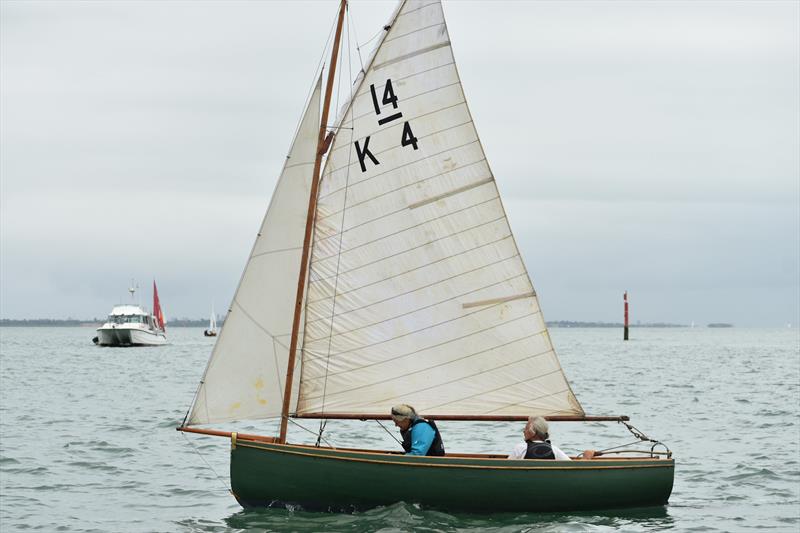
The earliest International 14 still known to be afloat © Dougal Henshall
One of the most noticeable aspects of the RYA Dinghy Show back in February was the large number of significant birthdays that were being celebrated. There was cake and candles for the Firefly Class and the Merlin Rockets, then the Solos, Darts, Solutions and many others were all able to exchange celebratory cards. The oldest birthday went to the Norfolk Punts at 100, whilst the youngest went to the H2 Class that celebrated their first ten years in style by winning the Concours trophy as well.
However grand these individual milestones may be, they pale against the big birthday bash that will be celebrated next year, as 2027 will see the centenary of that most iconic of classes, the International 14.
The old class tagline used to be 'Fourteens are Forever', and with a full 100 years of continuous, documented development, they have an amazing story to tell in the months to come. And what a story it is, as unlike the modern process where a dinghy is designed to fill a marketing led opportunity, the influences that gave their DNA to the 14s came from the Southwest up to the East Coast and numerous points in between.
From the outset it was to be clearly understood that the 14 would fall into the restricted development category of dinghies, leaving the way open for many of the great designers of the day to develop and pen lines for successful boats. Francis Morgan Giles would leave his mark on the class, as would Tom Thornycroft, but the early annals of the 14s would be dominated by the name of Uffa Fox. Fox designed the boats, built them in his boatyard at Cowes on the Isle of Wight, and then raced then with incredible success.
And it will be at Cowes that one of the biggest of next year's birthday celebrations will take place, when the first running of the Prince of Wales Cup in mid-July will be recreated. This could well turn out to be one of the most significant of classic events afloat, if not THE most significant, and certainly if you multiply the number of entrants by the number of their years (and that's without adding in the ages of their crews) then it becomes clear that there can be few events that will match this.
But, as anyone who is involved with anything that is preceded by the word 'classic' will know only too well - be that boats, bikes, planes or cars - these are not activities to be taken lightly.
The great columnist Jack Knights once wrote about the negative ratio of time spent working on and preparing a boat for competition as against the time actually spent sailing it. If you're talking elderly classics, then take that ratio and multiply it by an order of magnitude and you'd still most likely not be allowing enough time (and that's before you think about the costs of restoration).
Because of this, owners of these amazing icons of dinghy history are already looking at their charges and assessing how much work will need to be done ahead of the event next year. One such owner is Gillian Westell, daughter of John Westell who has the design of the 5o5 on his CV. In his younger days John was a keen 14 sailor and ended up buying K316 Nimbus, a 1934 Fox designed and built boat that was state of the art. John successfully campaigned the boat, but when the 14s decided to host the Prince of Wales Cup in Hunstanton, on the southern shores of the Wash, he was left facing the problem of getting there.
He borrowed a set of Firefly sails and rigged them on Nimbus, rolled his race sails up in the bottom of the boat and with a friend crewing, they set out to sail from Itchenor on Chichester Harbour around the coast (including an overnight sail across the mouth of the Thames Estuary). It is only when you have sailed a boat like Nimbus that the full enormity of this enterprise becomes apparent.
Nimbus was very much a boat of her day, as in 1934 Uffa Fox was still wedded to the design philosophy that a quick boat should have 'the head of a cod and the tail of a mackerel', which in practical terms meant that the boat had to carry much of the fullness in the hull in the forward sections under the mast, whilst the run aft would be narrow and pinched in (exacerbated by the topsides containing a fair degree of 'tumblehome').
In flat water this doesn't present a problem but in waves or a seaway, the boat's head can easily be pushed off course requiring rapid corrections, and all this with a spoon rudder that looks too small to be on a Solo.
Nimbus then disappeared for a number of decades until she was identified as one of the boats to be sold off at an auction (for the full background story on this check out Sailing History For Sale written in 2017). John Westell's daughter bravely bid for her father's old boat and having secured it, commissioned Simon Hipkin to complete a full restoration.
It would have been easy at this point to compromise and introduce some more modern aids to sailing, but Gillian's intentions from the outset had been to keep Nimbus looking as close to 'as was' when she was first launched back in 1934.
This certainly adds a new dimension to getting rigged as the halyards are on cranked winches and apart from a pair of simple blocks on the mainsheet and a block on the kicker (not that it does that much) there are almost no other blocks or cleats. The genoa sheets are led through a hole in a piece of wood and the crew has to hang on!
The mast is a work of art in itself, using two sets of diamonds and forward angled prodders, whilst master sailmaker Michael McNamara made a suit of new sails out of modern materials that still looks like cotton (and they set beautifully too).
Despite looking like a floating museum exhibit, there is a lot to be done if Nimbus is going to return from whence she came and thus sail once more at Cowes next year. The wire on the main halyard compresses on the winch, destroying any semblance of luff tension whilst the centreboard, which thankfully is unweighted (many back then had great lumps of lead moulded into the tip) won't go down... but once it has dropped likes to come straight back up again.
It was with all this in mind that last week Gillian took full advantage of this glorious spell of autumn weather to give Nimbus a full work out down at Exmouth, which 75 to 80 years ago was a popular venue for the 14 fleet. The plan was to create a snagging list of actions along with an action plan to remedy any issues.
Whilst this was the primary objective of the sail, one cannot be out in Nimbus, in John Westell's boat and on his home waters, without that strong sense of place and the recognition that yes, Fourteens really are forever.