
The America's Cup at 175yrs - a fine legacy and bright future
by America's Cup Media 21 Aug 03:11 BST
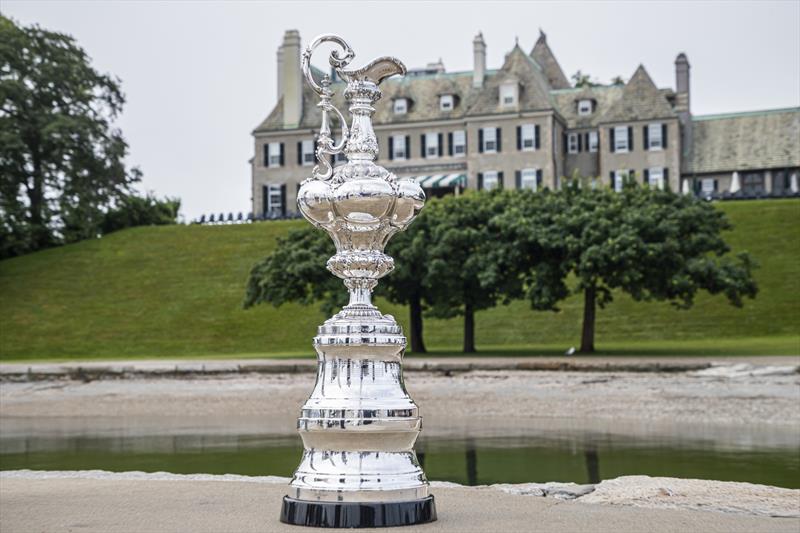
The America's Cup Trophy in front of the New York Yacht Club's Newport Club House © Carlo Borlenghi
When John Cox Stevens caught his steamship home across the Atlantic and back to the New World in 1851, he had in his possession a trophy, an unremarkable (for the time) Victorian ewer from the Crown Jeweller, R&S Garrard of Panton Street, London that would define competitive sailing for the next 175 years.
As the first Commodore of the New York Yacht Club, Cox Stevens was a competitive, foresightful man who had made a lasting impression on the young Queen Victoria who stepped aboard 'America' on the 23rd August, the day after the race around the Isle of Wight. By doffing their yachting caps as the Victoria & Albert steamship passed by the 'America' mid-race on the final approaches down the Solent after an east-about lap of the Isle of Wight, Anglo-American relations were warmed. Remarkable for a Republican.
But could Cox Stevens have imagined what 'America's Cup' would become? Sadly, he passed away on June 10th, 1857, a month before close confidante and syndicate member of the yacht 'America,' George Lee Schuyler, presented the trophy to the New York Yacht Club on July 8th, 1857, with a strict Deed of Gift that has been the guiding document, amended in parts, to this very day. One suspects the influence of Cox Stevens in the tone of the Deed of Gift promoting 'friendly competition between foreign countries' and thankfully initial thoughts of melting down the silver to make commemorative medals was averted.
The America's Cup receives its first Challengers.
The first challenges for the America's Cup came from Britain in 1870 and 1871 with the latter seeing the first seeds of acrimony as the NYYC acceded to match-racing but fielded two vessels that they could select from depending on wind and sea conditions. These were the days when to challenge, vessels had to arrive across the Atlantic or from the Great Lakes via their 'own bottoms' - an often arduous and treacherous journey to New York in the late 19th century.
The New York Yacht Club held the trophy for 132 years through the most remarkable period of yacht design and development. The longest winning run in sporting history saw the Cup evolve from wave-line schooners to cutters and on through the glorious 'Golden Age' of the J-Class before world wars intervened and it went into hibernation. Come 1958, and amidst still austere times, the Cup evolved again with the introduction of the 12-Metre class yet still the NYYC out-sailed, out-designed and out-thought all comers for the trophy.
The cultural significance of the Cup
From its very earliest days, indeed the first race, royalty and high society took an interest in the America's Cup. Early challengers, particularly from Britain and Ireland, were the cream of society, wealthy tycoons, pioneers, industrialists, and entrepreneurs whilst banking scions and industrialist tycoons defended for the NYYC. Royalty has been ever present from Queen Victoria & Prince Albert, to King Edward VII and George V, through to King Harold of Norway and His Serene Highness Prince Albert of Monaco and Prince Karim Aga Khan IV.
Politicians increasingly witnessed Cup races from the 1960's with John F. Kennedy and his wife Jacqueline Kennedy Onassis starting a trend, followed by Ronald Reagan, Bob Hawke, George H.W. Bush and Michael Bloomberg. Today, Prime Minister Giorgia Meloni greeted the arrival of the Cup in Rome. Celebrities connected with the event include Bing Crosby, Humphrey Bogart, Tom Cruise, Cindy Crawford, Morgan Freeman, Russell Crowe and sports stars like David Beckham, Max Verstappen and Stefanos Tsitsipas. The America's Cup's unyielding allure at the apex of sport has naturally, almost effortlessly, reflected society through the ages.
End of one era, dawn of another
Come 1983 and with the proliferation of sailcloth globally and the emergence of computer-aided design and tank testing, the winning streak came to an end. A gripping Match was held between Australia II, the Challenger who had won the first ever Louis Vuitton Cup, and the Defender 'Liberty' and with a novel winged keel, it was the Australians led by John Bertrand and syndicate head Alan Bond who defeated Dennis Conner, 'Mr America's Cup,' 4-3 and fire the starting gun on the modern competition.
Taking the Cup down under to Perth, Western Australia where the famous 'Fremantle Doctor' blows onto the shore with regularity accompanied by Southern Ocean swells, captured a global audience. The redemption story of the defeated Conner winning back the trophy, this time for his home club in San Diego, elicited a ticker-tape parade down Fifth Avenue in New York as the America's Cup went mainstream.
Deed of Gift Match
The intersection of evolution and avarice was brutally exposed by the first ever 'Deed of Gift Match' in 1988 that ended up pitting a giant 90-foot monohull against a nippy 45 foot per hull catamaran - again with Conner on the helm. The Cup went to court in New York but stayed in San Diego as a new class - the IACC - was introduced. Again, the world's top designers pushed the limits of material science and physics whilst sailors became athletes and women competed on an equal footing for the first time through the mid-1990's.
Third and fourth countries to win
New Zealand became the third-ever country to win the America's Cup in 1995, and just like in Perth, huge infrastructure projects were initiated in Auckland - the lasting legacy of the modern America's Cup.
By 2003 after just one successful defence, New Zealand ceded to Switzerland who famously became the first, and currently last, European team to lift the trophy. The simple fact that only four countries have ever won, is testament to the complexities of winning the longest continually contested trophy in international sport.
After defending in Valencia, Switzerland lost a bitter second 'Deed of Gift Match' - a race run under the strictest interpretations of the Deed - and the Cup went back to the USA and San Francisco for one of the greatest comeback stories ever told as the now catamaran class of AC72 yachts began experimenting with foiling.
Kiwi first to Foil
Emirates Team New Zealand were first to achieve what had previously thought to be impossible, namely foiling upwind and stole what looked like an insurmountable 8-2 lead, one race from victory. Oracle Team USA performed a miracle in not only matching the Kiwis in foiling but coming back from match-point to win 9-8. The America's Cup was 'box office,' utterly absorbing, and front-page news again.
Bermuda was the next stop and the Kiwis again innovated by replacing arm power with leg power, introducing cyclors to the Cup that had first been trialled in the 12-Metre era below decks. With incredible ingenuity they took the trophy back to Auckland and started a period of dominance in the new AC75 foiling monohull class unseen before in the Cup's long history, becoming the first consistent team to win three in a row - Bermuda, Auckland and Barcelona.
Pathways to the future
If the AC75 is the pinnacle of yacht racing, the AC40, its smaller sister is the pathway to the future. Emirates Team New Zealand's design office brought in the AC40 as a way to bridge skills gaps for generations to come. The Youth America's Cup came back in 2024, alongside the inaugural Women's America's Cup and such were the regatta's success that for Naples in 2027, women will compete alongside men in the AC75.
Evolution in the America's Cup is baked into its DNA. When once eight or nine knots was seen as the pinnacle back in 1851, today speeds of 55.6 knots have been recorded. The America's Cup has gone stratospherically fast but in step with the times. That is its greatest legacy, yet the final word goes to the greatest of all time, Dennis Conner who opined on the ingredients required to win, saying: "Commitment to the commitment. The three basic ingredients for winning remain the same: attitude, attitude, attitude."
John Cox Stevens would no doubt, heartily concur.
.