
John Rousmaniere noted sailor, historian and author dead at 82yrs
by R. Steven Tsuchiya and Sheila McCurdy 12 Aug 02:04 BST
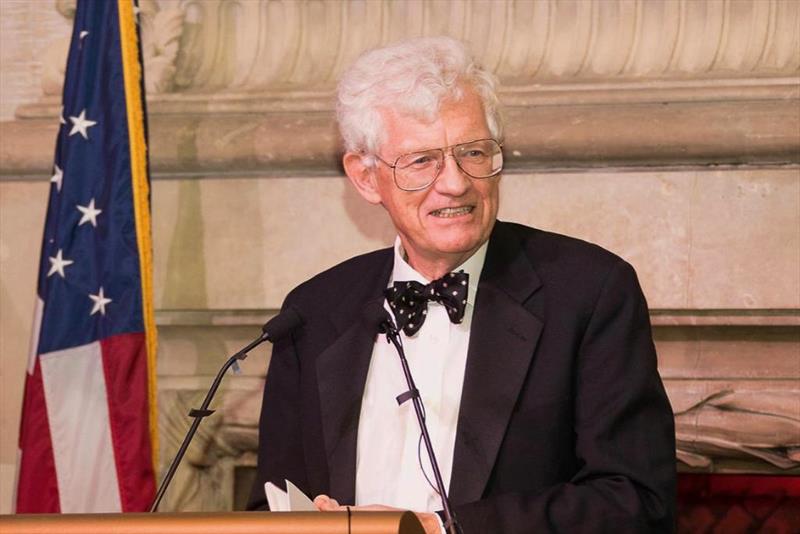
Yachting historian John Rousmaniere delivers a presentation about Lord Dunraven - Hall of Fame induction for Ernesto Bertarelli Alinghi and Lord Dunraven © Carlo Borlenghi
John Pierce Rousmaniere, sailor, historian, advocate for safety at sea, and 2020 National Sailing Hall of Fame inductee, whose books became essential reading for generations of sailors, died on August 8, 2026. He was 82.
The author or editor of nearly forty books on sailing, yachting history, and New York City, John was widely regarded as the "dean of yachting historians.” But he was more than a chronicler of the sport. He was a teacher, a survivor, and a thoughtful observer of the complicated human impetus to go to sea.
He understood that attraction firsthand.
Over decades of sailing, he logged more than 40,000 miles offshore, including nine Newport Bermuda Races, two Fastnet Races, and three transatlantic passages. Then, in August 1979, during the Fastnet Race, he experienced the kind of storm that can permanently alter a sailor’s understanding of the sea.
Sailing aboard the 48-foot sloop Toscana, John survived a Force 10 storm that killed 15 sailors, sank five yachts, and forced 24 crews to abandon ship among a fleet of more than 300 boats and 2,700 sailors.
He turned the experience into the bestseller Fastnet, Force 10 (1980), a riveting first-person narrative that brought readers into the thick of the storm and has been a must-read for sailors ever since. For John, the book was not simply an account of what had happened. It was a call to prevent it from ever happening again.
“He had a goal that a book like Fastnet, Force 10 would never need to be written again if sailors and boats were better prepared,” said Sheila McCurdy, Vice Chair of the Board of Trustees at Mystic Seaport Museum and past commodore of the Cruising Club of America.
John became one of the creators of the U.S. Sailing Association’s Safety at Sea Seminar and organized or participated in more than 100 courses. He also served on U.S. Sailing Independent Review Panels that investigated fatal sailing accidents.
His approach to safety was characteristic of the man: practical, rigorous and deeply curious about human nature. He wanted sailors to understand not only how to prepare for heavy weather, but why people were drawn to confront it in the first place.
“Why do we go?” was, in many ways, the question that impelled his work.
A historian of the sea — and the city
Born in Louisville, Kentucky, John was the eldest of eight children of James Ayer Rousmaniere and Jessie Broaddus Pierce Rousmaniere. He spent his early years in Cincinnati, Ohio, before the family moved to Oyster Bay, Long Island, when he was eleven. He graduated from St. Paul’s School in Concord, New Hampshire, and from Columbia University, where he earned a B.S. and an M.A. His master’s thesis examined the history of settlement houses.
Drafted during the Vietnam War, he trained as an infantry officer and served as an Assistant Professor of History at the United States Military Academy at West Point. He was discharged in 1972 as a First Lieutenant. He later worked as an editor at Yachting and Natural History magazines before launching his freelance writing career in 1978.
While at West Point, John married Jody Hall. They had sons, Will and Dana, and divorced when the children were still toddlers. Of all his many spectacular achievements, John was most proud of having raised his sons as a single parent.
Sailing a small boat on the ocean had become, for him, a test of faith. The Fastnet Race deepened that calling, and he enrolled at Union Theological Seminary, where he earned a Master of Divinity degree. There he met Leah Ruth Robinson. They married and were together for 37 years.
“During the nineteen-eighties, I was Associate Registrar at Union,” Leah recalled. “Nowadays if the Registrar dated a student, she would get fired, and the Seminary would get sued. But back then we got away with it!”
John’s writing about sailing was never merely technical. His Annapolis Book of Seamanship, through four editions, became a standard reference source for the United States Naval Academy, sailing schools, and recreational sailors across the country. His books addressed the practical demands of seamanship and the motivations of generations of mariners to seek blue-water challenges.
He could move easily from a discussion of how to prepare sailors for the dangers of storms and shoals to using literature to illuminate the mystery of why people leave the safety of land. John was as likely to quote Joseph Conrad—describing sailors as "our fellowship of the craft and mystery of the sea"— as E. B. White —"I cannot not sail"—to explain the drive to depart the land.
In After the Storm: True Stories of Disaster and Recovery at Sea (2002), John delved into philosophies influenced by personal loss and survival. He even edited Desirable and Undesirable Characteristics of Offshore Yachts (1987) while sailing from Connecticut to the Azores aboard the 35-foot Wissahickon, a McCurdy and Rhodes design featured in the book. His presentations on seamanship always included his personal experiences and lessons learned — and were told with authority, humor, and unpretentiousness.
Much of what John’s readers know about yachting history is preserved in his books, including The Golden Pastime: A New History of Yachting (1986); The New York Yacht Club: A History, 1844–2008 (2009); The Low Black Schooner: Yacht America (1986); and A Berth to Bermuda: 100 Years of the World’s Classic Ocean Race (2006).
“A new generation of historians is expanding our understanding of the past,” said Steven Tsuchiya, yachting historian and Chair of the America’s Cup Hall of Fame Selection Committee, “yet they are all grateful for the excellent foundation John established. His books will remain touchstones for those who write about the sea and ships.”
John’s curiosity was not confined to boats. He wrote histories of his beloved New York City, including Green Oasis in Brooklyn: The Evergreens Cemetery (2008); the Union League Club of New York (2013); and The Life and Times of the Equitable (1995). He contributed 40 essays to The Encyclopedia of New York City (2nd ed., 2010) and published his Master of Divinity thesis, A Bridge to Dialogue (1992), on Jewish-Christian relations. He even contributed to a documentary on the Beatles, The Compleat Beatles (1982).
People sought his expertise because he diligently studied the subject, relying on primary sources, and he could distill his vast knowledge into beautifully worded explanations. Here is a gem he crafted in 2007 for a documentary: "Someone once wrote that the America’s Cup is a synonym for things brave, big, and famous. To those words, I would add one more: spectacular. No inanimate objects are more beautiful than two America’s Cup yachts racing bow to bow, sailing for glory and into our affections. That’s the way it is, and that’s the way it was.”
“He was a thoughtful man who made the sport better for everyone who sailed,” said Gary Jobson, America’s Cup winner and co-president of the National Sailing Hall of Fame. “John has left a lasting legacy that surpasses his list of accomplishments.”
John’s many honors included induction into the Bermuda Race Roll of Honour in 2024. He received the Cruising Club of America’s Richard S. Nye Trophy in 2009 for meritorious service, U.S. Sailing’s Timothea Larr Award in 2013 for sailor education, Mystic Seaport’s W. P. Stephens Award in 2014 for maritime history, and the New York Yacht Club’s inaugural Commodore Henry H. Anderson Jr. Award in 2014 for volunteerism.
The human side of sailing
John chaired the New York Yacht Club’s Library Committee for seven years, during which he launched a monthly book discussion group that the membership came to value highly. Jim Cadranell, who succeeded John as committee chair, remembers: “One of his strengths was understanding the people behind the boats. He loved the human side of the sport, and his writing made it all come alive.”
His many interests included American and European history, and traveling with his wife, Leah. Wherever they went, they visited museums, cathedrals, churches, synagogues, botanical gardens, and historical houses. They went section-hiking on the Appalachian Trail, the Camino de Santiago de Compostela in Spain, and the various walking paths across the English countryside.
Leah recalled that people often asked her what they talked about. John read his Episcopal prayer book each morning, and he and she often discussed the day's readings, consulting their vast collection of Biblical commentaries before she went to work.
They read together, too. His Christmas gift to Leah was often two copies of the same book — perhaps a new translation of War and Peace or Homer’s Iliad and Odyssey — so they could read and discuss it together.
Their son Dana once began counting the books in their New York apartment. He gave up at 3,000.
Knowing when to stop
In June 2018, as his physical capabilities declined, he confronted the fact that offshore sailing had become too risky for him. True to form, John put his thoughts on paper. In an article later published in Cruising World, “Safety at Sea: Giving up Offshore Voyaging,” he explained why he had decided to leave the ocean.
“I wouldn’t want me on the foredeck,” he concluded. “It wouldn’t be fair to the rest of the crew.”
Perhaps that article was the most important lesson he ever taught. “He got letters from sailors from all over,” Leah marveled. “He got letters from sailors’ spouses and kids. The letters all basically said the same thing: ‘Thank you! If the great John Rousmaniere can decide not to sail offshore anymore, so can we. You gave us permission to decide the same — without shame or dishonor.’”
John is survived by his wife, Leah; by his sons, Will (Dana E.) and Dana S. (Marinell); by his grandchildren, Julia, Liam, Charlie, Tripp, and Jack; by his brothers, Peter (Ruth), David (Marie), Joe (Chia Li), and Arthur (Jennifer); by his sister, Kate (John); by his sisters-in-law, Sharon Rousmaniere and Kate Stanley; and by his mentee and “honorary” son, Steve Tsuchiya. He was predeceased by his brothers Jim and Ned.
A memorial service will be held at 10:30 am on August 22 at St. Paul’s Episcopal Church, 59 Court Street, Dedham, MA 02026.
Gifts in John’s honor may be made to the Staff Christmas Fund at Bridges by Epoch Alzheimer’s Memory Care, 140 University Avenue, Westwood, MA 02090; and to Courageous Sailing,197 8th Street, Charlestown, MA 02129, www.courageoussailing.org