
America's Cup: Kiwis call it a day in Auckland
by Richard Gladwell, Sail-World NZ 18 Aug 02:11 BST
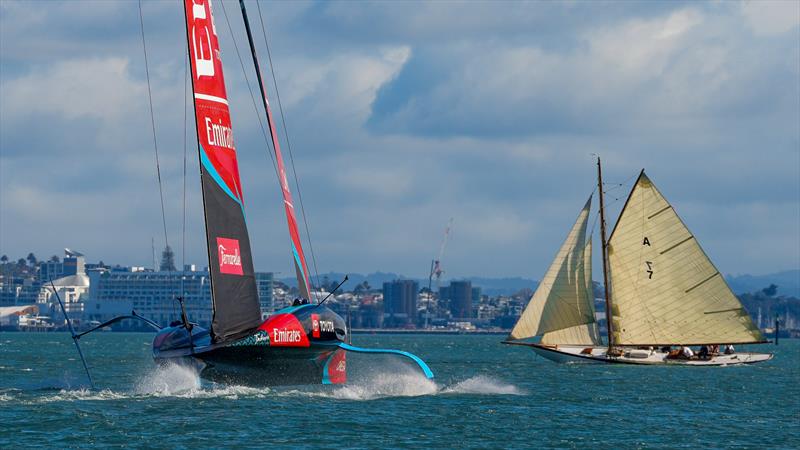
Rainbow (launched 1898) crosses Emirates Team NZ AC75 - Day 21 - August 15 2026 - Auckland, NZ © Sam Thom/America's Cup
Emirates Team New Zealand wrapped up a two-week-long test block in Auckland on Saturday - enjoying a near-optimal weather window.
"It was a glamour day once again," said co-helm Chris Draper after the session.
"Razor and Clouds [Coach Ray Davies and meteorologist Roger Badham] absolutely nailed it. We had a nice range of breeze, which was exactly what we wanted for the end of the block. It's been a fantastic block. I thought we'd get all-or-nothing breeze-wise this time of year, but we've done really well."
"We hit every sort of wind speed that we wanted. We came into the block with a really structured plan for what we wanted to see, and we've managed to tick all of it off. It's been great. We're really thankful for the winter in New Zealand. It's been good!"
This America's Cup is Draper's fourth - he was Head of Performance for the Athena Pathway team in Barcelona in 2024, which focused on the Youth and Womens America's Cup teams. A top 49er helmsman, winning two world championships and an Olympic Bronze medal. Draper was the primary helmsman with Luna Rossa in the 2013 America's Cup. The Italian team had a partnership with Emirates Team New Zealand, which was assembled and launched in Auckland, and did some practice racing here with the Kiwis.
He stayed with Luna Rossa for the 2017 Cup, but switched to Softbank Team Japan after the decision was made to change the class from the AC62 to the AC50, 18 months into the campaign. With the Japanese team, skippered by Dean Barker, he had multiple roles including sailing team manager, tactician and wing sail trimmer. He brings a diversity of skills to the developing Kiwi team.
Asked where he would put Emirates Team NZ on the 2027 America's Cup timeline, and whether he felt ETNZ were on track.
"It's hard to know if you're ever on track," he replied. But all you can do is look for opportunities and keep pushing to find them across all areas, which is what the team's done so well for so long. I think that everyone's doing a fantastic job, and it's an incredible environment where everybody is just looking for those seconds and those metres that are on the table.
"I believe that the team's on track, and I think everybody in the building does. But we'll keep pushing as hard as we can till the very end."
"This Cup's obviously a little bit different. We won't be launching a new boat, but the key design areas we can focus on are obviously the appendages and the sails.
Increasingly available time is becoming a big factor in the 2027 America's Cup. Racing starts in nine months. Many of the design decisions are now dictated by the available time for building and testing. For instance, a new foil takes three months to construct, plus design and testing time. Sail development continues right to the start of the Cup, and in between rounds.
"All the appendages take quite a long time to make. It's obvious there's a lot of design and testing. So there are all those targets coming up, and we keep ticking them off slowly as the year goes by and as we get closer to the final decisions on what we choose."
The just-concluded winter test block of five days sailing in a ten-day period started on August 5. The team last sailed their AC75 in Auckland on June 15, and have clocked up 21 sailing days to date, out of the 45-day quota the Defender is allowed - or 47% of their quota, which is refreshed in mid January 2027.
In this ten-day phase, the team introduced three "new" foils - thought to be legacy foils from the 2024 Cup - but which are permitted to be modified to an extent limited by the Cup Rules. They have also done some testing with sails, including striking one fresh day where they got a look at their M3 mainsail and #5 small jib.
The test slots have to be worked around other sailing squad commitments - mainly SailGP and Olympic programs.
"A few of us are off to SailGP". Draper is a trimmer with the Artemis Racing team, which comprises several Emirates Team NZ members, including skipper Nathan Outteridge, Andy Maloney and coach Sam Meech.
"Then we all get together in Naples for some AC40 training in Naples ahead of the [Second Preliminary] event. With a couple of SailGP events dotted in between, so it's a busy time. But it is a really good opportunity to focus on our racecraft, and then we can come back here and focus on boat speed and testing with the AC75."
"So there's a nice balance of sailing and testing in the next few months ahead."
Emirates Team NZ are expected to resume testing in Auckland in October - taking advantage of the summer sailing season, before packing out for Naples in late January 2027.
Emirates Team New Zealand - Day 21, Saturday, August 15, 2026 – Auckland, NZ
Recon Report – 15th August 2026
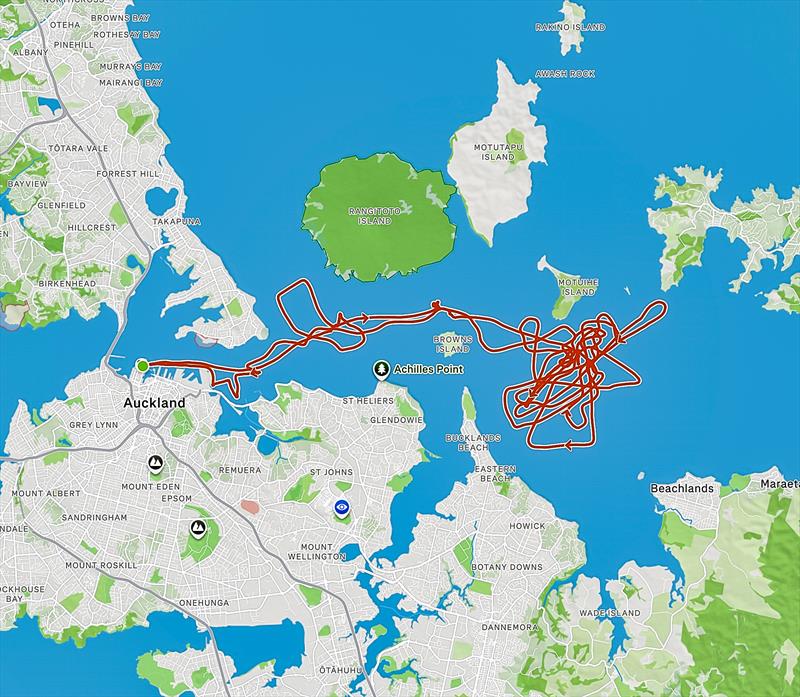
Emirates Team NZ spent most of the day in `The Paddock` - Recon Unit track - Emirates Team NZ - Sailing Day 21 - August 15, 2026 - Hauraki Gulf, Auckland - photo © ETNZ Recon Unit
Wind & Sea Conditions:
- AM: Overcast. Wind: -15kts 270° (SW)
- PM: Sunny. Wind: 18-25kts 270° (SW)
- Sea State: Flat (AM) Flat(PM)
Sailing Stats:
- Dock Out: 0857hrs
- Dock In: 1400hrs
- Time sailed: 3hrs
- Foiling time: Not reported
- Tacks: No data Gybes: No data
Crew List:
- Port Helm: Seb Menzies (NZL)
- Starboard Helm: Nathan Outteridge (AUS/NZL)
- Port Trimmer: Iain Jensen (AUS)
- Starboard Trimmer: Andy Maloney (NZL)
- P5: Jo Aleh (NZL)
Recon Report - Sailing Day 21 - August 15, 2026
Recon Report – 15th August 2026
Key Points:
- Wide wind range.
- Flat, offshore conditions.
- Last day of training block.
Very strong winds were forecast for the afternoon, so ETNZ rolled out of the shed much earlier at 0714 this Saturday morning for the last sailing day of this block. This was the last possible day before the team were flying out for SailGP and Naples, with the team showing a strong commitment to finishing their scheduled AC75 testing programme before the break. The crew consisted of Outteridge, Menzies, Maloney, Jensen, Aleh and Armit.
ETNZ were off the dock at 0857 and off the tow at 0912 just the other side of Bean Rock. A very light 4-6 kts awaited as they hoisted their M2-0 and J2-2. At 0943 they sailed up onto the foils and after a few manoeuvres off of North Head they set off towards the Back Paddock. At 1002 near Browns Island they stopped sailing and spent 20 minutes with tools on the jib traveller. This was explained during the post-session interview as general tuning and not as a specific failure of any system. At 1021 ETNZ were back sailing and made their way down to Waiheke, where after several up and downs they fell off the foils in a tack. They sailed back onto the foils before deciding to end their session shortly after at 1052hrs, still spending a lot of time looking at the jib clew. ETNZ then changed to their J3-3 for the steadily building breeze.
The next session started at 1110hrs in a steady 10-12 knots and consisted of long runs up to Eastern Beach and back down to Waiheke Island. There seemed to be a strong focus during these sessions on the timing and speed of the board drops/raises so that the platform remains as steady as possible in both direction and heel out of the manoeuvres. There seems to be very little “hunting” of the apparent wind out of tacks and gybes, or catching/overcorrection of the heel with the sails. The session ended at 1143 with a dropped gybe in a light patch next to Motuihe Island.
Overall this block, it has seemed, that while manoeuvres in general have become very refined, there are times when ETNZ perform the same manoeuvre in an unexpected light patch that the boat suddenly fails to adjust and will “pop” off the foils. There doesn’t seem to be many touch and go’s, especially when a jib is below its intended wind range.
At 1158hrs ETNZ then changed to their J4-3 ahead of the expected strong breeze. Impressively, they were able to sail onto the foils in only a patchy 8 knots with the small jib before sailing upwind into the quickly arriving wind line. The rest of the session was in a much stronger 18-20 knots. This session consisted of long runs up and down with minimal manoeuvres ending with a pre-start in the now 20+ knot breeze. Session ended at 1239.
The final session of the day started at 1249 and consisted of several pre-starts as they made their way from the Back Paddock back up the harbour to where they dropped their sails in the shelter of Mechanics Bay at 1328. Arriving back at the dock at 1400.
Overall it was a good final day of this mid-winter sailing block. ETNZ were able test their modified foils across the full wind range, using their full quiver of sails. There also seemed to be a strong focus on balancing the boat and refining their systems to maintain consistency across this full wind range.
Additional Images:
.