
From Paris to LA: Sophia Montgomery's story
by Ziyan Huang 15 Jul 14:25 BST
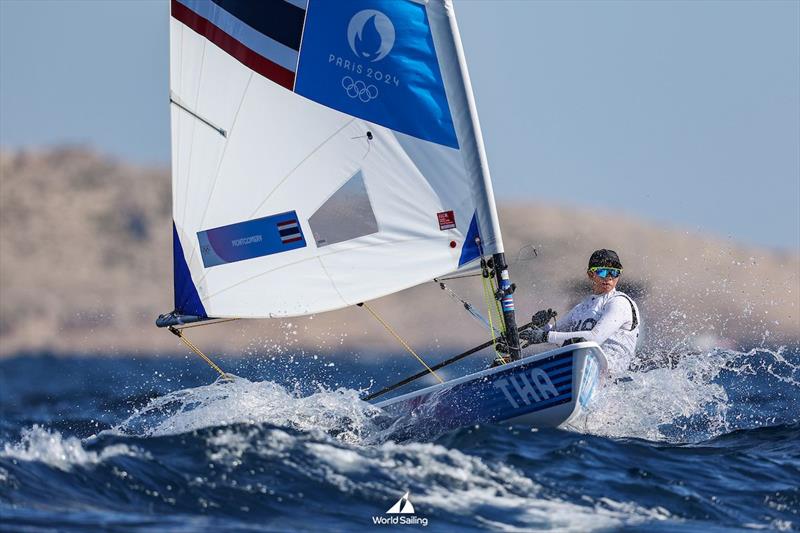
Sophia reach Paris 2024 © World Sailing
She represented Thailand at the Paris 2024 Olympics. Now, Sophia Montgomery is determined to do it again. The 23-year-old Thai ILCA 6 sailor is now based in Los Angeles and is fresh off the 2026 North American Championships.
She is also heading to the San Pedro Olympic Classes Regatta later this July, where racing will take place in the very waters where the 2028 Olympic Dinghy Races will be.
A Harvard graduate (Class of 2025) now continuing her studies at UCLA, Montgomery balances elite sailing with academics—and a NASA internship. But as she tells the Unstoppable Podcast in this exclusive interview, Sophia talks about how this campaign has already tested her in ways Paris never did, and why she almost quit sailing altogether.
You've spoken about how your dad started sailing in your family. But when did the Olympic dream become real for you?
I didn't start sailing with hopes of going to the Olympics. It felt like a buzzword—like this highlight, kind of a dream. But I was lucky in the way I was raised: we take everything seriously, and we only do it if it's fun—but it's fun to take it seriously. So I just followed the next steps. National tryouts. Then the next thing. I kept climbing the ladder because it was the next thing to do and it was fun at the time. Then I became a training partner for Thailand's first female Olympian, Kamolwan Chanyim. I got to train with a bunch of Olympians and saw what it takes to make the dream possible. The dream felt like something concrete that could happen for me. I took a year off school to go to the Olympics. And when it worked—I also didn't think it was going to work—I was there and it was insane. After experiencing it once, I've now completely structured my life around trying to go again.
Taking that gap year from Harvard must have been a big gamble. What kept you going when you were scared?
Before I started, I thought: "If I'm 40 and I knew I was this close to trying—who cares if you didn't? Just being able to say, 'Yeah, I tried to go to the Olympics,' is so cool." Are you gonna pass that up when your body doesn't work the same way? That's crazy. So I couldn't. And during training, half of it was like, "Well, you already quit school. What are you gonna do?" And the other half was, "What a privilege to be so stressed about something we love so much."
You've said the Asian Games in Hangzhou went awfully. How did you turn it around so fast for the Olympic qualifier?
I had a lot of really good people in my corner. As much as I was scared, I wouldn't have taken the gap year if I didn't believe I could do it. I didn't think it was going to happen, but I believed I had the capacity to do it. My coach liked to call us "the two scraps"—nobody believed I could do it, nobody believed he could do it. But we saw something in each other and worked towards it, and it paid off.
What's been the hardest moment of your career so far?
Honestly, last year, after the Olympics. I placed 27th—better than I thought I would, and the best Thailand has ever placed. But on the last day, I was sad I didn't get to sail one more day. I was jealous they got to sail another day and I didn't. I made a vow: I'm coming back. I don't want to just participate—I want to sail really well. So last summer, I started the LA campaign early. But now we were four years out, and nobody was looking to help me. So I got an internship in LA, used all my funds from the Olympics, bought a boat. I paid for myself to go to the North Americans, the OCR. No coach—we're doing it. Used all my internship funds. Then everything was more expensive. I ended up not being able to afford anything. I got to sail at two events, maybe 10 days on the water. I'd invested all my money, my time, everything—and it didn't pay off at all. At no point in my life had I genuinely thought, "I actually have to quit." Before, it was like, "This is hard, sleep it off." But now it was like, "I can't even sail." It's a financial barrier. That was the lowest of the lows. Hopefully we're on the up. I cannot confirm quite yet.
You studied physics at Harvard and interned at NASA JPL. Do those things inform how you sail?
Everyone's like, "You study physics—you must be so good at sailing." That's not true at all. The more you think about physics, the worse you sail. Sailing is about feeling the boat. If you think about it too hard, your body lags behind because your brain can only compute so fast. But I love physics because I like solving problems. A lot of the exams at Harvard were untimed—if you can solve it, you can solve it. I'd sit there forever until I got it. Same with sailing: "I don't know how to get this problem, but I'm going to get it." And art, too—I paint and draw, and if it's ugly, I keep going until it's not. It's all the same approach: it's bad, don't stop until it's good.
What's the biggest thing you've learned about yourself through all of this?
Two things. I'm more resilient than I thought I was. And I am very lucky. Everyone really has the capacity to do so much. I just happened to be the luckiest girl in the world to have people in my corner who believed in my potential before I had any evidence to back it up. They saw something in me and gave me the opportunity to grow. I'm proud I didn't let those opportunities pass. But if these countless people didn't see anything in me and didn't give me a chance, I wouldn't be anywhere at all.
A short thank-you from Sophia
"I received a lot of support from my friends and people in my network to help fund this summer's training block. I'm really grateful for all the help I've received through my GoFundMe - it's allowed me to train and compete with the best, which isn't something I could have done on my own."