
America's Cup Recon: June 26 - Luna Rossa - Foiling Mainsail Fix - Day 5
by Richard Gladwell, Sail-World NZ 29 Jun 03:13 BST
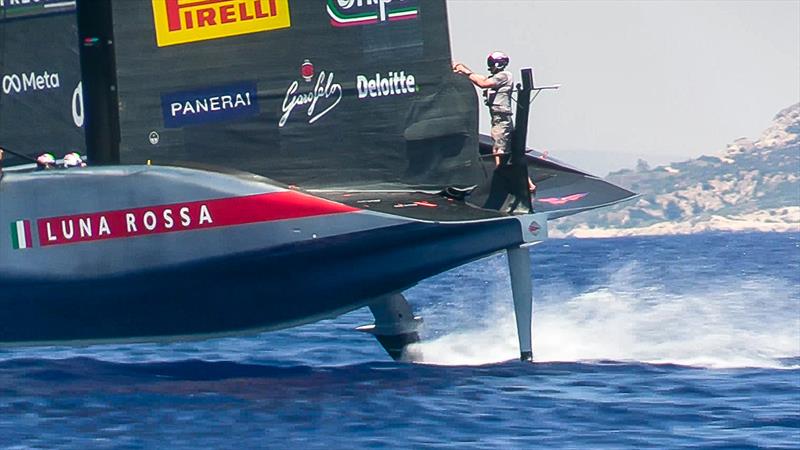
Luna Rossa - Sailing Day 5 - AC38 Recon - Luna Rossa Team - June 26, 2026 - Cagliari, Sardinia © LR Recon / America's Cup
Italian America's Cup Challenger, Luna Rossa sailed for its fifth day of the 2027 America's Cup cycle, from the team's base in Cagliari, Sardinia.
Sail Design team member Marco Capitani - a member of Luna Rossa since its first competition in the 2000 America's Cup in Auckland, gave a good interview. He was on board Luna Rossa today swapping between the 5th and 6th cockpits - getting a look at both co-helms Peter Burling and Marco Gradoni.
There is an interesting video sequence of a sure-footed crew member working on the mainsail clew adjustments - while the AC75 is foiling, we guess at 30kts, in a likely apparent wind of 40-45kts.
After the sailing session, Michele Melis of the AC38 Recon Unit spoke with Marco Capitani, sail designer and long-time team member of Luna Rossa - going right back to their 2000 America’s Cup campaign in Auckland.
With the sail quota restrictions, the teams (except for new teams) are restricted to use a mix of legacy sails (built for the Barcelona America’s Cup) and new sails for the Naples America’s Cup.
“We can think about how we can modify these [legacy] sails,” Capitani explained. However, it seemed their options in this regard were quite limited and not a focus at this stage.
“Anyway, it's important to sail the boat, even with the legacy sails. It's important to stay on the water and spend time on it. As every minute on the water counts. So it is important to stay, so it's important to stay out there.”
Responding to a question on the procedures of learning on the water, and then debriefing within the design team on specific sail modification.
“It’s business as usual,” Capitano responded. “We collect the data and information from every day. Then we analyse sails and boat performance and get together with the sailing team to hear their feedback. Then we have to think forward to the next move, the next modification.”
Luna Rossa, like the only other AC75 sailing at the moment, is carrying Lidar units on wands projecting from the sheerline around the cockpit area. The units provide very accurate data on sail shape for each of the two mainsail skins, which can be configured differently to produce the optimal wing shape.
Additionally, data and images come from a variety of sources - such as cameras and wind sensors located around the boat and rig.
“All the information you can collect is useful, because the more information we have, the more accurate our debrief will be, and the more we will learn, so it's quite important to have as many tools as you are able to use. I think it's a plus.
On this occasion, Capitani was switching between the two aftermost cockpits overlooking co-helms, Peter Burling and Marco Gradoni.
Asked what he was looking at when he sat behind Gradoni, who has only just transitioned to the AC75, Capitani said he was not looking at the sailors, but more at the rig and sails. “I was more focused on the sail than on them,” he said.
Although we don’t have details on which sails and foils Luna Rossa used in the 2024 America’s Cup Challenger Selection Series in Barcelona, it would seem from the equipment data recorded by the Recon team that they are in a commissioning process and sailing the boat in a Barcelona configuration. This is just their fifth day of sailing, and compared to Emirates Team New Zealand, who are further into their sailing days quota (Day 16), we’d expect the Italians to sail for another five days in commissioning mode before bringing in modified legacy gear for testing.
It will be interesting to see if Luna Rossa brings in a slimmer replacement for their glunky mainsheet/mainsail clew adjustment system, which appears to be the same one used in Barcelona. They seemed to have some minor issues with the current model, which were able to be fixed by a crew/support team member while the AC75 was foiling fast - captured on the long video below. Emirates Team NZ appeared to have a refined model in place from the outset of their test sailing in mid-March.
Both the Kiwi and Italian crews are introducing new sailors to the AC75 sailing squad, and this crew work-up phase is reflected in the large number of tacks and gybes conducted during the session. There were a few touch-downs, which is a good reflection on the crew coordination progress, but also on the fact that the Italians were mostly sailing in ideal foiling conditions, with a moderate 10-15kt breeze and flat water.
All up, Luna Rossa seems to be turning in numbers comparable to the New Zealand team, who are the benchmark, given that we don’t have access to performance data but do have video of the training sessions.
Luna Rossa - Day 5, June 26, 2026 - Cagliari, Sardinia.
Crew List:
- Port Helm: Marco Gradoni/Ruggero Tita
- Starboard Helm: Peter Burling (NZL)
- Port Trimmer: Umberto Molineris (ITA)
- Starboard Trimmer: Vittorio Bissaro (ITA)
- Positions 5 & 6: Maria Giubilei ( Port) Gigi Ugolini (Stbd) and Marco Capitani
Wind & Sea Conditions:
Summary: .
1230hrs Wind: 155°: 10-14kts
1345hrs Wind: 180°: 11-13kts
1440hrs Wind: 185°: 14-15kts
PM Sea State: Flat with a slight chop later
Dock Out: 1210hrs
Dock In: 1645hrs
Time sailed: 4hrs 5 mins
Foiling time: 130mins
Tacks: 52/3 Gybes: 64/3 (Fully Foiling/Touch & Go)
Recon Report
The Italian team rolled out at 1100, stepped mast and craned in by 11:30hrs. Starlink devices were mounted on the primary chase and boats media post. The anemometer and the previously mounted device on the masthead were removed for this day. GoPros were positioned on the jib track, both port and starboard. With dock-out scheduled for 12:10, the M1 mainsail was being locked in. To hoist the first upper battens, technicians used a soft hammer.
Once out of the harbour, M1-8 was hoisted and paired with J3-9. Breeze was 10–12 kts from 150°. For the first session, the following crew was on board: on port, Ruggero Tita (helm), Umberto Molineris (trim), and Maria Giubilei (5th); and on starboard, Peter Burling (helm), Vittorio Bissaro (trim), and Marco Capitani (6th, sail designer, on interview).
The first session started at 1250hrs with a tow-to-foil. The boat sailed mostly straight and longer boards upwind, one on each tack, appearing quite unstable in ride height but stable in pitch. Unsure whether this was linked to any new crew rotation or testing behaviour. On the other hand, downwind it appeared more stable in ride height. On the longer downwind boards, a crew member on deck checked the main clew and tack using a tool. More manoeuvres were executed downwind, with bulb-to-bulb times again counted at approximately 6 seconds. Similar to the previous sailing day, the crew occasionally loaded the rudder downwards, trimming the boat bow-up with leeward heel.
The sea breeze increased closer to shore to 11–13 kts, turning right to 180°. After a quick lunch and sailor debrief, the boat was back foilborne at 13:50hrs. The second session focused on more manoeuvring, back-to-back upwind and downwind, and the boat looked more locked in for ride-height stability upwind. As the boat sailed closer to shore, some more complex manoeuvres were practiced, perhaps in a virtual starting box. Besides some minor mistakes during the aggressive bear-aways and round-ups, the boat seemed quite stable.
For the third session, the crew rotated: on port, Marco Gradoni (helm), Umberto Molineris (trim), and Marco Capitani (5th); and on starboard, Peter Burling (helm), Gigi Ugolini (trim), and Maria Giubilei (6th, sail designer). Foilborne by 14:40, this session unfolded similarly to the previous one, with a large series of manoeuvres at the beginning before switching to several pre-start routines. As this session ended, batteries were swapped.
For the fourth session, sailing resumed by 15:35hrs, and the breeze had ramped up to 15 kts with some minor chop. The boat sailed some diamonds with intensive upwind manoeuvres; the rudder was stalled in a couple of tacks. On the other hand, downwind, the boat sailed longer boards, and two-board immersion was observed in faster upwind and downwind modes. J3 was lowered at 16:16, the mainsail at 16:26, and the team was towed back to the harbour.
The team docked in at 16:45hrs, concluding the day with approximately 130 minutes of foiling time, 52 tacks, and 64 gybes, with three marked as "touch and go".
Additional Images: