
America's Cup Recon: Then there were three - French conduct AC75 Tow Test
by Richard Gladwell, Sail-World NZ 30 Jun 03:30 BST
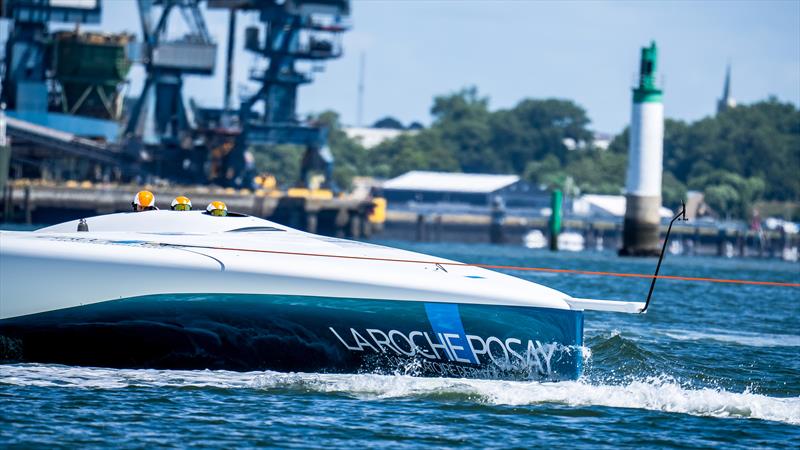
Tow-Test - La Roche-Posay Racing Team (FRA) - June 29, 2026 - Lorient. France © Pierre Bouras / America's Cup
The French America's Cup team, La Roche-Posay Racing Team, has splashed and tow tested their AC75 from Lorient France.
The test session lasted approximately 90minutes, and appeared to pass without incident.
This was the third day the Recon Team has been on site. Due to a pending PR announcement by the team they were given permission to impose a Media Embargo, as permitted under the Protocol that governs the conduct of the 38th America's Cup. The French team is permitted to test-sail for 55 days prior to January 15, 2027, after which they will receive another quote to take them through to the start of the Louis Vuitton Cup.
The test sailing quota is only used when an AC75 actually sails, and doesn't get used for tow testing or other activities. The Recon team is always present at the point an AC75 emerges from the shed, regardless of whether it splashes or sails.
Long story short, on the first day, the systems were tested with the AC75 out of the shed. On the second day the mast was stepped and checked, and on Non-Sailing Day 3, the AC75 was splashed and tow tested, to check foiling systems ahead of the first day of sailing, expected to be Wednesday.
The long and detailed report of the three non-sailing days is below:
Non-Sailing Day 1:
Recon team arrived at the Lorient base at approximately 19:00. RPRT advised through Antoine Carraz that the boat would be rolled in and out of the shed multiple times until around 22:30 with foil movements, as part of a media reveal shoot. The Regatta Director has granted K-Challenge (now La Roche-Posay Racing Team) a media embargo until 30 June under TR 17.12(d), so no content is to be released before that date.
The boat emerged from the shed on its trailer, already fitted with port and starboard foils and rudder, and was positioned approximately 45° to port of the shed's longitudinal axis. The port foil was canted up until the wing reached roughly 20 to 30° from horizontal and held there, while the starboard foil was cycled through its full range to maximum extension. The shooting crew then proceeded into multiple team shots with the boat in the background. Once done, both foils were cycled down and retracted. Over the remainder of the session the boat was rolled in and out several times, with the foils brought to door frame level for additional filming. Operations concluded at approximately 22:01.
Foil geometry: the starboard foil wing and flap appear consistent with the Barcelona 2024 configuration, retaining winglet tips with the flap running to the tip end. The port foil differs: the tip carries no winglet but instead a flat grey piece that appears separate or modular from the rest of the wing, with the flap terminating at the junction with this piece rather than continuing to the tip. This arrangement suggests the tip piece may be interchangeable to trial different tip geometries, the port and starboard asymmetry potentially allowing a new tip geometry to be evaluated on starboard tack against the Barcelona 2024 geometry on port tack. The remainder of the foil wing, flap, wing to bulb junction and foil arm fairings show no apparent change. The rudder elevator appears broadly similar to Barcelona 2024. The shaft, however, shows a different profile near the top, with both the leading and trailing edges appearing incurved compared with Barcelona 2024.
Non-Sailing Day 2:
The plan for the day was a rollout at approximately 09:00 for a mast stepping exercise on the forecourt, with a roll back into the shed expected around 12:00. On arrival the Recon Unit was advised that a RIB briefing with the chase boat assistance captain would take place during the morning. The Recon Unit requested Antoine Rucard, Boat Captain, to RPRT for the post-session interview.
The mast came out of the shed shortly before the rollout, already fitted with all components including halyards, spreaders and shrouds. It was lifted from the head and brought to vertical, after which a tube associated with the trolley was removed. The rotation bulb collar was visible through an opening at the bottom of the mast aft face. The Cunningham system appeared incomplete, with the hydraulic ram missing. Two openings were noted on the aft face near the top of the mast tube, with a third below the spreader, all of a lozenge shape. These are consistent with the access openings permitted under Class Rule 17.7 for permitted systems and the passage of RigCS and instrumentation cables. A temporary carbon piece was fixed to the aft face and stabilised on the spreader, likely to hold the spreader in position while the shrouds were not yet under tension.
The boat began rolling out at 09:26. The team had to remove the guardrail stanchions to clear the shed door, and the boat was then brought fully out for mast stepping. The boat showed its two foils, but unlike the D1 session the rudder was absent. Both foils carried blue tape covering what appears to be a series of anti-ventilation fences on the lower foil arm fairing. Four fences were noted: the uppermost running around the entire chord length on both sides, with three further fences on each side of the fairing terminating at approximately three quarters of the fairing chord length aft. The fences are more pronounced outboard than inboard.
A small spike or protrusion was noted on the leading edge of the port foil wing, just inboard of the differently-finished tip section, its purpose unconfirmed but possibly a boundary-layer or flow-control feature. What had earlier been thought to be a modular or separate port wing tip piece is confirmed not to be modular. The tip presents a different surface finish from the rest of the wing, possibly bare or uncoated rather than the coated finish elsewhere, though the exact finish could not be confirmed. No other apparent change was noted on the foils. The boat was fully out and the mast was lowered for stepping.
A deck cover was removed and the forestay was preliminarily attached. The port shroud and lower shroud were fixed, followed by the starboard shroud and lower. A forward hydraulic pump was present, probably used to measure tension via a white soft cable, while a black soft forestay appeared to be the working forestay attaching to a black soft bottom cable through a dyneema lashing. The white soft element remains tentatively identified as the jib halyard. The team then prepared the forestay attachment and began hydraulic tension testing.
A tension sequence followed, alternating between the white and black forestay. The white was tensioned by the hydraulic pump, the black tensioned using the dyneema lashing attached to the bottom black soft cable, cycling back and forth. Mast rake was observed moving progressively forward during this process, until what seems its sailing position (approximately 5° rake).
A crew member was then sent up the mast to the forestay head. Two poles were brought onto the boat while the crew member sent up the mast was lowered down to spreader level, where the starboard attachment of the temporary piece was eased off. The foils were lifted until the wings reached horizontal, and the poles were installed and fixed on their supports at the hull-to-deck junction, aft of the cant system. At least one pole carried a sensor unit at its upper end. Whether they also carry cameras could not be confirmed.
A mast rotation test was carried out, rotating to starboard and back to centre with hydraulic noise, then to starboard again and back to centre with another hydraulic noise, before moving onto port smoothly. The team then appeared to be measuring the mast rake using an inclinometer on the mast aft face.
The Recon Unit checked the RIB with the chase boat support captain around midday. When returning to the boat the poles were removed. Manual handling on the forestay resumed and the team began releasing the forestay to unstep. The forestay and the shrouds were off, the mast lifted unstepped, brought forward to vertical, lowered, and laid horizontal next to the shed. The boat was rolled back into the shed at 11:54 and was in by 11:57.
Non-Sailing Day 3, June 29, 2026 - Lorient, France.
Crew List:
- Starboard Helm: Quentin Delapierre (FRA)
- Port Helm: Diego Botin (ESP)
- Trimmer: Jason Saunders (NZL)
- Trimmer: Timothé Lapauw (FRA)
- Positions 5 & 6: Amélie Grassi (FRA) Philippe Presti, Antoine Carraz, Mourniac
Wind & Sea Conditions:
Summary: .
Wind: 7-14kts 270°
Sea State: Swell from West
Dock Out: 1242hrs
Dock In: 1630hrs
Time towed: 90 mins
Foiling time: 90mins
On-Water Recon Report Non-Sailing Day 3:The plan for the day was a tow test of the boat, its first launch in Lorient for AC38, with dock-out scheduled for around 11:30. As the first time the AC75 had been craned at the Keroman site, much of the morning went on the launching routine itself, the team working out crane and trailer positioning.
The boat rolled out at 10:30, the guardrail stanchions lowered and reset once clear of the shed door. It was fitted with both foils and the rudder, the rudder at full forward rake and touching the hull at roll-out. The anti-ventilation fences on the lower foil arm fairing, taped over on D2, were now exposed, and a white mark was noted at the bottom end of the lower fairing, possibly a visual reference such as a ride-height mark.
The rudder shaft appears consistent with the Barcelona 2024 configuration, the leading and trailing edges curving outboard and then inboard at around a quarter of the span from the root. This suggests the rudder fitted today differs from the one seen on D1 and is similar to the AC37 rudder.
The boat was craned in on four slings and lowered into the water, the slings released at 11:22. Four crew were in the pods during the lift, and the foils were cycled through their range while craning, which appeared to be for clearance during handling.
At the dock the deck remained largely covered, the jib track not visible, though the main traveller and the double mainsheet system, sheets rigged, were in view. The former aft pod positions remained visible on the deck. Technicians worked from laptops on deck and below, running a sequence of systems and instrument checks.
The foil cant system was cycled repeatedly, the boards raised and lowered, the boat heeling each time a foil was lifted fully clear of the water, on both sides.
A dock briefing preceded dock-out at 12:42. The boat was towed out under a short towline and, before any foiling, carried out two towline-release tests at around 7 knots with both boards down, one to port and one to starboard.
The first foiling run began in the channel and ran out toward the bay, towing from 12:52, the boards canted up until the wings were horizontal at 13:02, foiling by 13:11, and a stop with tow release at 13:17. Through this run ride height and pitch appeared fairly stable, the hull skeg grazing the surface, with some bow-down trim toward the end.
The boat then stopped and the foil cant system was cycled again on the water. Two further foiling runs followed in Lorient bay, a short one from around 13:50 and a longer one between 14:08 and 14:22, the last finishing back in the channel close to the dock.
On these later runs the pitch appeared irregular early, the boat pitching fore and aft, before settling to a mostly slight bow-down trim, which would be consistent with flight control and flap testing. Antoine Carraz, Technical Director, pointed to this testing in the post-session interview.
The boat docked at around 14:30 and was lifted out at 15:03, returning to the shed at around 16:00.
Additional Images: