
Ambrogio Beccaria secures a spectacular IMOCA maiden win after dramatic end to the Vendée Arctique
by Ed Gorman / IMOCA Globe Series 16 Jun 11:51 BST
16 June 2026
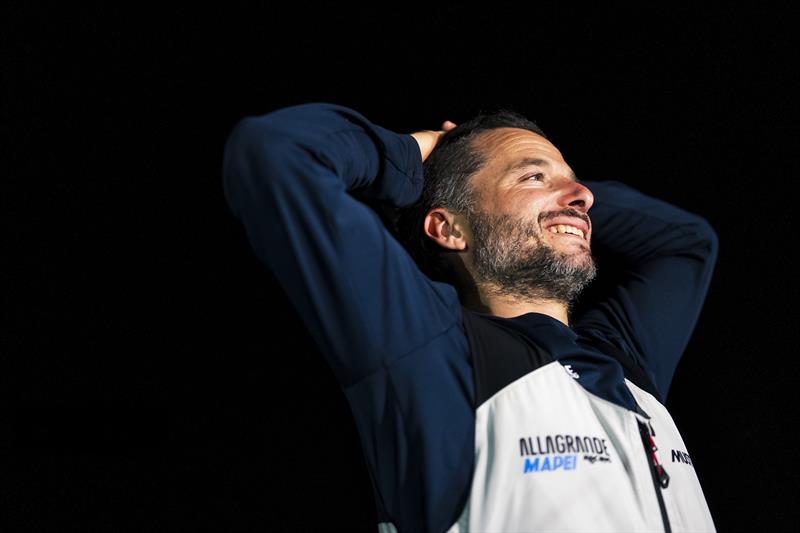
Ambrogio Beccaria wins the Vendée Arctique © Jean Louis Carli #VALS2026
The third edition of the Vendée Arctique-Les Sables d'Olonne will be remembered as one of the most fascinating IMOCA races of recent years, and one that has cemented this unique challenge as a minor classic in the solo offshore racing calendar.
The race had everything - storms, calms, landmasses, forbidden zones to avoid - and it demanded great resourcefulness from its skippers, who had to make critical strategic and tactical decisions all the way through eight and a half busy days at sea.
And the race will be remembered too for its incredible finish that saw the leader from day one, Sam Goodchild (MACIF Santé Prévoyance), overtaken in light winds off Les Sables d'Olonne by Ambrogio Beccaria (Allagrande MAPEI), who was racing solo in IMOCA for the first time.
Tight finishes to oceanic races have become something of a trademark of the IMOCA Class and this was no exception, with the first three boats crossing the line in just over two hours.
Beccaria secured his maiden victory in the Class in the early hours, just an hour and a quarter ahead of Goodchild after sailing 3,190 nautical miles at an average speed of 15.5 knots and after eight days, 14 hours and five minutes at sea.
In an impressive third place, arriving an hour after Goodchild, to follow her third place in the season-opening 1000 Race, it was Violette Dorange (Initiatives-Coeur). Then came the most disappointed skipper in the race, Élodie Bonafous (Association Petits Princes-Quéguiner), who was on course for the podium, at the very least, but had to take a 12-hour time penalty for straying into the TSS at the entrance to the North Channel. In fifth place was Francesca Clapcich on board 11th Hour Racing.
This was a remarkable performance by Beccaria, the ebullient 34-year-old Italian skipper known to one and all as 'Bogi.' He had to dive under his boat to cut away a lobster pot line off the Irish coast, then experienced an electrical failure and still managed to come back from fifth place in the early stages to secure a spectacular victory.
His race on board the Antoine Koch/Finot Conq-designed former For People, was marked by his confident and independently-minded decision-making, showing he was not afraid to do his own thing or split from the boats in front, as he did by choosing to go to the west of Ireland on the way south, rather than follow Goodchild into the Irish Sea. And, as his finishing speed demonstrated, he was quick in light winds and faster than Goodchild on MACIF, a boat that is regarded as a step ahead of all its rivals.
The skipper originally from Milan, who enjoyed a successful career in Class 40s before joining IMOCA last year, was measured and gracious in his moment of triumph. He admitted he found coming into the famous harbour channel at Les Sables d'Olonne, from where he plans to set sail on the next Vendée Globe, quite intense.
"Coming through the channel was still quite emotional, seeing all those people who were there simply to congratulate you on the race. It's not something that happens every day," he said. "It's true that if there was one race to win, this was probably a good one to choose - the welcome was incredible."
Beccaria said winning the race was never the objective for him or his team - this was a chance to validate his racing technique solo on board - and he simply took advantage when conditions favoured him. "You can't really say that I led the race," he explained. "Sam was the one who led it, from start to finish. He sailed an incredible race. He was really unlucky at the end, and I was able to seize the opportunity when it came."
Beccaria said he felt for Goodchild and the entire MACIF team after the death of Charlie Dalin which was announced during the race. "We received the news of Charlie Dalin's death while we were crossing the Arctic Circle - that was a moment when you feel quite alone out there," said Beccaria. "And yes, Charlie was someone who left a huge mark on the sport in general. He was one of the great figures of our sport and he inspired all of us enormously. I thought a lot about Sam at that moment."
Goodchild himself, who had won four of the five races leading up to the Vendée Arctique, was understandably disappointed and admitted he could not match Beccaria's pace in the closing stages. It was with a heavy heart that he returned to Les Sables d'Olonne surrounded by a team still coming to terms with the loss of Dalin.
"There is obviously the emotion of arriving in such circumstances - it's a lot to carry," said Goodchild. "Right now, that's what we are thinking about most. We've just come through the channel with the entire MACIF team and Charlie is very much on our minds."
For Dorange the Vendée Arctique was a big step in the right direction as she demonstrates her increasing mastery of, what for her, is a big step-up to a new-generation foiler. She said her result exceeded her expectations. "I sailed well," she said. "I made a few small mistakes along the way, but I learned an enormous amount from this race - it was incredibly rewarding."
She spoke about what she called the "rare intensity" of the Vendée Arctique and its unique course to the far north and back. "I feel as though I've just come back from a mini round-the-world voyage," she explained. "We went through at least four or five storms and every one of them required manoeuvres, decisions and constant adaptation. All of that compressed into just eight days. And then there were the landscapes; I discovered the Faroe Islands, passing close enough to admire the steep cliffs. I crossed the Arctic Circle, which I still struggle to fully grasp. This race took me farther than I have ever sailed in the Atlantic before."
Dorange's performance, after a race that qualifies all its finishers for both the Vendée Globe in 2028 and the Route du Rhum in November, lifts her to second place behind Goodchild in the 2026 IMOCA Globe Series Championship, with Beccaria now in third place.
Behind the top-five Nico d'Estais on board Café Joyeux, the only daggerboard boat in the eight-strong fleet, had about 320 miles still to sail as he passed the Isles of Scilly, with Arnaud Boissières (April Marine-Recherche Co-Partenaires) just over 100 miles behind him. In eighth position it was Manuel Cousin (Coup de Pouce), who was on his way past the latitude of Cape Wrath.