
What the Firefly means to me - Tiggy and Greg Ansell
by Alex Baxter 10 Jun 13:06 BST
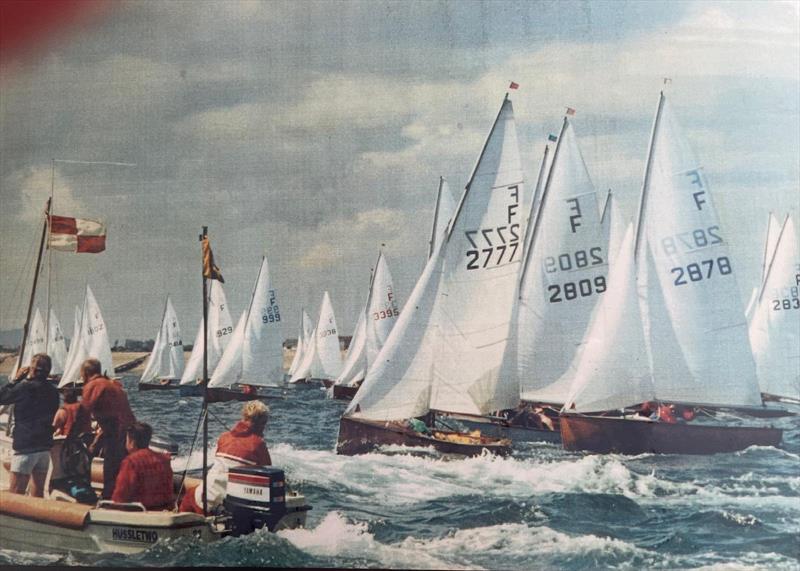
Early 1990s wooden Firefly fleet, possibly at a Pevensey Nationals © Tiggy Ansell
As the Firefly class celebrates its 80th anniversary, we are sitting down with some class legends to hear their reflections on the fleet, including why they keep coming back and what it means to them.
Up next are two who, between them, are arguably the reason there is still a Firefly fleet left to come back to: Greg and Tiggy Ansell.
Tiggy grew up in Lymington and learned to sail in the family Firefly alongside her late brother Peter. She is a retired nurse from a household full of stethoscopes (Peter went on to become a psychiatrist; their father was a GP; and their daughter, Gilly, and son-in-law, Alistair, are both consultants). She turned eighty on the 7th of June, with a party that was apparently a quiet affair.
She has also, for as long as anyone can remember, been the unofficial photographer of the class: out on the committee boat with a camera always a generation ahead of whatever the rest of us had, printing results on A4 sheets that papered her walls and turning up in people's hands in an era when nobody yet had a camera in their pocket.
Greg is from ex-London and joined the Firefly class properly through his brother-in-law Peter at medical school. He is an ex-class chairman, and he was also one of the first proper team racing umpires of his generation, part of the small clan that, with Bill Brockbank and others, did much of the work of getting team racing recognised as a discipline in its own right.
Together they organised Spinnaker's Firefly fleet from the mid-1980s onwards, when the class was, frankly, dying. Open house after training; Tiggy fed everyone, and Greg fixed everyone's boats. They are, in effect, the southern equivalent of the West Kirby brigade, and are reliably reported to have spent at least part of their honeymoon racing a dinghy at Cowes Week.
Their current project is a wooden Firefly undergoing Mark 4 conversion (deo volente, and Chris Sumner finishing it) for the Nationals. After that, a Shrimper.
Getting them to sit down together to reflect on the class they have given the better part of their adult lives to was an absolute pleasure.
Tiggy Ansell
I was thirteen when my father bought our first Firefly. She cost him £82: sails, rig, spars, the whole boat ready to go on the water at Lymington. Things were different in those days. My brother was eleven or twelve, and the two of us sailed her every summer holiday at Lymington, where there was a small Firefly fleet of similarly elderly boats. We sank her occasionally. We capsized her rather more often than that. We did a bit of racing, though it was a small fleet of sinkers and breakers, all of us scraping our way around the same buoys. None of it would have looked impressive from the bank, but that was the start of it.
Greg Ansell
When I went up to Oxford as a medical student in the early sixties, the university sailing club had some Fireflys that were being allowed to fall slowly to pieces. Regular maintenance of wooden boats was not a priority, especially when sailing could take place in twelve-foot GRP Alpha dinghies that had been bought to replace the Fireflys. Many of us preferred the Freddies much more, despite their decline. Eventually, in my fourth year, the OUYC moved to Farmoor Reservoir, which offered much better sailing, though the bike ride from town to the reservoir was a bit of a pain.
The next phase of my medical training took me to St Thomas's Hospital Medical School, where there was a very active sailing and team racing club based at the Welsh Harp reservoir at Wembley in north London, under the administrative umbrella of the London University Sailing Club. Most of the constituent colleges and medical schools of the University of London were also based there, and we all sailed Fireflys. Better still, several colleges had sheds where we could actually repair and repaint, so the Freddies mostly survived in reasonable condition, though the rudder and tiller fits were awful.
There was a great deal of team racing between colleges, within leagues, and in the Castaways Cup, as well as between visiting college teams and older members competing for the Foot Trophy, a bronze foot. The Castaways was the London University old members' club. The St Thomas's team spent at least some of its weekends visiting Firefly events around the country, one of which was the Royal Lymington Yacht Club Easter Dinghy Meeting, where Good Friday was devoted to a three-boat team race competition. Some teams came complete; others were simply ad hoc Firefly sailors who had teamed up for the weekend.
It was through the Firefly class that I met my wife Tiggy, at the Lymington Easter meeting. Tiggy's parents had a house at the end of the old toll bridge in Lymington, which was a toll bridge then, though it is not anymore. They had the very sensible idea of saying, "You all can have the house, so long as you (Tiggy) are there to keep an eye on it," so that people who had come for the team racing could come and stay. Tiggy was eighteen and nineteen at the time, and about twenty-eight people would descend on the house for the weekend. You can imagine, can't you?
There was a fair bit of drinking, and a great deal more that I shall draw a veil over. The team racing was usually freezing; Easters seemed to be windier and colder than they are now. It was enormous fun. Meanwhile, Tiggy was slogging through the first two years of nursing without a single full weekend off, so it took us a while to overlap properly. But we managed it, and the class is at least partly to blame.
We moved to Bournemouth and then to Ringwood, where I became a GP. Ringwood happened to have its own sailing club, the Spinnaker Club as it was originally known, on a small disused gravel pit that grew larger when Wessex Water took it over and joined it to another former gravel pit to form a reservoir. Work and family curtailed sailing for a time, and then Tiggy developed back problems that required two operations over three years, after which her orthopaedic surgeons banned her from sailing small boats for ten years. She had crewed with me in whatever small boat we had, and in our XOD keelboat, but this instruction put paid to her sailing, so she took up race officiating instead.
Spinnaker ran a Wednesday evening pursuit race throughout the season, with as many as fifty boats of all kinds, each with a personal handicap based on the Portsmouth Yardstick, reviewed every week so that nobody won two races in a row. The series was started by former Spinnaker Commodore Ken Rolls, taken over by Tiggy and a small group of friends, and continued under her care for thirty years.
When our children had more or less passed through their Optimist phase, I decided to buy our first Firefly for all of us to sail and race in various combinations, even though the officially adopted classes at Spinnaker were the GP14, Enterprise, Heron and Optimist. Other club members took kindly to this interloper, and we spent the next two years or so driving around the South of England in search of second-hand Freddies. Our search was aided when the Parkstone Yacht Club Firefly fleet collapsed due to a perverse change in attitude on the part of the PYC Sailing Committee, and when a local school shed six wooden Fireflys, making more second-hand boats available.
Around this time, Charlie Askew persuaded Southampton University Sailing Club, then based at Hamble, where they sailed Merlins, to move to Spinnaker and sail Lark dinghies. That move quickly transformed their sailing team into champions over successive years and introduced them to Fireflys and the national Firefly Class team racing meetings.
Some of those students even bought old boats and spent time in our large concrete garage repairing stems, transoms, decks and even centreboard cases using the magic of epoxy resin and fillers, helped along by the generosity of our neighbour John Keating, who owned Wessex Resins. Those repairs taught us all a great deal about Firefly construction, and what was repairable and what was not, so we became much more discerning when choosing old boats to restore.
It was then that the club set its sights on the Class team racing trophies. Much time was spent in practice on Sunday evenings, often with a few of us club seniors sitting in RIBs to manage starts and finishes, and afterwards everyone would repair to our house for supper, prepared by Tiggy, of course. The expanded fleet of Fireflys also meant that some of those team race events were hosted at Spinnaker. The first we ever ran, I believe, for the RNVR, was managed without a computer to generate the round-robin draw, and we only completed the race when the home team and visitors turned on their car headlights across the lake so that the competitors could make out the race marks and the finish boat.
For a stretch in the late sixties and through the seventies, the future of the Firefly class looked uncertain. The existing fleet was obviously ageing, and although Fairey Marine had brought out a plastic version around 1968 (St Thomas's, my own medical school, bought one), it proved slower than the wooden boats, and few people wanted a plastic version of something that was beaten by its wooden counterparts. Meanwhile, other classes appeared that seemed to appeal more to club racing, and newer GRP dinghies replaced Fireflys in the fleets of the services and some universities and schools, despite the evident fact that the Firefly was still simply the best team racing boat.
The decisions that halted the decline were, I think, two in number. First, David Derby and the Firefly Committee managed to persuade Porter Brothers to produce an entirely new competitive GRP version just before West Kirby Sailing Club decided which class would replace its ageing Wilson Trophy Firefly fleet. The Wilson Trophy at West Kirby, then called the world championship of team racing, drew teams from all over, including the United States and Ireland, and was easily the biggest team racing event in terms of coverage in the yachting press. The club's own Fireflys used for the event were rather below the expected standard. West Kirby had found sponsors for the event and wanted to buy new boats; the question was: would the replacements be Larks or Fireflys? The Porter boats came in cheaper than Larks. The West Kirby members, many of whom had grown up in Fireflys, swung the decision by a hair's breadth.
I am convinced that had it gone the other way, the class would have quietly faded away.
As it was, every university with team racing ambitions suddenly had reason to keep or acquire a Firefly fleet. There were, however, snags with the Porter boats, notably concerning buoyancy, of which there was too little at the stern. This could have been corrected fairly easily, but it was not, and the Class changed builders again to Rondar, who redesigned the deck and rudder arrangements to much greater general satisfaction. The continued interest in Fireflys at Spinnaker encouraged the club to buy a team racing set of six boats, which were also available to club members for individual club racing, and later Southampton University bought two flights as their Lark fleet wore out, so there were plenty of Fireflys for team racing, training and practice.
Tiggy's team supported all of this, sitting in the start and finish boats for hours at a time. Several former Southampton University sailors became Spinnaker Club members and, with plenty of club support, set their sights on the RNVR Trophy, the Foot Trophy, the Wilson Trophy, the Prince Philip Trophy and the Worlds. Much training took place on Sunday evenings, and we often had supper at home for everyone afterwards. So Tiggy became chief cook as well.
The Firefly also had a unique handle on team racing of a slightly different kind: two boats a side rather than three.Budworth Sailing Club pioneered this format, which meant that in theory, one car with four people and a single trailer could transport an entire team to a two-boat event, with the top boat travelling upside down, bow to stern, on the boat below. No other class tried that. Geoff Jackson at Spinnaker refined the two-boat game into "Random Pairs," which is still running. You enter as an individual and are paired randomly with another entrant against two others, also randomly paired, for one race. If your pair wins, you score a point. For your next race, you are paired with a different entrant against two different entrants, and so on. Experts and the less expert can find great entertainment in this, and it all happens in good spirit; after all, your next partner might have been your last opponent.
It was a little after this, when Spinnaker boats began appearing at the Nationals and Open Meetings, that I was asked to become Class Chairman. I was told that the Chairman's main function was to encourage the fleet to go to the Nationals. The retiring chairman was stepping down early because he had committed to crewing with a friend in another class and could not divide his interests satisfactorily. I thought it might be worth the effort if we could deal properly with some of the Firefly's snags that were being drawn to my attention, in particular by some of those Spinnaker members who had been originally enthusiastic about the boat: the height of the boom above the hog, the buoyancy problems, the mainsheet angle differences between centre and transom-sheeted boats, and the rudder and tiller fit. We made a start.
The other thing the Firefly has given us, which other classes simply could not, is the opportunity for an old boat to win an open meeting or the class championships. This requires some effort on the owner's part, with sensible care of sails and decent covers. Old boat used to mean simply an old wooden boat, but it seems that even older GRP boats by Rondar and Ovington may be able to share in the silverware. I know of no other dinghy where that is true.
There was a moment about twenty years ago, at a South Staffs RNVR weekend, that has stayed with me. In the changing room, two Hollingworth Lake sailors were comparing notes on a new Merlin that a club colleague had just bought. It had cost fifteen thousand pounds for the boat, and the builder had charged a further five hundred pounds to tune it. It was observed that all thirty or so of the Fireflys tied up on the jetty, every one of them, could have been bought for what he had spent on a single Merlin and a single afternoon's adjustment of its rig. That is probably not quite true any more, but it is not far off, and that gap is the whole reason a class of seventy-year-old boats is still putting fleets on the water.
We are restoring our old Firefly, number 2836, called Medusa, built in 1963, the same boat I bought years before. She has been sailed for the most part by our daughter Gilly with her friend Melanie. You never passed them on the water without hearing chatter, laughter, and singing. Chris Somner at Poole is doing the work and will hopefully have her ready in time for the Nationals. There has been some discussion over deck layout. I made her a Mark Three, but Chris is keenest on doing a Mark Four, which is what she will come back as, and that is fine; she is going off to the next generation. A Mark Four floats high after a capsize, and the under-thirties roll her up easily enough. For those of us over a certain age, a Mark Two or One with a bow and stern tank is the better deal. She comes up with a good deal of water in her, but you can bail her out and get back in without too much trouble.
A further note on buoyancy. A few years ago John Brickwood, then captain of Southampton University Sailing Club and Lark national champion, borrowed one of our Fireflys, a Mark Two with bags and no tanks, for the Nationals. Just before he drove off, someone said, "And you'll need two buckets." It was explained that if he capsized and the bags were not perfectly strapped down, he and his crew would only be able to get the water level inside the boat down to the top of the centreboard case, even with both of them bailing flat out with a large bucket each. After some equivocation, he took the two buckets.
What the Firefly means to us, in the end, is a small wooden boat cheap enough to be passed down and robust enough to survive being passed down. A boat that you can fix in an afternoon, and a boat that quietly kept its class alive at a time when the world was full of glossier alternatives. A boat in which we both learned to sail, in which we met each other, and in which I have shouted at and been shouted at by some of the best friends of my life. A boat in which the next generation will at least once cross the line first at a Nationals in a sixty-three-year-old hull that we kept alive because she deserved it. That seems to us, on reflection, not a bad thing for a boat to have done to you.
The 80th Anniversary Year
2026 is kindly being sponsored by a variety of companies.
Our travellers series, the Vines Series, is proudly supported by Craftinsure.
As part of the Firefly Class's 80th anniversary celebrations, the fleet will come together for a landmark season of racing and events, including the Tideway 80th Anniversary National Championships at Tenby Sailing Club, kindly sponsored by Tideway Wealth Management, a full calendar of Open Meetings across the country, and the 80th Anniversary Dinner on Saturday 21 November 2026 at the Royal Thames Yacht Club.
The 2026 anniversary raffle prize is a race-ready Firefly (F4444), generously provided by Ovington Boats - complete with Selden Mast, Hyde Sails, covers, and a launch trolley from Sailboat Trailers.
Up next, the fleet heads to the Norfolk Broads YC open meeting on 13-14 June. 27 boats and counting are signed up, enter here: nbyachtclub.byretail.net/menu/Racing/Dinghy-Open-June
All results, entry details, and further information can be found at www.fireflyclass.co.uk