
At the mercy of the elements?
by Mark Jardine 10 Jun 08:00 BST
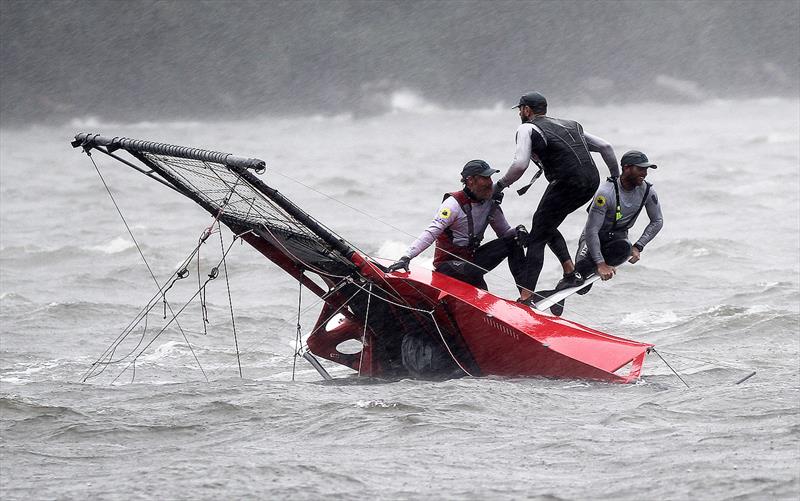
Racing cancelled on day 3 of the JJ Giltinan 18ft World Championships © Frank Quealey
Possibly more than any other sport, sailing demands the right conditions to take place, specifically with the wind. Both too much and too little cause their own issues, but there are more factors at play...
SailGP has broadcast windows, some locations have tidal windows, evening and weekend racing has a set start time, so we are forced to use the conditions at a certain point. That's all well and good when conditions are within that event's wind range, but otherwise sailing can't happen.
But firstly let's look at the forecasts, and the dramatic effect they have had in recent years.
Forecast-based participation
The 'Windguru effect' is now well-known in sailing, where people make their decision on whether they will sail or not a week or more in advance, most commonly to decide against travelling, and often missing a cracking event as a result.
This has been happening for a good 20 years now, and also before the days of GRIB files and online forecasts, when we used to get our information from the TV and Shipping Forecasts.
Recent advances in AI make it an extremely powerful research tool, and highlight just how misplaced our trust is in forecasts, particularly when it comes to the wind. The graph below shows how a general weather forecast has a 50% probability ten days beforehand, whereas a wind forecast only has a 20% probability of being correct.
Probably the most marked difference here is at seven days to go, which is when many make their decision. A general weather forecast at this point has an 80% reliability of being correct, whereas a wind forecast has only a 30% reliability. If we make our decisions with a week to go, it's worse than a coin toss!
Even at five days out, any decision we make is 50/50. It goes to show that our decision-making process is deeply flawed.
Broadcast windows
When it comes to getting sailing out to a wider audience, SailGP undoubtedly leads the way. Broadcast agreements have been signed in various countries so that the live show is on sports channels throughout the world.
While this is great news for the sport, these agreements create their own problems for SailGP, most pressing being that the racing happens during the broadcast window.
Furthermore, decisions on where SailGP host events can often revolve around many factors including hosting fees, dramatic backdrops, and whether spectators can watch the racing closely. The wind conditions may well be well down the decision-making list, so it has been up to designers and the SailGP Technologies team to design and build boats which are capable of sailing, and foiling, in as wide a wind range as possible.
Last season's Abu Dhabi Grand Final was a case in point, becoming a bit of a drift-fest at times, even when the teams were using their biggest rigs. With foilers the place-changing becomes far more dramatic when one team is foiling and the others aren't, and brings into question the fairness of the racing, but let's not forget this is primarily an entertainment product, so maybe that's not so important to SailGP organisers as it is to us as fans.
SailGP has the added complication of the wing sails which, as was demonstrated on the Saturday of the New York Sail Grand Prix, can make craning in difficult. The scene of only four boats on the water wasn't a good look, especially when this was reduced to three after the Australians nose-dived.
Racing did take place, but there was confusion for a good while as to whether the points gained by those three teams would count. In the end the slate was wiped clean, but it wasn't the best look for SailGP, and demonstrated just how restrictive a broadcast window can be for sailing, even at the highest level in what is a made-for-broadcast event.
Expanded SSL Gold Cup and the vagaries of lake sailing
Meanwhile, I'm currently in Switzerland on the shores of Lake Neuchâtel where the African and Oceanian Qualifiers and now the European Qualifiers are taking place for the SSL Gold Cup Brasil 2026 which will begin in late November.
There are plenty of geographical factors influencing the weather here, with the Alps surrounding the lake, making it tricky to work out whether it'll be a good sailing day or not. The locals know to take nothing for granted, and get out on the water regardless of whether there is wind forecast or not.
The past two days have been a case in point, with an almost flat calm followed by torrential rain on Monday, and then a near perfect sailing day on Tuesday.
It's fantastic to see what the SSL Gold Cup is doing for global sailing, bringing new nations into the fold such as Mozambique, the Seychelles and Morocco, but it's also good to see a philosophy where you go sailing regardless of the forecast. Maybe this lack of accurate forecasting is beneficial to participation since the Windguru effect is meaningless?
Switching things up
I had a really insightful chat with Pom Green of Element 6 Evolution, where we talked about how the Switch One Design foiling dinghy was widening the wind range where racing could take place through the use of different rigs. The class is even looking at electric drives to get up on the foils in light conditions where it would otherwise be impossible.
From the word go with the development of this exciting dinghy thought was put in as to how time on the water could be maximised. Here's an extract from my interview which is well worth a read if you haven't already:
"Very early on we looked at the different weight ranges of sailors. And one thing that came out is the bigger sails developed with Quantum and Mike Lennon - a really lightweight, large sail - and we thought, "Where do we go with this?" It's incredibly deep, gets someone of my weight, 80+ kilos, foiling in 6 knots of wind, which is pretty light, but then we looked at other options, and started pushing boats with RIBs, seeing at what point we could actually sustain foiling, and we were down to not much over 4.5 knots.
"I've got some amazing videos of us flying around on millpond-like water; if you fall off the foil then you're not getting up again, but you can sail just fine. Then we thought, if the class was to own big sails, and the class was to look at foil drives, would that be a way of getting people racing in ultra light winds - regardless of whether it's a counting race or not - rather than just being sat there having coffee all day?
"So that's something we're very much looking at moving forward: lending big sails and foil drive systems at events to cover those boring days, which happen all too often, and making them fun again."
As we can see, there are issues to overcome, but there are also solutions out there. It's great to know the innovators are looking at different ways to help make every day a sailing day, as well as making it possible to sail to a broadcast schedule, which could make the Switch foiling dinghy an option as an Olympic class where such requirements are becoming more vital.
Some of the restrictions in when we sail, such as the Windguru effect, are behavioural, and how we decide whether we're going to sail may need a substantial re-think.
Mark Jardine
Sail-World.com and YachtsandYachting.com Managing Editor