
IMOCA skippers will deploy Météo France weather and climate buoys during Vendée Arctique
by Ed Gorman / IMOCA Globe Series 8 Jun 10:58 BST
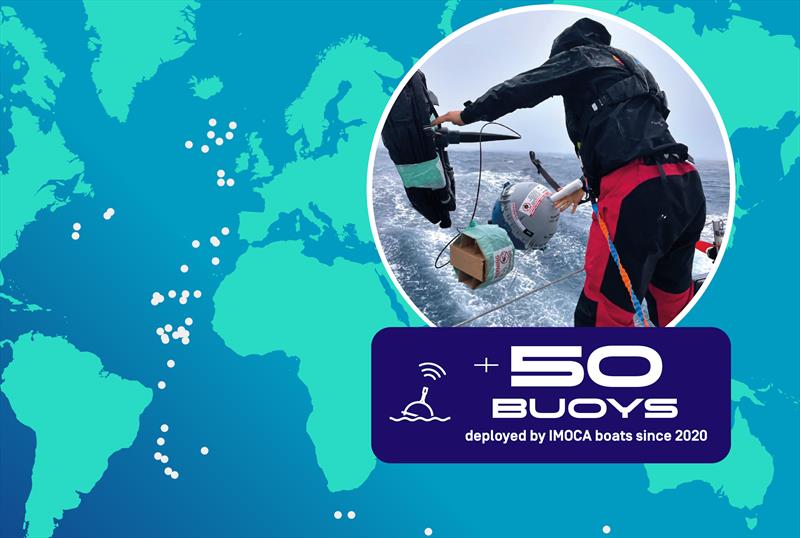
IMOCA skippers continue to deploy weather and climate data-collecting buoys © IMOCA
In common with most of the major IMOCA races in recent years, skippers taking part in the Vendée Arctique, which set sail on Sunday, June,7, will be deploying weather and climate data-collecting buoys near the Arctic Circle.
Of the nine skippers who are taking part in the third edition of the race - which takes them from Les Sables d'Olonne up to the Arctic Circle and back - three will be deploying buoys on behalf of Météo-France, France's national weather service.
They are the Italian-American skipper Francesca Clapcich on board 11th Hour Racing, and the Frenchmen Arnaud Boissières on April Marine-Recherche Co-Partenaire, and Manuel Cousin on board Coup de Pouce.
11th Hour Racing, the IMOCA Class's Sustainability Partner that is committed to the health and resilience of ocean systems. It's an initiative that goes back more than six years, with similar deployments in the Transat Café l'OR last year, the 2024 Vendée Globe and The Ocean Race 2022-23, amongst many other races.
At a time when maintaining robust ocean observation systems is more important than ever, these buoy deployments provide critical real-time data from remote regions, helping scientists improve weather forecasts, monitor climate change, and better understand changes in ocean circulation.
All together IMOCA skippers have released nearly 60 drifting buoys of which 16 are still active, each one making a valuable contribution to weather and climate research and the understanding of global warming and its effects on ocean health.
Each buoy is equipped with a GPS transmitter, a floating anchor, a barometer and a sea surface thermometer. Every hour the buoys transmit data about the ocean surface - including sea temperature - and atmospheric pressure. On average the buoys drift for about two years before washing ashore, though about one-fifth of them survive for more than five years.
Arnaud Boissières deployed a buoy when taking part in the last Vendée Globe and, he says, releasing another one during the Vendée Arctique is the least he can do to help protect the waters on which he races.
"The ocean is our natural playground and we are incredibly fortunate to sail in stunning places, sometimes completely remote and untouched," he said. "So if, in our own way, we can help improve our understanding of this environment in order to better protect it, then it's important to do this."
Boissières says the Vendée Arctique is the perfect race to release buoys in remote parts of the ocean rarely visited by vessels of any kind. And, he says, it's an opportunity to make a contribution to the understanding of how weather, climate and the ocean are changing.
"Carrying a weather buoy on board is a tangible way to contribute to that effort. The data collected is especially valuable during a race such as the Vendée Arctique, which sails through areas with very little maritime traffic and therefore very few observations. Every piece of information gathered helps scientists understand the ocean and how it is evolving," he said.
For this race, the sailors will deploy the buoys as far north as possible, close to the Arctic Circle, whenever weather conditions permit. Their positions can be affected by course changes decided by the Race Director. "Safety remains a top priority," said Sébastien Péré, responsible for data quality from drifting buoys at Météo-France.
Péré says the buoys deployed during the Vendée Arctique will collect information that will be shared in real time with scientific organisations around the world. "The information gathered will advance knowledge of the oceans and the atmosphere, thereby improving oceanographic and meteorological models," he said.
In terms of weather forecasting, Péré says the buoys can detect a deepening low pressure system, for example, that might be poorly anticipated in forecasting models which can then be corrected. "In the short term, all vessels operating in the area benefit from improved weather forecasts, but over the longer term, this data may prove valuable to any region of the world," he said.
Péré says sea temperature measurements help improve the quality of information in areas where satellites are unable to collect data, and the buoys make an important contribution to the understanding of climate change. In particular the ones being released during the Vendée Arctique can help monitor ocean currents in the north Atlantic and detect any signs of them slowing down which could have major impacts on the global climate.
For example, they can provide data about the Atlantic Meridional Overturning Circulation (AMOC), a system of ocean currents that transports warm water from the tropics to the north Atlantic, where water cools and sinks to the deep ocean and then flows back south. Its influence prevents sea ice from forming along the Norwegian coast. Péré says monitoring this current is critical to our understanding of how the ocean is changing. "The AMOC is one component of the global ocean circulation system, the Great Ocean Conveyor belt, which connects all the world's oceans," he said.
Arnaud Boissières has no doubt whatsoever that taking on the extra responsibility of deploying a buoy during the race, will be worth it. "I believe we all have a responsibility to take care of our playground during our time on Earth," he said.
"The planet is beautiful, the ocean is beautiful, and if sailors can make even a small contribution to its preservation while doing what they love, then that's a meaningful initiative. And if my boat can serve a purpose, beyond simply going as fast as possible, then that's even better," Boissières added.
www.imoca.org