
Musto Skiff class training at Brightlingsea Sailing Club
by Andy Whittle 5 Jun 07:45 BST
30-31 May 2026
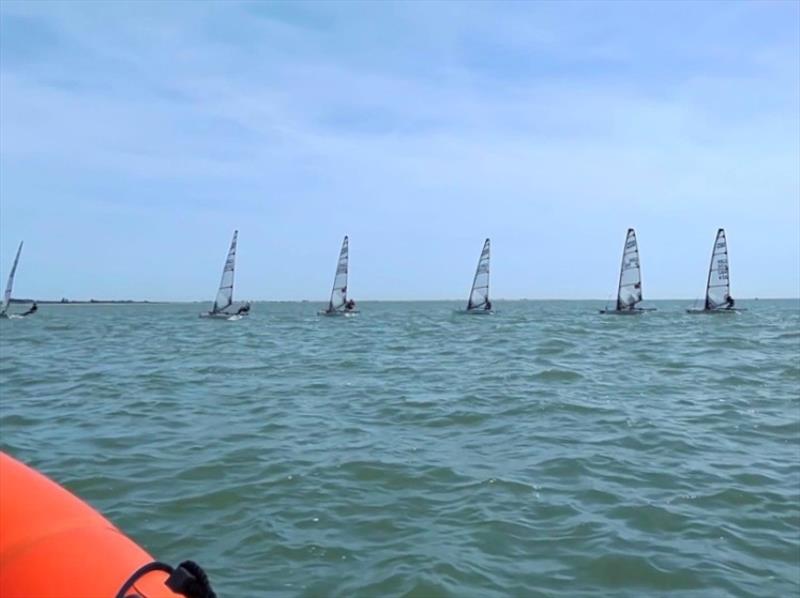
Musto Skiffs Training – Saturday - Going upwind after start © Rebecca Bines
With the World Championship in Carnac now firmly on the horizon, nine Musto Skiff sailors headed to Brightlingsea Sailing Club for a final training weekend before the fleet makes the trip across the Channel.
Kindly hosted by Brightlingsea Sailing Club, the weekend brought together a mix of experienced campaigners and newer faces, creating the ideal environment for knowledge sharing and focused preparation. With seven boats on the water each day, the group was large enough to be good for training while remaining small enough for plenty of individual feedback.
On the water duties/coaching were expertly handled by Rebecca Bines and Maddy Anderson, who gave up their weekend to support the fleet and ensure everyone got the most from the excellent conditions on offer.
Saturday: Boat speed, setup and starts
Brightlingsea delivered a glamour day on Saturday, with sunshine and a building breeze providing near-perfect training conditions. Following an 11:00 briefing, the group agreed to focus on three key areas:
- Boat setup
- Boat speed
- Starting
Before launching, there was a quick check-over of the boats belonging to newcomers Jason and Tom, providing a chance to discuss some of the finer points of Musto Skiff setup and ensuring everyone started from a solid baseline.
The fleet launched around 12:30 and began with a series of upwind and downwind exercises designed to assess setup and relative speed. As always, some useful trends quickly emerged.
One recurring theme was outhaul tension. Several sailors were found to be sailing with either too much or too little tension, with the consensus being that the sail should be flattened sufficiently without introducing a crease along the foot when all controls are fully applied.
The mainsheet bridle also attracted plenty of discussion. Many sailors had their bridles set slightly too long, which was compromising pointing ability upwind. Small adjustments here delivered noticeable improvements.
Perhaps the most valuable takeaway from the speed sessions was the importance of finding a stable groove. The quickest boats were consistently the ones being sailed with minimal correction - flat, balanced and requiring only small inputs on the mainsheet and rudder.
Once a cycle of over-correction begins, it becomes surprisingly difficult to recover, often resulting in a slower and less predictable mode.
Attention then shifted to starting practice, with what felt like an endless sequence of rolling starts followed by short upwind-downwind races. As the afternoon progressed, the building tide added an extra layer of complexity, challenging sailors to judge both position and timing accurately.
The intensity of the training perhaps showed through at times, with enthusiasm occasionally getting the better of discipline and a healthy number of boats finding themselves over the line. Fortunately, that is exactly what training weekends are for!
The session eventually drew to a close as the increasing breeze and growing capsize count began to suggest that enough lessons had been learned for one day....
Sunday: Championship starting practice
Sunday morning arrived a little greyer, but Brightlingsea once again delivered excellent sailing conditions. There was more breeze than Saturday, although large shifts and occasional holes kept everyone on their toes throughout the day.
Aches and pains from the previous day's four-hour session were evident during the morning briefing at 10:45, perhaps providing the clearest indication that the training had been productive.
The fleet began with a 30-minute free-sailing and tuning session, allowing sailors to settle in and reinforce the lessons from Saturday before moving on to the day's primary objective: championship-style starts.
The format centred around rolling races with three-minute sequences, although the coaches also used "secret starts" up to 30 seconds either side of the start time to keep the sailors on their toes.
The focus was on developing the skills required to execute starts in a championship fleet:
- Being established in the start box with 90-120 seconds to go
- Maintaining flow over the foils at all times
- Timing the final acceleration onto the line
Sailors experimented with batten orientation to influence bow behaviour, with backed battens encouraging the bow to bear away while unbacked battens naturally promoted heading up. The importance of maintaining some flow over the foils was repeatedly reinforced, as even small losses in flow quickly led to loss of control.
The group were aiming to be one to one-and-a-half boat lengths below the line with a gap to leeward to accelerate into at the go.
As always, the biggest gains came from getting the trigger right. A well-executed final acceleration not only secures a good start but often dictates the outcome of the first beat.
Key Takeaways
Several themes emerged over the course of the weekend:
- Four hours of focused Musto Skiff training is physically demanding.
- Maintaining flow over the foils remains one of the fundamental skills in the boat. Once flow is lost, the consequences quickly cascade into leeway, loss of control, rounding up and, if it really gets out of hand, capsize.
- Small setup changes can deliver surprisingly significant performance gains.
- Starting remains one of the easiest areas to make large improvements in race results.
- Brennan's start-line triggering is becoming suspiciously good. Carnac competitors have been warned!
A huge thank you to Brightlingsea Sailing Club for hosting the fleet and providing such a fantastic venue for the weekend.
Special thanks also go to Rebecca Bines and Maddy Anderson for generously giving up their time to coach, organise, and support the sailors throughout both days.
With Carnac now just around the corner, the fleet leaves Brightlingsea a little fitter (possibly), a little faster (hopefully) but, ultimately, a bit better prepared for the Worlds.