
Kieler Woche - New formats aim to secure sailing's Olympic future
by Kieler Woche 31 May 15:48 BST
20-28 June 2026
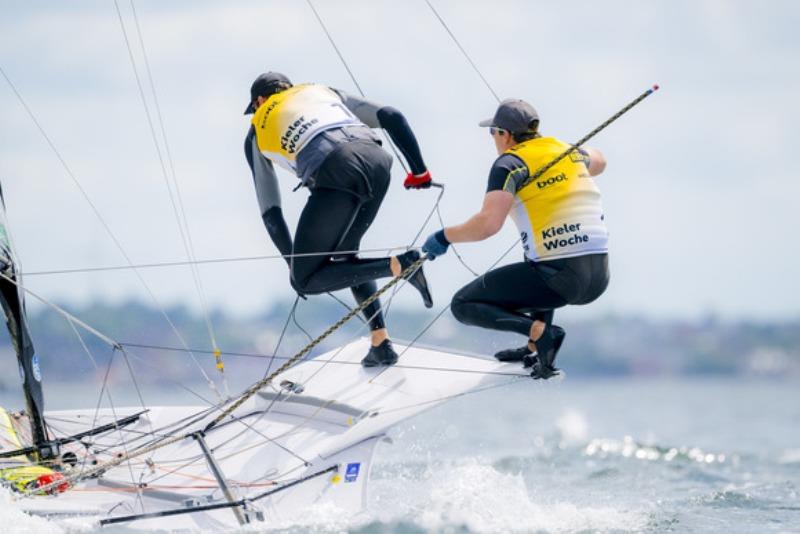
More suspense right up to the end: The team wearing the yellow jerseys as the leader following the opening series can't win Kieler Woche anymore with the final to spare. The outcome will now be decided over two medal races instead of just one © Sascha Klahn
Reliable competition schedules, maximum medal contenders on final day, and compelling understandable races — this is how the sport of sailing aims to secure its Olympic future even after the 2028 Games in Los Angeles, USA.
That is why World Sailing, the global governing body for the sport, has decided on several format changes that will already be evident at the 2026 Sailing Grand Slam - comprising the six most important regattas - and thus also at Kieler Woche. The highlight of the six Olympic disciplines, which begin on June 20 at 1 pm, will be the medal races on Wednesday (June 24).
This year, sailing fans can look forward to two medal races in the Olympic classes instead of previously just one. These will no longer count double but only single-point races. Each medal race is expected to last only about a quarter of an hour; the specified time window is 12 to 17 minutes. KielerWoche.TV will broadcast the decisive races live via stream and on the LED screen at the Sailing Arena in the Schilksee Olympic Center.
Another new feature is the points scoring before the finals of the five dinghy classes and the Nacra 17 catamarans. As before, the top ten from the preliminary races will advance to the medal race. However, the outcome of the medal race is now completely open. This is because no finalist can gain more than a nine-point gap over their closest pursuer, regardless of how large their lead was beforehand. Furthermore, the maximum deficit behind 3rd place and ranks four to ten is reduced to 18 points. This means that even someone in tenth place could theoretically still sail to "bronze." As a result, no one has a podium spot guaranteed before the final day.
The hope behind the point compression following the opening series is that, by the end of any Olympic regatta, ten different nations will still have a chance at medals, thereby enhancing that their broadcasters' rights holders will air the final races. For program planners, in turn, reliable start (and finish) times are essential. Frequent mass false starts are counterproductive, leading to general recalls and delays lasting several minutes.
The 49er class has taken a leading role in eliminating this problem. It relies on electronic start control via GPS. The starting line is drawn virtually via satellite between the start boat and the "start buoy" (pin end, usually a rubber dinghy). This now works with centimeter precision. All participating boats also have GPS trackers from the company Vakaros on board. In the event of an early start, the display flashes red and signals to the competitors who must turn around and restart. The race committee no longer misses any hidden OCS. It can allow the race to continue. Stricter starting rules are unnecessary.
Other boat classes are likely to follow suit soon to meet the demands of their media coverage. Regardless of its versatility and long tradition, the sport of sailing must demonstrate broad spectator interest globally. Kieler Woche is pursuing this goal with great enthusiasm, not least against the backdrop of Kiel's bid to host the Olympic sailing competitions in 2036, 2040, or 2044.
More information: sailing.kieler-woche.de