
An interview with Jesse Wiegel about the 2026 Race to Alaska
by David Schmidt 9 Jun 16:00 BST
June 9, 2026
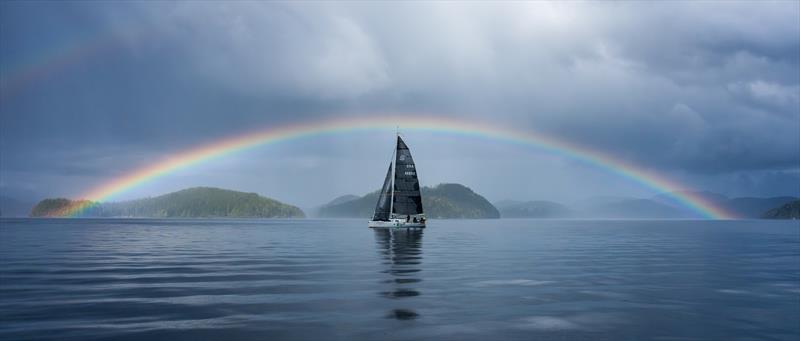
Team StrangerDanger Rainbow - 8th Race to Alaska © Garret Weintrob
Some sailboat races test starting-line acumen, boathandling skills, and tactics and strategy, while others are aimed at testing each teams' aptitude for adventure. The Race to Alaska (June14; R2AK), a 750-mile sail- and human-powered race that stretches from Port Townsend, Washington, to Ketchikan, Alaska, falls in the latter category. That's not to say that strategy and tactics aren't critical components of the R2AK (they are), but rather that here, the ability to brave cold water, near-wilderness coastlines, and potentially boat-breaking conditions—all without the back-up assurance of auxiliary power—play far bigger roles in determining the race's outcome than the ability to lee bow one's competitors.
The R2AK began in 2015 as an annual affair that started with a 40-mile unscored leg (dubbed "The Proving Ground") from Port Townsend across the Strait of Juan de Fuca to Victoria, on Vancouver Island's southern tip. Teams had a couple of days to recuperate, before the 710-mile leg from Victoria to Ketchikan, via the Inside Passage that separates Vancouver Island from mainland British Columbia.
The rules were simple: Teams and competitors could use any vessel they like (read: SUPs to carbon-fiber multihulls), so long as there are no engines or motors onboard, and support vehicles aren't allowed. Competitors are free to use publicly available outside resources, but only if they are available to the entire fleet.
The first team to Ketchikan received $10,000 in cash nailed to a log; the second-place team received a set of R2AK-branded steak knives.
The offbeat race proved popular, and the years rolled by without many format changes, until the 2022 edition, when teams were allowed to either take the Inside Passage or brave Vancouver Island's west coast. This rule persisted through the 2023 edition, before the race organizers reinstated the mandatory waypoint in Seymour Narrows, thus requiring all teams to take the Inside Passage.
The next big change arrived in 2024, when the race organizers announced that the R2AK would be contested biennially.
I checked in with Jesse Wiegel, the R2AK Race Boss, via email, to learn more about this now-classic Pacific Northwest adventure race.
It's been a pregnant minute since the last R2AK. Can you please bring us up to speed on any changes or evolutions to the race's format since it was last contested?
Oh well there is that one bit where there's half as much R2AK to go around. We took an online class about supply and demand and decided to tinker with the formula. So now R2AK is only every-other year.
That gave us the space to fire up another race—The WA360 (that's pronounced "Washington - Three - Sixty"). That happens in the alternate years and sticks closer to home, doesn't require folks to remove their engines, and is about 48-percent as dangerous, takes half the time, all while being 82-percent as fun and exciting.
What do you see as the biggest benefits to turning the race from an annual contest into a biennial affair? Also, are you seeing these benefits reflected in the 2026 entry list?
Change is hard and always bad. At least that's what a portion of 2025 R2AK hopefuls would say. After a short flurry of hate mail—"I've already spent $20,000 on this race!"—the tone quickly shifted and it turned out that WA360 was pretty cool in its own right.
And as for benefits, we have a whole big board with pins and red yarn up in the office, and the equation seems to be saying that withholding R2AK for a year whetted all involved appetites: we've had the largest application season in Race to Alaska history, with 80 teams applying, with another 35 on a waitlist. That's more than double what we've ever seen before.
You've spent years around this race and interviewing teams for the R2AK podcast. Generally speaking, what are the attributes that tend to differentiate the teams that finish from those who are not so fortunate? And building on this, what pre-race attributes tend to suggest teams that are contending for the cash versus those who are fighting to finish?
Teams contending for the $10,000 generally spend more than $10,000 to get it. Everybody else shows up with wildly different programs, with boats in wildly different states.
The folks who are seeking a spiritual awakening often apply having just discovered an old moldy boat under a tarp somewhere and see it as a service to the world to bring it back to life.
Those seeking to overcome something difficult in their life often build a boat from scratch, in an attempt to wrest control over their experience from the universe.
Teams in it purely for fun spend more time figuring out beer storage than they do route planning.
Let's say that a team hired you to consult them on their pre-race preparations, and they had enough wherewithal to either show up in Port Townsend with fresh sails and an OK manual-propulsion system, or a really well thought-out and bombproof-engineered manual-propulsion system and OK sails. Which path would you send them down and why?
At the risk of sounding like my role is to give advice: Many teams have finished under human power only; no team has ever finished under sail alone.
We've now seen everything from catamarans to trimarans to a Lyman-Morse 40 win via the Inside Passage. If you were personally selecting a whip for this course, what would you choose?
A hot-tub boat.
Do you think the R2AK will ever get rid of the Seymour Narrows waypoint and allow teams to sail outside of Vancouver Island again? I know there are grumbles about the outside leg changing the nature of the race from a small-boat adventure to a big-boat race, but doesn't the mandatory stop in Victoria's tight harbor—and the law against sailing in said harbor—naturally restrict the LOA and beam measurements of competing boats?
We're more likely to put up a Sidebet for the first boat over 60', and let the racers figure out how to get in and out of Victoria. (Anybody want to fund that one?)
Given the challenge/complexity of getting boats back to the Lower 48 after the race, have the race organizers ever considered a Delivery to Washington (D2WA) race or rally, just to increase the safety factor? Having personally helped deliver a boat back from the 2022 race, via Vancouver's West Coast, I know that there aren't too many AIS targets or running lights out there, should a team get into trouble.
I'll put that in my filing cabinet of "Suggestions that Race High Command Do More Things In Order To Make Things Easier/More Straightforward For The Racers".
A great strength of R2AK is that we believe in the racers to figure out their own problems, rather than curate solutions.
There's been some pretty stiff inflation since 2015, when the R2AK first announced that the race's first place winner would receive $10,000. According to the U.S. Bureau of Statistics, $10K in 2015 had the same buying power as $13,925 (rounded to the nearest $5) in 2026. Is there talk of increasing the prize pot? And if so, shouldn't the steak knives also come with a set of forks, or at least a couple of soup spoons?
As I mentioned, the winning teams will likely use the bulk of the $10,000 on their next coat of bottom paint. We're not out here changing lives with the cash pot, and yet people keep showing up. Makes you think maybe it's not about the cash, eh?
Is there anything else about this year's R2AK that you'd like to tell us about, for the record?
Oh, I think everything is on the record already.