
Noble Marine Musto Skiff Training at Weymouth & Portland National Sailing Academy
by David Annan 19 May 14:36 BST
8 May 2026
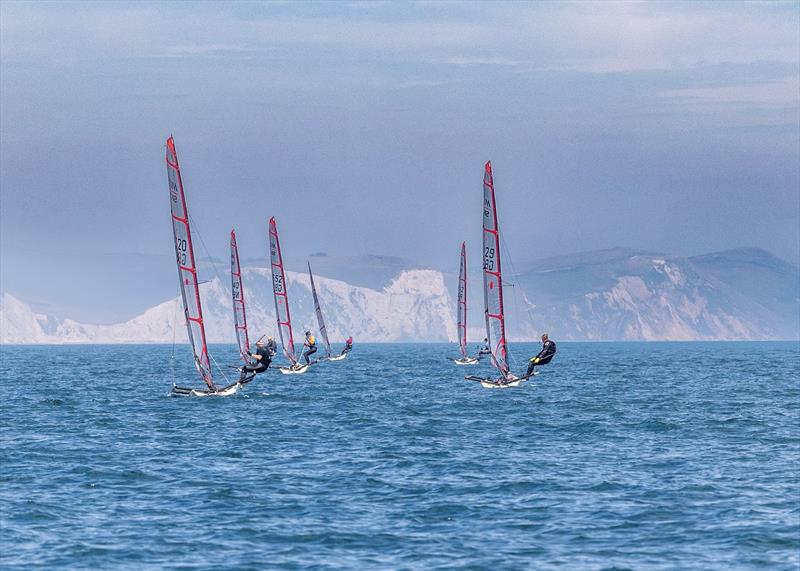
Musto Skiffs at WPNSA © Michael Oliver
The annual pilgrimage to Portland Harbour for the "Weymouth Three-Dayer" has become one of the top fixtures in the Musto Skiff calendar. Comprising a Friday of organised class coaching, generously supported by Noble Marine Insurance, followed by two days of racing hosted by WPNSA to test everyone's skills.
This year, fifteen sailors arrived at WPNSA for the training day. The coaching was led by Adam Bowers, a top racing coach who has worked with the class for several years and brings a great mix of racing knowledge and humour to the session. The skill level in the group ranged from newcomers to the class right up to the reigning world #1 and #2, and it's fair to say there was something for everyone to learn and practice.
Now, we all love to obsess with the finer points of rig set-up, batten tension and how much daggerboard we need in different conditions. But reality is that most sailors have more to gain by developing their racing skills rather than worrying about whether their lowers are on 9 or 10 (their trusty Loos gauge). With this in mind, and the 2026 World Championships just weeks away, the focus of the day was on two key racing skills:
- Starting - because it sets up your race.
- Leeward mark rounding - because they set-up the next upwind leg.
Conditions for the training were perfect - the sun was out and there was enough wind for everyone to be trapezing off the racks but not enough to make the boat handling too difficult (although there was the odd swim!). There were two sessions on the water with briefings and de-briefings in between to review video footage creating plenty of discussion and a healthy level of banter.
The primary exercise was rolling starts where the fleet could practice different starting techniques, sailing for about 40 seconds after the start to see how it panned out before returning for the next one. Every third start there was a short two lap race to work on the leeward mark rounding.
Starting
The key points that come from the starting exercise where:
- Remember the objective - to have your boat accelerated (not accelerating!) on the 'B' for bang, and to position your boat so that thirty seconds after the start you are in clear wind and water and heading in your strategic direction.
- Slow speed boat handling is critical. This is something most of us do not practice enough and it is so easy to do every time we sail, just using a buoy or any object that is fixed to the seabed. Your slow speed boat handling gives you the tools to create and defend the space you need to achieve the objective.
- Use training exercises to practice different types of start - pin end, committee boat end, mid-line, biased lines etc.
- Pre-set the cunningham but leave the vang off, which helps prevent the boat stalling. Pull the vang on with between 15 and 10 seconds to go and start to accelerate into the gap you have (hopefully) created to leeward of you.
Leeward Mark Roundings
Many boat lengths can be gained and lost at mark roundings. This is another skill that is really easy to practice, but we rarely do!
The discussion about mark roundings also highlighted the importance of being in clean water. We all understand having clear wind to get the best performance from your sails, but having your foils in clear water is just as important. Sailing in the disturbed water of the boat in front of you reduces the efficiency of the foils and can result in the boat slipping sideways making it harder for you to establish and hold a lane.
The key pointers for leeward mark roundings:
- Practice it before the race, so you know how much room you need to drop the spinnaker and get the boat ready for the rounding in the conditions of the day. When its windy you will need much more space compared to a light wind day.
- Enter wide, exit close. You want to be passing the mark as close as possible and already on your close-hauled course.
- Practice the infamous "Argentinean Rounding". This involves a little luff as you pass the mark with the aim of gaining just half a boat width to windward. This can get your foils out of the dirty water of the boat in front of you, which can really help you get into a good lane out of the mark. It also makes it really difficult for the boat behind you by putting them in your dirty air and water.
- There are occasions when slowing down to create some space from another boat can create the opportunity to get inside and overtake.
The debrief of the video footage at the end of the day conclusively showed the improvements made by everyone. The first start of the day was a bit chaotic, whereas the final start looked like an Olympic medal race. The power of practice was obvious!
The day ended with fish and chips on Chesil Beach and a couple of pints at the Cove House Inn enjoying the sunset.
Huge thanks go to Adam for his excellent coaching, WPNSA for the use of their facilities, and to class sponsor Noble Marine Insurance for their generous support of class training. Another training day is being planned for the day before the UK National Championships in September.
In the meantime, our next ACO Musto Skiff World Championships hosted by Yacht Club de Carnac is just around the corner, where we will all be there putting our skills to the test.