
America's Cup Recon Diary: April 1 - Another six hour session in the Paddock
by Richard Gladwell, Sail-World NZ 2 Apr 10:22 BST
28 March 2026
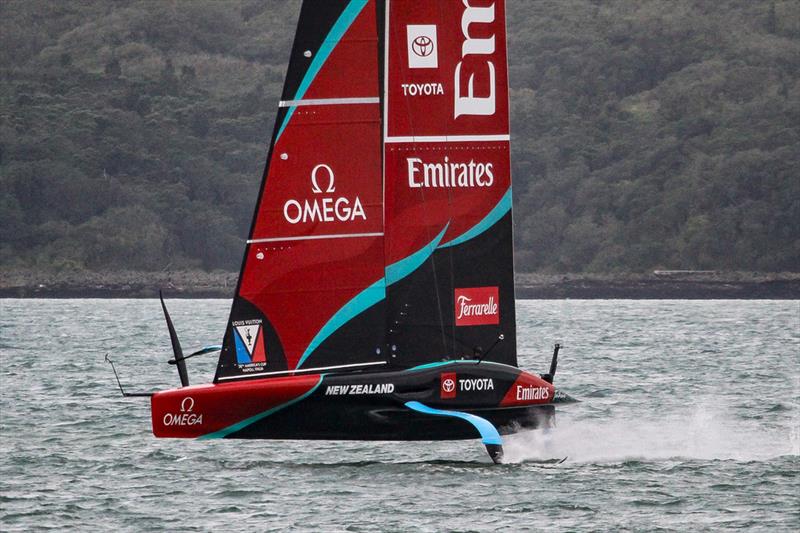
Emirates Team New Zealand - AC75, Day 9 - April 1, 2026 © Richard Gladwell / Sail-World.com/nz
April 1 is an auspicious date in the annals of the America's Cup.
It's memorable for the bombshells as well as the far-fetched stories, which catch a few.
Those who have been around for the past decade or so will remember that it was on April 1, 2015, when the decision was made to rip an America's Cup Qualifier away from Auckland, and by a 3-2 majority decision, to switch the class from the AC62, which had been announced 18months earlier, to the smaller AC50. Luna Rossa announced their decision to pull out a few days later and threw their lot in with the struggling Kiwis. Team New Zealand took their case to the Arbitration Panel and won a damages claim.
A decade later, in 2025, April 1 was the day the New Zealand Government announced that it was not prepared to financially invest in the 2027 America's Cup to the level required for an Auckland-hosted event. And, to the local dismay, the Cup was again set to be hosted offshore.
Today, on April 1, the America's Cup Partnership, not the Defender, stated that Late Entries had been received by the extended deadline. The fact that the announcement was made by ACP and not the Defender, Royal New Zealand Yacht Squadron, confirmed that control of the America's Cup had indeed shifted to ACP.
There were no jolly japes today on the Hauraki Gulf, where Emirates Team New Zealand clocked up another long day on the Hauraki Gulf, in a 12-18kt onshore breeze.
We’re not entirely sure whether it is Day 8 or Day 9 for the Kiwis, but they're certainly off to a good start, given they launched their repurposed AC75 just two and a half weeks ago on March 13.
In that time, with the lowest sailing day quota of any of the five entered teams, the Kiwis have only had one short day - when their mainsheet control system blew up, the late afternoon of Day 6, March 24.
After a few days to get the new crew up to speed, the team has settled into a familiar routine, which revolves around doing windward-leeward legs and cross-wind reaching on the familiar area known as the Back Paddock.
A lot of the time, the decision as to sailing area is made for them, with winds either being too fresh or with a moderate seaway. The Paddock is virtually landlocked, providing near-ideal foiling conditions and likely some good comparative test data.
It is likely that the sessions are being watched live back at the team base, in Jellicoe Harbour, by the design and performance analysis team, who can see the data and hear the on-board audio and video, and talk about what is being seen by other members of the team, without being bounced around in the Chase boat.
Although we are watching the testing from 5nm distant, at a nice elevation with powerful gyro-stabilised binoculars, and can't pick up the nuances of sail-shape, you certainly can see any wipeouts of which there are very few (in fact, I can't recall seeing one). But it is very easy to see when the boat slows or stops sailing, and the pace.
From the Recon Unit reports, it appears there's a stop for a battery change every two hours.
One big advantage of batteries over grinders/cyclors is that you don't wear out a grinding team, and six-hour sessions are easily achieved.
Earlier this month, the team were laying marks and doing exercises designed to coordinate the crew, but recent sessions seem to involve a lot more free sailing.
The remarkable aspect of the training so far has been the dedication to giving new co-driver Seb Menzies, the port helm each sailing day, according to the Recon Unit Reports. If there are switches being made, with Chris Draper (GBR) coming on board, then Draper switches out with Nathan Outteridge on the starboard side.
From where they started and where they finished up, our guess is that they had a warm-up sail beating to windward in a moderate seaway, before cracking off and sailing to The Paddock.
Today was a complete change from Tuesday, when Team NZ didn't sail, with a complete change in direction and a halving of windstrength.
It was a completely overcast day, quite bright and glary at times, but without a peep of blue sky.
This day - Day 9 marked the end of this block of test sailing, and the team will resume on April 20.
Emirates Team NZ Training Report - Recon Unit
Summary:
Wind against tide provided a challenging warm-up for Emirates Team NZ. Bow up to keep the rudder well in the water and a flat or slightly leeward heel to the platform were key mode settings for wavey and windy conditions off Auckland’s North Shore (2021 AC Course A location). This was a contrast to the lighter, flatter and softening conditions for the long afternoon session in the "Back Paddock" (2021 AC Course E location).
Key points
Wave mode, bow up and flat or slight leeward heel
Larger Jibs and flatter mainsail balance
Jib car position critical to speed build
Underpowered out of manoeuvres on mainsail setup
Conditions: Morning - Wind 15-20kts, easterly direction. Sea state - medium to large. Ebb tide (against the wind)
Afternoon - Wind 8-15kts, easterly direction. Sea state - flat to small chop. Flood tide (not particularly relevant except in spots of the Paddock.
Roll-out: The yacht rolled out at 1010hrs.
Crew: Nathan Outteridge, Andy Maloney, Jo Aleh, Seb Menzies, Josh Armit
Session Timeline:
12:23hrs Hoisting the J5-1 and M1-0 behind Rangitoto Island and heading out to sail off the north of Rangitoto light in a 16-20knt Easterly with a medium to large sea state.
Two downwind runs were made with only one gybe made. The team then sailed towards the "Back Paddock", changing to the J4-2 between Waiheke Island and Motuihe Island where the wind was significantly lighter.
Long upwind and downwind runs with five or six tacks and gybes made each leg. Lighter wind technique of slight leeward heel roll-tack and roll down into the gybe with a later board.
1400hrs: Battery change and an issue within the port drivers pod. The support team spent 20 min working on this area.
1437hrs: The breeze was 8-12 kts and jib was changed to J3-2. Josh Armit was replaced by Jake Pye as port trim.
The trim looked like they were unable to power up the mainsail enough in the lulls or speed builds, and also the jib slot was very narrow, which affected both the speed builds and led to several big catches out of manoeuvres.
1530hrs: a battery swap and some pre-start practice, mostly favouring a higher lead/push back angle.
1630hrs: Another batter swap followed by some pre-start manoeuvres, which featured one good rudder ventilation from a sharp turn up with too much mainsail load.
1715hrs: Battery swap before reaching and running back to North Head to finish the session.
Additional Images: