
America's Cup Recon Diary: March 27 - Kiwis chase the breeze
by Richard Gladwell, Sail-World NZ 27 Mar 13:25 GMT
28 March 2026
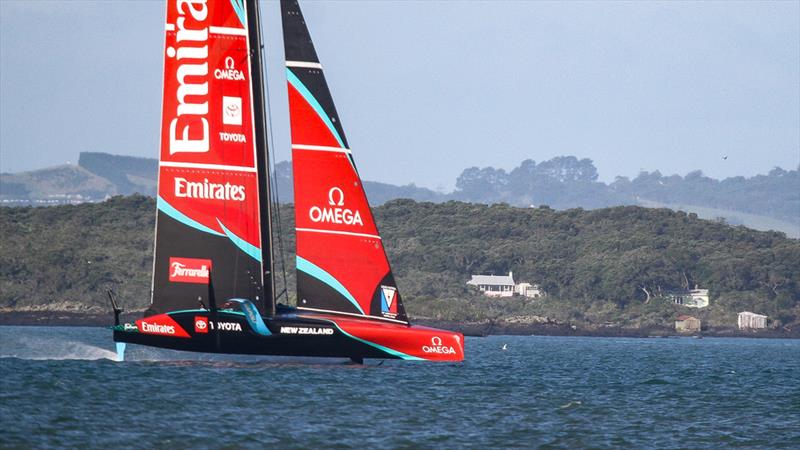
Emirates Team New Zealand - AC75, Day 7 - March 27, 2026 © Richard Gladwell / Sail-World.com/nz
After two days of fresh onshore winds and gales, Friday dawned with blue skies, little wind, and a remaining seastate. The Kiwis docked out at noon for what was to be a chase around the Hauraki Gulf in search of wind, but ironically, they found the best breeze close to home.
We caught up with them sailing in the Rangitoto Channel in what felt like a bottom-end northerly breeze - more than enough to self-launch, their problem was with dead spots. The ones we could see were caused by the wind splitting around Rangitoto Island, and between the Channel and their favourite training ground, the Paddock - also sheltered to some extent by Waiheke Island, there was a "No-Man's Land" of calm water.
The Kiwis looked quite good foiling down the edge of Rangitoto, but soon ran out of gas as they got into the lee of the island while trying to sail across to the Paddock.
While we have seen the Kiwis sail almost flawlessly for the past six sessions, it was reassuring to see they were still human when they hit the soft pressure in the lee of Rangitoto and came off their foils.
They had to be towed across the windless hole to reach the Motuihe Channel, where there was a more unobstructed breeze, allowing them to stretch out and sail longer legs instead of the short stints in the Channel breeze. They did multiple windward-leeward legs starting from alongside Browns Island into the northwestern end of WW1 Prisoner of War camp on Motuihe Island, before returning to the Rangitoto Channel (without a tow), and finished the session around 6.00pm with another windward-leeward in the Rangitoto Channel.
Training Report - Recon Unit assigned to Emirates Team NZ
Light winds training session, manoeuvres, speed builds & take-offs.
Notes:
- Initial Crew setup: Jake (port trim), Seb (helm), Andy and Nathan (starboard), Jo onboard support.
- Ongoing work on cant/auto functions (cunningham + automation systems).
- Light-air manoeuvres highlighted importance of slower turn rates and timing of board deployment.
- Delayed board drop in gybe
- Rudder ventilation/cavitation observed during aggressive turns.
Session Timeline:
(Times assumed to be in UTC they docked out at 1146hrs or 11.46am NZDT)
2254hrs Boat setup with Rig No.3.
2306hrs Crew configuration confirmed. Initial system checks and automation (cant/auto functions) under review.
0012hrs Sailing commenced with J2-2 configuration. Early testing included gybe headings from 252° to 165°
0055hrs Building phase observed with target speed around mid-teens. Boat speeds 22–28kts
0105hrs Initial manoeuvres:
- Slow turns required.
- Slight heel applied into turns.
0109hrs–0125hrs Repeated rudder loss events during turns:
- Full rudder loss reported twice.
- Adjustments made to slower turn rates eliminated the issue.
0132hrs Bottom-end speed through tacks approximately 14kts.
0133hrs Gybe performance:
Best results achieved with slow, controlled turns.
0134hrs Battery change.
0159hrs Course angles through 310° to 035°.
0208hrs Light-air testing:
Double tacks and short build phases emphasised.
0255hrs “Slow pop” noted—indicating delayed or soft foil takeoff.
0310hrs Battery change.
0354hr Speed range 28–33kts in 6-8kts of breeze (efficient low-wind foiling phase).
0401hrs Upwind sailing from 345° to 090°.
0402hrs Tow initiated to Motuihe Channel area.
0428hrs Breeze stabilized at 9–11kts. Transition to J3 configuration.
0452hrs Tack/ bear-away combinations practiced.
0504hrs Shift to longer legs.
0505hrs Mixed mode sailing: upwind/downwind and reaching.
0506hrs Final battery change. Session concluded shortly after.
Key Takeaways
- Manoeuvre control: Slower turns reduce rudder ventilation and improve consistency.
- Board timing: late, deliberate board drop in light air gybes.
- Trim & setup: Jib car and slot tuning crucial in sub-10kt conditions.
- Reliability: Frequent battery changes