
Qualified. Determined. Passionate. Focussed.
by John Curnow, Sail-World.com AUS Editor 8 Mar 21:00 GMT
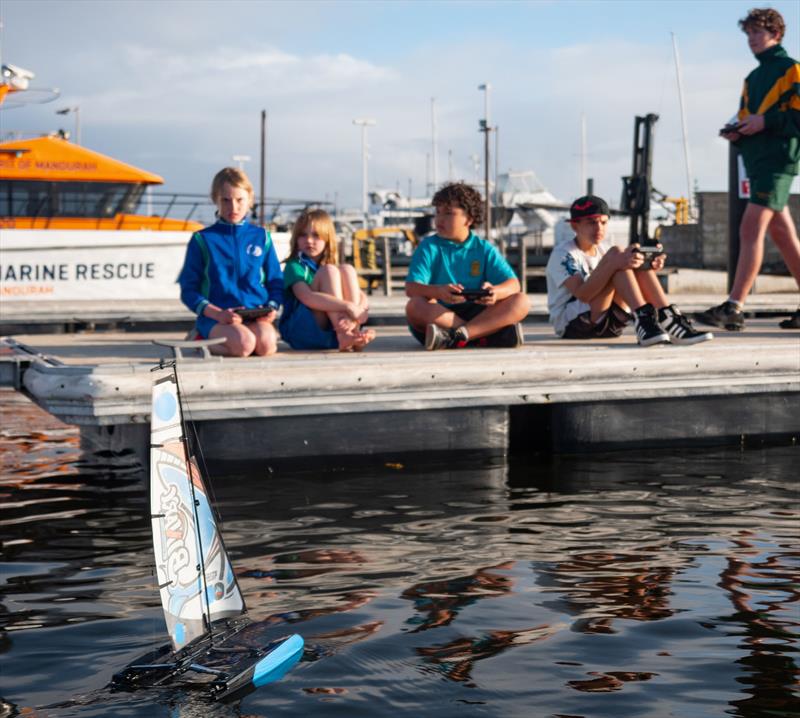
Remote control boats at Mandurah © Australian Sailing
Little wonder that it is all working out, then. And it is only the beginning! Take a former Australian Sailing Team member who has her Barrenjoey Pin, she also happens to be both an Environmental Scientist and certified teacher with over 10 years of experience, as well as being a mum, and voila, you have one of the most exciting opportunities to grow sailing.
We could well stop right there, and if you take nothing else from this Editorial, then the paragraph above is both the elevator pitch for what Jessica Lundh (née Eastwell) has created, as well as the fanfare, spotlight, and billboard for SailLAB. Created in Western Australia, and now under the auspices of Australian Sailing, it is the STEM (Science, Technology, Engineering and Maths) education program for Primary and Secondary students across the land.
It is not just exciting, it is also quite inspirational for the way it incorporates real world and hands on sailing experience into any curricula, as well as being free, and provides all the support that teachers need to take it on. It is in this way that Lundh's genius has had parenthesis added to bookend her name.
To create such a way for the largest ever exposure to our beloved sport is just as big a paradigm as when the late Andrew Plympton AM and Peter Conde (et al.) set up what we now know as the AST. If it is even half as successful as that, then SailLAB will earn a Gold Star on every page of its report card. To have both ends of the spectrum so ably catered for is quite an emotional thought, and there is every chance SailLAB will require everyone to wear welder's masks, for it should be shining just as brightly as metal being fused together.
Origins
Kate Wearn and the WA Australian Sailing Office must be commended for tapping our science teacher on the shoulder when they were preparing the grant application, for otherwise we would not have this program to teach students about sailing. "When Kate called me to say it had been successful, the very next thing she said was, 'When can you start?' It was a really great opportunity. I could see so many links with the Australian curriculum in science and technologies to be able to implement the science of sailing," said Lundh.
"Being able to link these two together and give students real-world examples was exciting. For example, in year seven when you're trying to teach the physics of levers and pulleys, it's so great to be able to show where that applies on a sailing yacht, and the different forces and mechanical advantage that this can create."
"I'd already had all these ideas over the last 10 years that I was dying to sort of put on paper. It was actually really hard to scale it back to just the original elements. There so many ideas and even now, we're writing another 10 modules for secondary school, which is terrific. I feel like we can round out the whole program, and make it over 100 hours of teaching time, so that teachers and schools can choose the modules for their own adventure that suits their school."
Actualities
"At the moment, there are six modules available for Primary Schools, and we will build this out to 10. There are currently 10 modules being taught this year in Secondary Schools, and by next year, there'll be 20 modules."
"Not only is SailLAB free, what we are doing is making it easy for schools to pick this up and fit it into their existing curriculum, which is a legal requirement. It is different from State to State, and NSW do not closely follow the Australian curriculum. They have a new curriculum, especially in technology, that's being implemented this year and next year. As a result, I'm actually aligning the SailLAB modules to create sort of a custom program or unit of work for Year Seven and Eight technologies for New South Wales. The Education Department and independent schools are assisting with making sure the modules are ready to go."
"There is a similar thing in WA, where there is a program called Marine and Maritime Science for Year 11 and 12 students. We have adapted items to fit into that, as well. In this way, even the materials that have been created already can be tailored to suit. This flexibility affords each teacher the chance to see where it fits for them and their students. It can cover a whole year, or work into a single or multiple terms," added Lundh.
Best of all, the classroom activities then lead into going to a Discover Sailing Centre for hands-on activities, like sailing remote control yachts. Every module has a hands-on component to go with the enquiry-based teaching. These could be hull design, sail shape and size, measuring wind, fluid dynamics, material selection, and aforementioned physics, like hiking, levers and load.
The final piece of the puzzle is where students come down to their local club for an experience day, which is more than taste, as there are several exercises to do in rotation, and also finally go for a sail to experience it all for real. Lundh has even organised for schools and clubs to purchase the remote-control yachts with an educational discount applied.
This is a great way to get communities to understand that sailing clubs are there, and those with Discover Sailing Centres utilise their rooms, lawns, and ponds from 9 to 2.30, rather than just some short and less memorable session.
The Breakdown
Six modules for Primary School (25 hours of lessons)
- Teaching Program - overview of all modules linked to Aus Curriculum
- Teacher Guide, with individual lesson plans
- Teaching PowerPoint (with embedded videos)
- Student Activity Sheets
- Answer Keys
- Certificate of completion
10 Modules for Secondary School (50 hours of lessons)
- Teaching Program - overview of all modules linked to Aus Curriculum (or relevant State-based curriculum)
- Teacher Guide - lesson plan, misconceptions, equipment lists
- Teaching PowerPoint
- Student Workbook
- Workbook Answer Key
- Module assessments
- Certificate of completion
Second set of 10 modules around SailGP Technology - ready for implementation second half of 2026 and will have the same resource structure as the current 10 modules and include a lot about material science and their uses/advantages/issues.
Website - one stop shop - all resources and videos available. Currently has:
- 16 module introductory videos
- Three promotional videos (including one about the SailLAB experience day, teacher testimonials)
- Three educational videos - custom made for SailLAB
NB - Each module for primary and secondary gets introduced by either an Olympic athlete, an America's Cup athlete, or a SailGP athlete or coach. One of these is Luke Parkinson on a stationary bike to show what Cyclors do, and then he sets a sprint mark for students to go and see if they can better it.
As we have seen, Lundh is also very keen to share the love, highlighting Kate Henderson (née Lathouras), "Who's a long-time friend and top sailor who recently became a teacher (currently on maternity leave). She's been a great sounding board throughout the project and has also helped write the module content (as sub-consultant). The depth and scale of this program would not have been possible without the support of Kate."
Achievements to date
2025 was the pilot years and was available in WA only. There were six Primary Schools involved with 248 students, and six 6 Secondary Schools with 286 students, so that's 534 young souls that experienced sailing. Yeehaaaaa!
Thus far in 2026, 109 teachers have registered their interest from 85 schools across the entire country, including very remote WA and NT locations. Brilliant. Now would be a good time to point out that one of greatest ever sailors came from Bendigo where they sail on a lake, and it is a good couple of hours drive from there to get to real water. Hello Glenn Ashby!
"We have primary schools out in the Western Australian Wheatbelt doing the program and they're using their community swimming pool as a venue for their radio-controlled sailing. So it's so great that farming communities are able to learn to sail because these students have never even thought about sailing before, and all they want to do now is actually go and do a holiday learn to sail course, and their closest sailing club which might be Esperance, or something like that," noted Lundh.
"There are no reasons not to do this because everything is provided for the teacher. You've got student workbooks, answer keys, teaching PowerPoints, presentations, and videos created for the program by Olympic athletes to inspire the next generation. Matt Wearn OAM has done quite a few videos for us, as too Grae Morris, literally just straight off the plane from Paris with his Silver Medal."
"Part of what SailLAB is all about is the new technology behind the sport. So looking at foiling with wing, board and kite, as well as OTB. Bringing this science into the classroom really get students engaged. Being able to have role models like Grae, who's not that long out of high school himself, on video talking about the speeds that he goes and explaining the shape of the foils and that sort of thing is just such an opportunity that we have in Australian Sailing."
"That's what this program does. It links the GROW team with the WIN team and the support team, which is looking after all the clubs, and has a huge impact on the development of the sport and the numbers that we can see down learning to sail." Sarah Ogilvie (Head of Sport Development and Growth) is "...a great mentor who leads the GROW team," concluded Lundh.
The recent SailGP events in Sydney and Perth also had behind the scenes tours with Jessica for schools that are running SailLAB. 10 tours of 25 students, and it was fully subscribed. It includes seeing the F50s up close, the construction of the wings, how they work to produce lift, seeing teams train on the simulator, meeting the sailors, as well as the Performance Engineers and Data Analysts who process all of the 53 billion data points that go to the Oracle Cloud for analysis.
Should you be so inclined, you can make a difference. Keep SailLAB going through your tax deductible donation via the Australian Sports Foundation.
If you're an educator and what to find out more, please go here to begin your journey.
Thank you for being a crucial part of Sail-World.com
John Curnow
Sail-World.com AUS Editor