
Antoine Mermod reflects on a thrilling Transat Café L'OR in the IMOCA Class
by Ed Gorman / IMOCA Globe Series 20 Nov 2025 21:25 GMT
20 November 2025
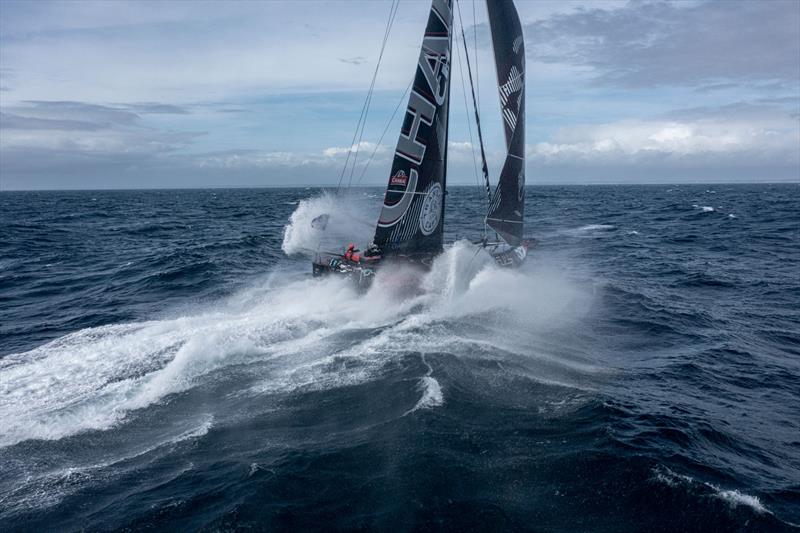
Charal during the Transat Café L'OR © Yann Riou / polaRYSE
With no retirements, a thrilling contest throughout the 18-strong fleet and near record-breaking speeds, the IMOCA Class delivered something spectacular in the season-ending Transat Café L'OR.
Not only that, the biennial two-handed classic from Le Havre to Martinique also saw a worthy winner in Charal, non-French sailors taking part on all but one of the top-6 boats, five female co-skippers in the top-8 and a top-four echelon of foilers featuring four different designers.
Antoine Mermod, the President of the IMOCA Class, says the race proved a "great event" book-ended by a vibrant start village at Le Havre and an equally welcoming finish village at Fort-de-France in Martinique.
In between, some of the best sailors in the Class had everything thrown at them, over the course of 5,500 nautical miles of intense ocean racing, during a voyage lasting between 12 and 20 days, finishing last Saturday.
"We had all different weather conditions - upwind and very strong winds in the English Channel, like it can be in late October," said Mermod. "After that, we saw a quite complicated and tactical race, with light winds in the Bay of Biscay and then another compression at the Canary Islands. And after that it was a huge run in the Trade Winds, with boatspeeds that we have never seen before at that angle, which was incredible."
Mermod was particularly pleased to see all 18 boats finish the race, confirming a trend of increasingly robust reliability in the Class in recent races, including the last Vendée Globe. "The level of reliability in IMOCA now is the result of the work of everyone involved," he said, "all the suppliers to the Class, the designers and a level of safety coefficient which is in line with what the boats are built for. It's also down to the quality of the shore teams that are able to prepare all the details in the best way because they know the boats very well and the challenge of races like this. And it's also the skippers - they sail their boats very well, they know how to sail them in strong winds and they are able to anticipate, to sail fast and to sail well."
Mermod said Jérémie Beyou and Morgan Lagravière at the helm of run-away winner Charal were worthy victors after an impressive display of high speed downwind sailing that saw them cross the finish line after just 11 days and 19 hours and 45 minutes at sea. They had sailed 5,467 miles at a remarkable average speed of 19.3 knots.
"They were great winners because, I think, they prepared for this race very well," he said. "They managed to improve the boat and its performance compared to last year and this race two years ago. And it seems the pairing of Jérémie and Morgan worked very well. They were focused on the objective to win and they managed to perform together, maybe better than their rivals."
Another standout pairing was Italian-American sailor Francesca Clapcich and her British co-skipper Will Harris on 11th Hour Racing (formerly Team Malizia), whose second-place finish marked the best IMOCA Class result by a woman in the past 20 years. "The boat was fast - it is a very good boat and, again, the two skippers worked very well together. They were well-prepared and it was a fantastic result and very nice for Francesca because it is the beginning of her project with this boat and this was the best way for her to start," said Mermod.
The fact that Charal was the only all-French boat, in terms of skipper nationality, in the top-6, is the best evidence yet that offshore racing in the IMOCA Class is no longer an entirely French-dominated sport. "It is something very remarkable," commented Mermod, who has championed a broader global reach for IMOCA, "and shows that the internationalisation of the Class is becoming real."
Equally impressive, he believes, was the strong female presence, with five female in the top-eight - Francesca Clapcich, Justine Mettraux, Sam Davies, Violette Dorange and Elodie Bonafous. "This is also something very positive and very positive for the future," said Mermod.
Of course much of the talk on the dockside in Fort-de-France centred around Charal's blistering pace, which gave Lagravière an unprecedented third win in succession in this event in the IMOCA Class.
Nicolas Andrieu, the engineering co-ordinator at Beyou Racing, said the improved performance was partly the result of new sail design - especially the big J Zero - and mast management on board Charal. In contrast, the appendage design on the Sam Manuard foiler has not been changed for 18 months.
In addition to the sails, the key element was the importance of hand-steering the boat in the Trade Winds, something that Lagravière practised during his last victory in this race alongside Thomas Ruyant. "Most of the time the autopilot is very efficient but on VMG, if you want to steer quite straight, you have to anticipate a lot of things, including the waves and the heel angle of the boat," explained Andrieu. "As sophisticated as they can be, the autopilots cannot see what's ahead and a skipper can do that - so that is the main difference."
Given that their rivals were also hand-steering in the Trades, there were clearly other factors at work, not least a powerful combination of two great sailors in Beyou and Lagravière. Andrieu says they re-wrote the parameters for a boat that has been studied and tweaked in as much detail over the past few years as any of its rivals.
"They were exceeding our performance table," summarised Andrieu. "And we will have to update it, so maybe there is a bit more performance to look for. But they did really well because they smashed all the polars that we had up until now."
We asked how they did it. "I think they are both very talented sailors and it was clear to them the importance of the Trade Winds and the commitment to have to steer the boat and reach this kind of speed. So all their training and preparation before the start was around that.
"Morgan is very successful and has won this race three times," added Andrieu."But let's say too that he arrived at the time when the boat was ready, and I think what he really brought to the team was his experience of hand-steering from past transatlantics and to show us the way."
Andrieu said the challenge for the team now was to try to replicate this blistering speed when Beyou is sailing single-handed, which is clearly not going to be an easy thing to achieve.
After several years of consistently finishing in the top five, Nicolas Andrieu said it was especially gratifying to see his team finally do themselves justice on such a storied racetrack.
"We were excited to watch them, and I have to admit I am also very proud of the team because at Beyou Racing we have invested four years now in a very strong team, and a strong engineering team, and it's very good that it has paid off, finally. So yes, a mix of excitement, but we were also very proud that finally the machine that we designed and optimised was working as predicted," he said.