
The Winner-Takes-All Race
by Mark Jardine 14 Oct 2025 20:00 BST
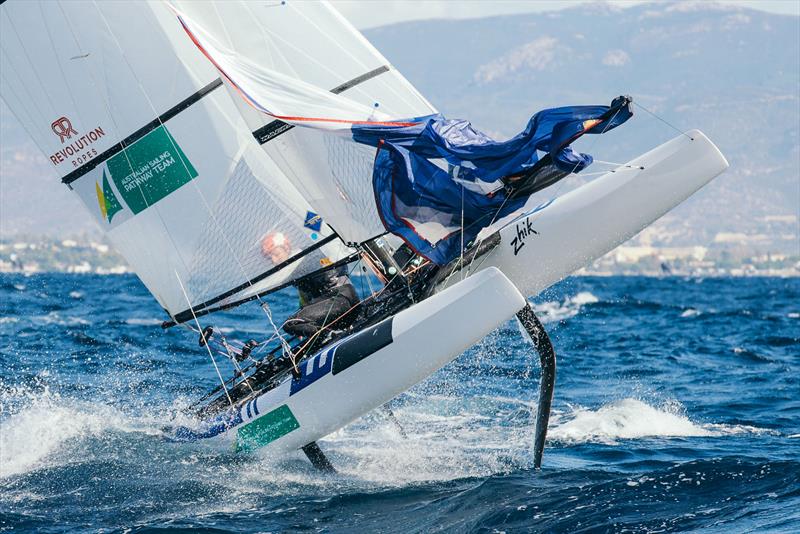
49er & 49erFX and Nacra 17 World Championships, day 6 © Sailing Energy
The 49er, 49erFX and Nacra 17 World Championships just held in Cagliari, Italy, could well be the most important held in the class. Not just that, it may influence how sailing happens at the Olympics.
Firstly, a word about the event and the conditions. After a light start, Cagliari turned it on for the Final Series, and the all-important final day where the experimental 4-point races were held. This is the scoring system which could be the 'least worst' format for the 2028 Olympics in Los Angeles, as I will explain...
The live video coverage on YouTube was world-class. On the commentary side we had the insights of Andy Rice, an extraordinary journalist who has also competed at the highest level in skiff classes, winning a 49er UK Championship and an International 14 Europeans Championship, who called the shots alongside Odile van Aanholt, the Dutch 49erFX sailor who won gold at the Paris 2024 Olympics with Annette Duetz.
The livestream was a little blurred at times, as the team had to balance drone battery life with the downlink speed, as well as taking into account the geography of the coastline around Cagliari, which with its high cliffs, and offshore course, made things tricky to get the footage from the race course to the editors ashore, and up to YouTube. Hats off to them for what they achieved. What they did on a tight budget was nothing short of remarkable.
Then there was the live leaderboard, which apparently the team at AALVAA Media put together in a day! With the fleet going upwind in what was known as the umpired finals race we could see the predicted scoreboard, and who was going to make it through to the 4 Point Race in what position.
These three things - commentary, livestream, and live leaderboard - provided clarity at a glance. The explanation and naming of each section of the race series needs to be better, but the 4 Point Race might just satisfy all parties... as much as that is possible.
So what was the format?
Drawn up by Nacra 17 sailors, there was a Qualifying Series, where the fleet divided into groups of 20 (Gold, Silver and Bronze if needed) for the Final Series. Since the Olympics has fewer boats, the Qualifying Series won't be required, so they'd go straight into the Final Series.
On the final day the Medal Series is held. This includes the 'Gold Umpire Race', which is the final race of the Final Series, and is non-discardable. At the end of this the top four boats go through to the 4-Point Race. Going into the race the top boat from the Final Series has 3 points, the second boat has 2 points, and the third boat has 1 point. Only the winner of the 4-point race gets 4 points - no other boats score at all - which means this race solely decides who is going to win the gold medal. No other points are awarded. Silver and bronze are decided by the points going into the 4-point race.
Why has this format been devised?
The vast majority of sailors would prefer a series of even races to decide a winner. It's the fairest system, and has served sailing incredibly well for decades. Discards have come and gone in series, but the basic structure has remained the same.
Sports for the Olympics are being led towards having their 'TV moment', a 52-minute timeslot where the gold medal is on the line. This is where the 4-Point Race comes in: a single race where any one of the four competing boats could win gold. It's not the 'perfection' of a series, but the boats which finished the Final Series in first and second would be guaranteed at least a silver and bronze respectively.
Yes, it's a compromise, but it could be one that is just about palatable with the sailors, and also fits the criteria of the Olympic broadcasters. Apparently the formats need to be finalised by March 2026 so the technology can be put in place to display it all correctly.
When I grew up, one of my favourite Olympic sports was the Decathlon, with the UK's Daley Thompson being the hero. The idea that you could be great across a range of sports, building up a points total, appealed to me. Daley was best at the 100 metres, long jump, 400 metres and shot put, but always struggled a bit in the 1500 metres - the final discipline. He won gold at the 1980 and 1984 Olympics without winning the 1500 metres, but everyone understood that the points total is what mattered, not who won an individual race.
Sailing is traditionally a series of equally-scored races, rewarding consistency in the same way as the Decathlon. The difference is that a brilliant sailing performance in a series can lead to winning the event ahead of the final race, meaning the jeopardy of that last race is gone, replaced with a victory lap. This is why the new systems are being touted and trialled. How to do it as fairly as possible is the problem, as no-one wants to see a repeat of the iQFOiL finals at Paris 2024.
Decision time is early November during the World Sailing Conference in Dún Laoghaire, which is why these trials are taking place at major events, as well as some minor ones. I enjoyed watching the coverage of the 4-Point Race but, like some of the athletes, I worried about how a single windshift could decide the winner. But, then again, many championships, and even Olympic titles, have been decided on a gust of wind coming in at the right place and the right time. Maybe this is just formalising the jeopardy?
I'm having trouble reconciling this in my head, but maybe that's just my own preconceptions about Olympic values. I always thought the Games were there to reward athletes for their unbelievable dedication to their sport, often over a decade or more of commitment. In this age of instant gratification, is the 'least worst option' the way of satisfying all parties?
I don't feel it's a neat and tidy solution - compromise rarely is - but maybe it's the one we're going to have to get behind to keep our place as an Olympic sport.
Mark Jardine
Sail-World.com and YachtsandYachting.com Managing Editor