
Safety first (like DRRR)
by John Curnow, Sail-World.com AUS Editor 12 Jan 2025 21:00 GMT
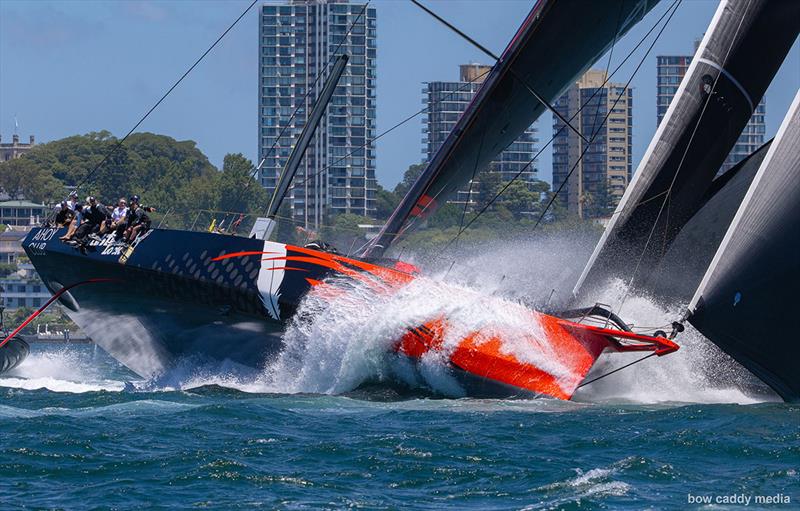
The power and the majesty - Master Lock Comanche during the SOLAS Big Boat Race on Sydney Harbour © Bow Caddy Media
Safety first was definitely the first rule of the sea, as explained to me when I was young. You know, one hand for you, one hand for the boat, and so forth. Nothing has changed, but what of the regulations, and we're not talking Government bodies and authorities, we're focussing square in on World Sailing.
In November of 2024, a whole bunch of things were changed to make it simpler, faster, more efficient, and better defined. Have to be honest, I'd missed it at the time. Paperwork and all not really being my thing... Alas, good job then that it was flagged for me to consider. It's all part of DRRR - Disaster Readiness and Risk Reduction.
Now this is going to take on a bit of an aviation theme. Partly because I am a self-confessed plane nerd, partly because we can aspire to that industry's efforts a lot, and not just only for when it comes to drilling down to the route cause, but also documenting it, and then finally partly because one of two of the authors of said changes is an aeronautical boffin.
So, what we have is the new global safety related reporting and enquiry regulations. These have been authored by Matt Allen AM (another plane guy) and Stan Honey, along with direct involvement from two-time Yachtswoman of the Year Sally Honey, and Shevaun Bruland, who apart from other things is the new President of Australian Sailing.
Not really getting warm and fuzzy over this. Sure. I get it, but any time we (definitely the 'royal we' BTW) can regulate ourselves better, then it leaves less wiggle room, and therefore we have a better time by not inviting the authorities in to do it for us. Going back to our analogy, if we had to deal with the paperwork the aviation industry has cast over it, then it is likely we would be forced close down.
Furthermore, the cost impediment would be horrendous. If boat stands for 'Bring On Another Thousand', then I would hate consider what PLANE means. Their parts make keels of unobtanium look cheap. Remember, we need to grow the sport, not build barriers to entry. So, any particular way you look at this, it is a positive approach that will bring about improved safety for sailors and keep the wolves at bay for even longer.
Now for reference, Allen is the Chair of World Sailing's Oceanic and Offshore Committee, on which Stan Honey has served tirelessly, and the latter's tenure actually ends at the beginning of next month. Specifically, what we are looking at is World Sailing Regulation 16. The brilliance is in how short it is, and how crystal clear it is as to what needs to be reported on, by whom, also as to why and when, and even more importantly, in which particular fashion.
Should you not be a believer, then take on this: -
16. Safety Reporting
16.1 Member National Authorities, World Sailing Class Associations, Rating Systems and Organising Authorities shall report to World Sailing, using the incident reporting portal, any incident of which they become aware and which:
a) occurs at, or while training/preparing for or otherwise associated with, an event using the RRS or otherwise;
b) falls within their jurisdiction; and
c) falls within the scope of the incident reporting system and Safety Policy as approved by Council from time to time.
16.2 The bodies listed in Regulation 16.1 shall conduct a review of all incidents resulting in fatality and submit an incident report to World Sailing.
World Sailing may request further investigation into any incident which results in a fatality or serious injury as defined in Regulation 38.1(c) of which it becomes aware. All Participants and stakeholders shall give all reasonable assistance to World Sailing if it conducts an investigation into an incident.
(FYI - Participants is defined elsewhere and includes racers, officials, and volunteers.)
Now of course there are a bundle of documents that sit behind this, and one such item would be the World Sailing Safety Policy, but the genius move here is that the latter can be changed and altered as and when required (once approved by Council), whereas the entire set of Regulations, which as of November 2024 are now far, far shorter than ever (at just 19 pages), have to first be created and then subsequently voted on, and that takes time (and I think we can put PITA in there by way of reference).
Allen commented on the clarification and definition of a reportable incident, along with its inherent inquiry, "Over the last five years, Stan and I have been looking at rewriting the safety reporting regulations. It is a project that started off in Oceanic and Offshore Committee, but there are many other individuals and Committees that have also been involved."
"Around two years ago, the Safety Commission for World Sailing was established under the Regulations, and so what we did was we put together a joint working party to rewrite the safety reporting guidelines for World Sailing, so as to make it very specific what needs to be reported and just as importantly, what doesn't."
"I think very decisively, it sought to define if there was a reportable incident during training or passage to a race or passage back home from a race. So that could be a dinghy, not racing, but going sailing back into the sailing club, or it could be a boat travelling from Hobart to Adelaide back to its home port after the Sydney to Hobart race, and it also includes a boat doing a qualifying passage that was not a race."
"Even just a training exercise relating to a particular race falls within their (see 16.1) jurisdiction and is also within the scope of the incident reporting system and safety policy as approved by council from time to time."
Now the Member National Authority or organiser must contact World Sailing within 48 hours of becoming aware of the incident and provide monthly updates to World Sailing until the report is provided. As we highlighted, there are documents sitting behind the Regs and one of these are the guidelines for independent incident reviews and reporting, which is on the on the World Sailing website, and it should be noted that the reporting portal is user-friendly.
Incidents will be reviewed by World Sailing's Safety Commission, the (Offshore) Special Regulations sub-Committee, along with the Offshore and Oceanic Committee. From there, changes to recommendations and also the regulations could ensue.
Things that flag the use off the portal are items that may cause fatality, such as loss of keel, and underwater entrapment. It includes emergency repatriation for medical care, and loss of limb, along with injury requiring resuscitation. As to serious injury, this is defined as requiring inpatient hospitalisation of 'more than 72 hours for reasons other than medical observation or diagnostic testing', with the latter statement being developed by the Medical Committee. It is true that more than one party may log and incident, but this is a far better outcome than no one providing information.
"Then we have an area of recommended logging, like catastrophic failure of the hull, entire crew being rescued, deployment of life raft, medical evacuation of one or more crew from the boat, and intentional activation of emergency beacon, or May Day," added Allen.
So that clarifies the definition, and it means that, "...engine failure, grounding, dismasting, and collision not resulting in rescue or serious injury, or injury requiring first aid, medical treatment, as well as collision with an object, vessel, megafauna, not resulting in return to harbour remain as recommended, not mandatory."
So if you are a fan of the TV Show, Air Crash Investigation, then you'll know that it can take years for the whole picture to be assembled, any litigation to take place, and most importantly, findings, facts and recommendations or mandatory alterations to be conducted. Sometimes the companies involved are long gone, so it is important for us to get a handle on what can be achieved from here.
Firstly, there is having everyone return home. Secondly, there is valuable, usable, and pertinent data from complete record capture that delivers a clearer picture. Taking our aeronautical analogy again, a plane falls out of the sky and there are people crawling all over the investigation and the black boxes go back to the manufacturer or HQ. It's a proper inquiry that looks into all aspects from ATC to pilot to craft to weather, with detailed findings/explanations and fixes. We should aspire to similar. The changes to 16.1 start us on that journey by assigning responsibility in a clear and simple to understand manner that sets about a process.
Thirdly, there is change. The latter can be in the form of the wording of special regs, better education around systems, or even engineering. Take for example, ISO, the International Organisation for Standardisation. After a number of years in the process, the standard for design and construction of keels for recreational craft (ISO 12215-9) was changed on 24/10/24, and is now increased the number of stress cycles from eight million to 16 million. i.e. That's double the fun. (Think going over waves, tacking, gybing and hard charging). Upside? Stronger keels!
The Sea Survival and Safety Course is certainly a candle to hold up here. For one thing, it's trained people to know what a life raft looks like (rather than a cannister), how to get into it, what to expect when they get into it (vomit). Another would be MOB; who hits the button? Who points? Who radios (these days emails)? Who's tasked with driving, and which side do you come up, and how are you to get them on board?
Plenty will be said, but in a time where the exposure to the nasty stuff is limited with a lot of racing abandoned in over 25 knots, I am thinking a 100% crew SSSC requirement is now essential, and it may need to be conducted in a wind tunnel, so as to get an idea of 50 knots plus does as it whistles across water and through the rigging. We could then switch the lights out to get a real idea, for it always seems the hard stuff happens in the dark...
Don't forget the fire hoses shooting water at you, and let's place said wind tunnel inside a flight simulator to give the real idea of what a moving deck feels like. So, as we come back to helicopter view, could we see the use of the standdown button? 24 hours could kill you, but waiting a day certainly won't hurt you...
Allen was co-Skipper of Master Lock Comanche who were tasked to go and assist Porco Rosso with their MOB in the recent Hobart. Received via email from the race office as directed by AMSA, they were making their way there and were some 15 minutes off. For them, one of the big things to consider was when they got there, how could the big girl help, and then if they needed to transfer their paramedic, what was that going to look like?
As an aside, HF is not without its long list of issues, but this highlights the electronics issues in heavy weather at speed, and possibly the dry-stored back-up to the back-up. Seeing as we're doing planes and all, redundancy rules the day...
Allen was also present at the Coroner's Inquest after the Flinders Islet incident. "The Coroner was very complimentary that we had done an enquiry, and had used, Rear Admiral (Retired), Chris Oxenbold AO, David Kellett AM, and John Brooks (the retired 707 and 747 airline Captain and offshore Navigator) to do that inquiry. It actually had far more expertise amongst those three gentlemen than the Coroner's Court could ever hope to assemble. The inquest into those two unfortunate deaths took less than five minutes. The Coroner accepted the report, congratulated the Cruising Yacht Club of Australia for their efforts, and recommendations. He then made no further comment, and subsequently closed the inquest."
Now I remember a boom on a Maxi in the 80's. It had a sticker on it designed to look like the warning on a cigarette packet. It said, 'WARNING: Skipper's Health Department. The boom can seriously damage your health.' Quite so. There's hit by the boom and then there's hit by the boom. No helmet on the planet will cover the second. We need to be masters of our own destiny. Lessons need to be learned from proper analysis. This is what 16.1 is all about. We just might need to come up with a snappier title than Sea Incident Investigation for the TV show, however.
Please enjoy your yachting, stay safe, and thanks for tuning into Sail-World.com
John Curnow
Sail-World.com AUS Editor