
The IMOCAs are on for record-breaking speeds in the early stages of the Route du Rhum
by Ed Gorman / IMOCA Globe Series 31 Oct 11:37 GMT
1 November 2026
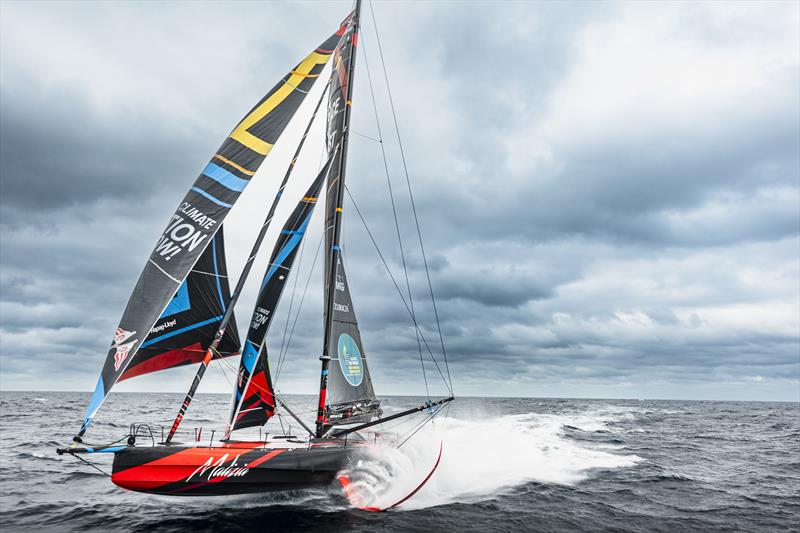
Malizia © Julien Champolion - polaRYSE / Malizia
The 22-strong IMOCA fleet in the Route du Rhum-Destination Guadeloupe is set for a fast start and then a super-quick ride to the north of the Azores islands in the mid-Atlantic ocean, according to the 2024-'25 Vendée Globe runner-up, Yoann Richomme.
The Paprec skipper, who is awaiting the launch of his new IMOCA early next year, knows a thing or two about the Route du Rhum having won it twice in consecutive editions in Class 40s, in 2018 and 2022.
He has been looking at the forecast for the 13th edition, which starts tomorrow, and admits he would love to be on the startline."Oh God, yes," he said, when asked if he wished he was taking part, "I had a powerful downwind boat and yes, this would have been a good Route du Rhum for me!"
Richomme says the IMOCA skippers will enjoy a 15-knot northeasterly when they set sail from St Malo and it's going to be fun to watch.
"That means a downwind start and probably two gybes to make it to the gate at Cap Fréhel," he said. "That could be nice, and we could see some manoeuvres. Once they pass this gate, it will be a run, pretty much to the Fastnet Rock, or a bit west of it, where they will have to gybe on the lay line to the north of the Azores islands."
He says there is no option right now to go south of the Azores, which is often the preferred route, because the position of the high pressure means the southerly option is littered with areas of light or no wind.
"The rhumb line goes through the north of the islands, but most of the routes in this race end up going south because it is usually too risky and too violent to go north. But this time, because of the position of the high pressure, the skippers must go north towards Ireland and then to the north of the Azores because there is no wind to the south," he said.
Richomme is expecting a very fast first few days before the race - and the weather options - start to become more complex and unpredictable. "The IMOCAs will be north of the Azores around Tuesday at the end of the day or in the evening, so that will have been a very, very fast passage to that point," he explained. "There could be a 24-hour record on the port lay line from the Fastnet Rock to the Azores because it's pretty much a straight line in very good conditions. We'll see."
At that point the leading boats are likely to hit a stationary weather front where they will encounter the first of several transitions between weather systems, where the fleet is likely to compress before stretching out again.
Although the second half of the race is likely to be mainly downwind, Richomme says the forecasts are too uncertain to make confident predictions. The end phase, when the skippers approach Guadeloupe and sail around the back of the island before finishing off Pointe-à-Pitre, could be very challenging. "For sure the end is going to be tricky - it could play out in many ways. There are even some scenarios that are giving upwind conditions for the finish, meaning westerly winds coming into the Caribbean," summarised Richomme.
Undoubtedly a fast downwind start to this race is better for most skippers than a boat-breaking beat into a north Atlantic depression. But Richomme says the pace is going to be punishing in the early stages and the skippers are going to be on the edge all the time, trying to balance speed with preserving their boats.
"It's going to be a nice fast start, but the rhythm is going to be hugely intense," he said. "And the problem is going to be, you know, keeping up to that rhythm for the first two or three days where we could see a break. Definitely, the downwind boats are going to be advantaged and the main thing is to keep it one piece and to be able to hold that rhythm for a long, long time."
And Richomme knows that keeping a state-of-the-art foiling IMOCA at, or near, full pace racing solo while also trying to work out your weather strategy is exceptionally demanding, given the violent conditions on board.
"It's not so easy because doing extensive weather analysis and routing on a boat that is moving and shaking so hard is not that easy," he said. "This is especially so when you have to aim for some real, precise weather windows and weather gates that are moving all the time, while the weather predictions are also changing. So it's always a little bit of a challenge," he added.