
Could Renewable Energy Eliminate the Onboard Generator?
by Citimarine Store 9 Oct 19:00 BST
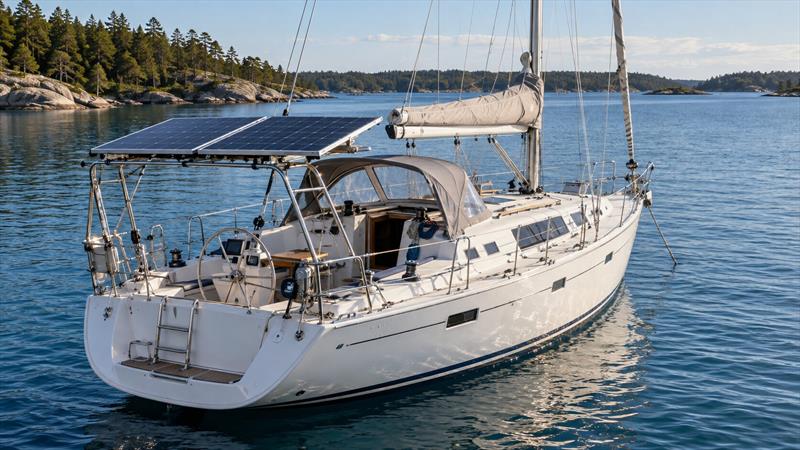
Solar-powered cruising sailboat at anchor © Citimarine
You cruise into an anchorage and shut your engine down. The refrigerator, lights and onboard electronics continue running, powered by the batteries charged by your solar panels throughout the day.
The batteries can keep everything running onboard for the night without starting the generator - but can renewable energy keep up for an entire cruise, including cloudy days or long periods at anchor?
On many boats, renewable energy such as solar power can dramatically reduce generator use, but may not replace it outright. The answer boils down to what your electrical requirements will be, how many panels you have onboard, where you'll be cruising, and for how long your system must remain self-sufficient.
Start with your daily energy budget
Generators are generally sized by their output in kilowatts. If attempting to replace or reduce generator usage, it's important to know how much energy you consume daily, measured in kilowatt-hours (kWh). A 60-watt load running for 24 hours would use 1.44 kWh (60 watts × 24 hours = 1,440 watt-hours = 1.44 kWh). A 1,000-watt appliance used for 15 minutes would consume 0.25 kWh.
Refrigerators, autopilots and other navigation electronics, lighting, communication and water pumps are baseline items that should be tallied and calculated when figuring out total kWh usage. Add in a watermaker, air conditioning, cooking appliances, and hot-water production for instance, and your electrical requirements can climb quickly.
To put daily energy use into perspective, a modest cruising sailboat with refrigeration, lights and instruments might use 1-3 kWh a day. A more heavily equipped cruiser could use 4-10 kWh, while regular air conditioning and other high-demand equipment could push the daily use above 10 kWh. Large luxury yachts can reach 20-60 kWh or more! However, these are just examples - you should measure consumption on your own boat to get a better understanding of exactly how much power you need.
What solar can actually deliver
Marine solar panels can reduce your reliance on a generator, and on some boats they may produce enough energy to forego the need for one.
Solar panel wattage is based on peak rating, not continuous output. For a rough estimate, assume four equivalent hours of full sunlight per day, then subtract 25% for heat, shade and other losses. Under those conditions, one 400-watt panel produces about 1.2 kWh daily. Divide the boat's daily kWh use by 1.2 and round up: a boat using 3 kWh would need about three panels to generate the same amount of electricity on a reasonably sunny day.
A modest sailboat using 1-3 kWh a day would need one to three 400-watt panels. Depending on its layout, an arch or hardtop might provide enough space. A more equipped cruiser using 4-10 kWh would need four to nine panels. Four may be workable on a large monohull or catamaran, but fitting nine generally calls for the broader roof and deck space of a large catamaran.
Regular air conditioning and other major loads can raise demand to 10-20 kWh a day, requiring roughly nine to 17 panels. A large luxury yacht using 20-60 kWh would need 17 to 50. At roughly 22 square feet per 400-watt panel, that upper range occupies about 350 to 1,100 square feet before mounting and access space, making solar alone impractical for most large yachts.
Even a boat that fits the number of panels needed to power the boat on a good day would likely fall short in cloudy weather, shorter winter days or periods of time where boom and rigging block direct sunlight. While a modest, efficient sailboat may be able to do without a separate generator, a higher-demand boat will require another charging source.
Beyond solar: hydro and wind
Solar is not the only renewable energy option available for your boat. Hydrogenerators and wind turbines can add to your energy supply, and in the right conditions, may even eliminate the need for a separate generator.
A hydrogenerator uses a submerged propeller to produce electricity as the boat moves through the water. It can charge through the night and in poor weather, making it useful while under way, however producing nothing at anchor. A wind turbine can work on passage or in a breezy anchorage. Its output depends on the wind speed and boat's direction, while noise and sheltered conditions can limit its effectiveness.
How much energy can they add?
A hydrogenerator producing 0.1 kWh per hour at five knots would add 2.4 kWh over 24 hours if the boat held that speed. At its rated 600-watt output, it could produce 0.6 kWh in an hour. A marine wind turbine might produce 0.29 kWh per hour in 21 knots of wind, rising to roughly 0.48 kWh per hour around 29 knots. These hourly figures apply only while the boat or wind maintains the stated speed; they should not be treated as guaranteed daily output.
All these renewable energy sources work well together because they can operate at different times but combine to provide more power: solar power in the daytime, hydro while under way, and wind when you have enough breeze.
Where the generator still earns its place
The toughest test of your renewable energy setup is when you have several overcast days at anchor, and someone wants to take a hot shower, run the watermaker or turn the AC on for a bit. Your marine generator offers dependable power on demand, and can recharge your battery banks quickly. For a boat with many onboard electrical needs, the best choice is a middle ground. Keep a generator onboard, but limit its use with the assistance of your renewable energy systems.
Finding the right power balance for your boat
So could renewable energy outright eliminate your need for a generator? Yes, if you can live within what the system produces, and are willing to reduce consumption when renewable output falls short. For others, the goal is quieter cruising and fewer generator hours - with renewable energy systems serving as the primary power source and the generator providing backup when needed.
Citimarine Store is a marine equipment retailer based in South Florida, USA, serving boaters worldwide. They carry solar panels, marine generators, battery chargers and other marine electrical essentials to help keep your boat powered and ready for the water.