
What the Firefly means to me: Dawn Langdon
by Alex Baxter & Barney Smith 10 Oct 10:29 BST
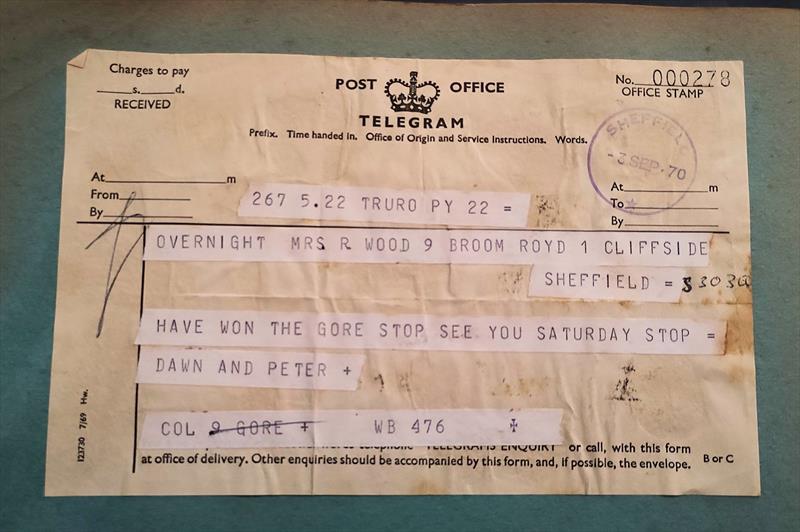
Telegram sent after the 1969 Firefly Nationals and Gore race at Weymouth © Dawn Langdon
As the Firefly class celebrates its 80th anniversary, we are sitting down with some class legends to hear their reflections on the fleet, including why they keep coming back and what it means to them.
This time, the series goes to Cornwall, to sit down with Dawn Langdon, one half of what may be the most celebrated husband-and-wife partnership in the history of the class. I couldn't make the trip myself, so this interview belongs to Barney Smith, who went down to Truro, sat down with Dawn, recorded the whole conversation and asked every question on my list, and a good many more of his own besides. Huge thanks to him: without Barney, this one simply wouldn't exist.
The Langdon family home in Truro, which the family has been in for many, many years, wears its history on every wall: photographs everywhere, folders of ancient newspaper clippings, and in the corner a grand piano that was once played (magnificently, by all accounts) by Eric Twiname. Before anything else can happen there is tea to be poured, milk to be negotiated, and chocolate biscuits to be pressed on the visitor. There is always tea to be poured in this house. Barney did the interview with a teacup in one hand and the recorder in the other, and afterwards the two of them headed down to the sailing club together.
Some context for those who never saw the Langdons race. Dawn and her late husband Peter won the Sir Ralph Gore Trophy at Falmouth in 1970, and were still racing Fireflys at championship level into their eighties. Liz Evans doesn't remember when she first met them (she was about twelve), but she vividly remembers what they were: the parents of the Restronguet fleet, encouraging people to go sailing, sharing advice, and building the fleet simply by helping people. Those who raced against them in their later seasons remember two things above all. The first is a downwind magic nobody could quite catch.
Barney remembers doing club races at Restronguet in the mid 2010s, in ten or twelve knots, when Peter and Dawn were still pretty quick and quite uncatchable downwind. He once did a little drawing of the two of them sailing, and he thinks it works because it captured the pose: kind of upright, the boom quite low, Peter leaning forward with the bow just touching the water, the two of them perfectly still, just watching. The second is the flask. The flask would appear over the side at all points of the race, and for years the fleet was quite convinced it contained some very special ingredients. We will come to the flask.
Dawn worried she couldn't be as funny as some of the others in this series. She needn't have. Barney says spending an afternoon with her, among the clippings and the memories and the tea, was a real privilege, and reading the recording back, I can see why. Over to Dawn, starting, as she insisted, at the beginning.
Dawn Langdon:
Peter was sailing long before I was. He grew up racing in the Redwings, and he won his first championship in them when he was about eighteen, at Torbay; there's a lovely picture of them starting in it somewhere in these folders. Then, of course, came national service, as it did for every young man in the early 1950s, and he was teaching pilots how to sail. Well, they'd come down to the sea and wonder what to do with themselves. University came after national service in those days, and that mattered rather a lot, as you'll see.
The services are a big part of the Firefly story, and of ours. Just after the war they bought Fireflys by the hundred. The story we've heard, told second-hand by someone much older, so treat it kindly, is that with everyone doing national service, there were suddenly a great many servicemen with time on their hands, and somebody worried they were getting bored. Somebody else at a dinner, where there may have been some sherry or port involved, had access to a great deal of money, and the upshot was five hundred Fireflys, bought in the late forties or early fifties, when there wasn't much else around.
Suddenly RAF stations and Navy bases everywhere had them, and it was an amazing boost for the class. I can vouch for the effect: the first Southwesterns we ever went to were full of servicemen. Full of them: Wing Commanders, naval people. That was a big part of the class in the fifties, before people started building their own boats and the Enterprises grew rapidly and took some of it away.
I came to all of this rather late, because I'm not Cornish at all; I'm a Yorkshire girl. Snow and hockey on freezing Saturday mornings: that was my sporting education. I left home at eighteen and escaped to London, and at London University I met Peter, who was finishing his degree after national service. I never sailed until I was twenty. He introduced me to the Firefly, and kept dipping me in. That is getting on for seventy years ago now, which hardly seems possible, and there's a big birthday celebration coming next year, by which time I intend to have my balance back.
We married in 1957, and we were given a Firefly as a wedding present. She was 794. We lived on a houseboat in those days. Peter was teaching, and we'd chosen the place quite deliberately: a school near the water, and Fireflys to sail there, which made it even better. That's why we went. We kept the boat alongside the houseboat and pulled her up on the galleys, and as there were no cars in those days, getting afloat meant walking the trolley over to Stokes Bay, hand in hand, where a friend would help us launch her.
Oh, she was the slowest boat out, 794. She was slow. But we enjoyed every minute of our sailing there. We did two years at Stokes Bay, went to a couple of opens on the Hamble, and one summer we put the tent on board and took her camping to the Isle of Wight. And the frostbiting at Stokes Bay was our first real taste of it all. It was tough. And we loved it.
Then the children started arriving (our daughter was born in 1959), and life on a houseboat got rather difficult with a pram, and with planks being carried about in the middle of the boat. Something had to give.
After two years sailing at Stokes Bay, we moved to Cornwall. Cornwall pulls its own back (Peter was very, very Cornish), and 794 came back with us and was sold. We sailed very briefly out of the old Restronguet Sailing Club site, and by 1962 the club was running at its new one. Getting there had been difficult, mind. The club had been kicked out of the cottage it used, and at one point tried to build its own little slipway. It got about halfway down, and I believe the remains are probably still there. That didn't work, because you couldn't get the cars in.
And then the perfect site came up, at a peppercorn rent (brilliant), and the people took to making the club what it is. Marvellous, really. They encouraged everything: the Optimists coming through, and the Dart fleet was very strong. The range of boats, and the range of people you'd meet. It's a very special place.
It was in the early 1960s that we had Uffa Fox down here in Cornwall. Peter was the sailing secretary of the club, and in those days the club held a very posh, full-scale dinner and dance at a hotel, the Headland. A very posh sailing club dinner, fifty people all dressed up, and Uffa was invited as the guest of honour. We'd finished our meal and recovered, and the chairman stood and said how pleased we all were to have Uffa Fox here today, welcomed him, and said how much we were looking forward to hearing what he had to say. And dear Uffa Fox stood up and said: 'I've been asked to say a few words. Thank you.' And sat down. He had said a few words. You didn't appreciate it at the time, but it was the adventure of it, and he was a character. The man who gave birth to the Firefly class, after all.
Others in the class saw a different side of him. The class chairmen of that era, Peter Slimming among them, had to negotiate with Uffa over the rules, and over any change to them, right up until his death, and I believe Peter Slimming had a number of words for him. One of them was 'cantankerous'. There were some others, which shan't be recorded here. The archives are full of long, long letters.
For ten years after the move, we didn't sail dinghies at all. The children were small, and it was cruising instead, with not a Firefly in sight. Though even then Peter couldn't entirely help himself: he took the cruiser over to France in 1962 and came home with first prize and a crate of Muscadet. So the racing never really stopped. It simply changed shape for a while.
Everything changed at the end of the sixties. The children got a Mirror in 1968, and someone invited Peter out on his Firefly. That was it. The cruiser went. The Fireflys arrived. We bought F2510 Spider (she was lovely), and that same year we went to the Southwest Championships at Plymouth, about fifty boats, and won. We thought: we must be going quite well. And there was a Firefly champion from the fifties there who took Peter aside and said, 'You're going very well, Peter. You should try the Nationals. You'll win that too.'
So we thought: well, the Nationals are at Falmouth in two years' time. Home waters.
[Newspaper cutting: Eric Twiname's report on the 1969 Firefly Week and Gore race]
He was right, as it turned out. In 1970 the championships came to Falmouth, and we won the Gore, with Eric Twiname second (he pops up again later on). The local papers made rather a lot of Peter and Dawn Langdon winning the Gore; local heroes, I think one of them called us. They're all still here, in the folders. Very ancient newspapers now.
[Newspaper cutting: 1970 Firefly Nationals report(s) from Falmouth]
And winning the Nationals took Peter to Burnham, of course, to the Endeavour Trophy at the Royal Corinthian, where the champions of all the classes meet. He went up and sailed it with another chap, a champion among champions for the weekend.
The next year, 1971, the class went to Ireland for the Nationals, and so did we. It was quite a tense time to be going. It was not quite the beginning of the Troubles, but there were all kinds of things happening in Ireland just then, and plenty of people stayed away. We took my mother- and father-in-law along as babysitters, and the children, of course. Andrew Pool got us there. Mimie Curry stayed in the same hotel as us. John Tagg was there too (he won the Gore that year, I think; it will be in the records), and Peter and I came home having won the Fairey points series. Still in Spider.
[Newspaper cutting: 1971 Firefly Nationals report (1) from Dun Laoghaire]
[Newspaper cutting: 1971 Firefly Nationals report (2) from Dun Laoghaire]
[Newspaper cutting: 1971 Firefly Nationals report (3) from Dun Laoghaire]
That whole stretch was a real golden time at the club. Club racing at Restronguet meant Peter and me against Phil and Jilly Slater, and against Peter Knight and Johnny Money: championship standard, every race. I sometimes wonder if they polished each other up. It was a wonderful time.
And before we properly got going, there had been the team racing. Eric Twiname was very keen on it, and it helped us enormously.
We went off to other clubs with Fireflys, and it spread our wings a bit, because we didn't do much travelling in those days. We used to go up to Exmouth, and to Manadon, the Naval College in Plymouth, which was great fun because they were all standing to attention all the time. It sharpened us up on the rules; team racing improves your boat handling and your close-quarters work like nothing else. At Plymouth they offered us their Larks to sail, and I have never fallen in so many times in one day. About ten capsizes. I'd hardly ever capsized at all with Peter.
But each time they would pluck you out of the water and put you back in the boat again, and then you'd fall over at the next mark. And it was great fun when they came back to visit us at the club: hulking men, super fit, squashing themselves into a Firefly. They fell out. They fell everywhere.
[Newspaper cutting: 1972 Firefly Nationals report - amazing as it contains the names of so many dinghy sailing legends, though sadly few crew names]
People ask whether there was a secret to Restronguet's success in those years. I don't know that there are any secrets, but there was certainly boat preparation. Months and months and months of it. And everyone checked up on everyone else. The Slaters were just as bad as any of us: they and Peter Knight constantly had a tape measure in their pockets, and they were all going round behind each other's backs measuring each other's boats.
By the time they'd finished, the boats were identical. And it worked. The Restronguet sailors had an amazing run in that period, and went to one championship and won every prize. Every single one, including the Marlow. That's probably never been done since. No, it hasn't been done since.
Eric Twiname was a very great friend of ours. He used to come and stay here, and he would sit at that grand piano, the one beside us now, and play the most magnificent Schubert. He was a fantastic pianist. I can still see him in this room. He died tragically young, in 1980, when he was only thirty-eight, and the class has never quite had anyone like him since. But he left us his books, the team racing one and Start to Win, and whole generations of youngsters have been brought into the sport through those pages. He understood better than anyone what this racing really is: a giant chess game with physical activity. And his team racing spread the Fireflys about a bit more, which was rather the idea.
He also had his revenge on us, which seems only fair. Two or three years after Falmouth, in about 1972 or 1973, we went to Felixstowe Ferry for a championship, and Eric was racing on the Gore day. He came first and we came second, chased all the way by the Slaters. So honours were even in the end. I'm told Mike Arnold won the Ferry points series that year, but the records will say.
Felixstowe Ferry deserves a chapter of its own. It was gritty and watery, with such a strong, strong tide, and shallow, and getting out to sea over that bar was like being in a washing machine. Some of those Felixstowe championships were very windy on top of it all. My favourite memory of things not going to plan comes from there. We finished a race: crossed the line, gun, sixth place. And then we drifted back behind the finishing line, so we had to do it all over again. We crossed the line a second time, about twenty-sixth by now, and the tide carried us back again. Every time. By the time we finally got across, we were down in the sixties, and Peter said: we are not doing this again.
There was another Felixstowe day that people who were there still talk about: blowing a gale, everything postponed, the whole fleet in the bar all day, and then at five o'clock they decided they would run the race after all. I suspect half the crews had been in the bar for quite some time by then. I wish I'd been counting.
We had six Fireflys in all (I've got it written down), and I can tell you about every one of them, because even though Fireflys are meant to be all the same, they always feel slightly different to me. After 794 came Spider, and Spider was definitely the favourite, followed very closely by Cyclone and Water Spider. Spider was the boat we won the Gore and the Fairey Points Series in, and the Southwesterns a couple of years before.
She had her quirks: her two side decks were slightly different, and we could never work out whether the starboard side or the port side was best for the beat. We never did work it out. There are stories that the moulds Peter used for laying the veneers on were sometimes slightly asymmetric, so perhaps that explains her.
When Spider was getting on, we got Arachne, one of the new hulls, from when another builder had come in alongside Fairey Marine; she'll be on the register. Arachne arrived with a problem. She was out at the club when the measurer came to measure her, and she was too high. She didn't qualify. They had to chop some bits off her before she would. Peter came over and said: 'Oh no. I don't call that fair.' He never did.
Then came Water Spider, who was lovely; she has a beautiful plate in her that Peter worked on. Then Cyclone, another big, big favourite; we had her a long time.
Now, people ask how we fitted all this in around work, because we were both working all the way through: Peter was teaching, and I was a teacher as well. I'd come down to Cornwall with him, and in time I got a headship at an infant school: 192 infants. I had that for about fifteen years, and it kept me pretty busy. I was going up the wall a bit, because at the same time I was running what amounted to a small hotel for the Firefly fleet.
You see, we wanted people to travel to the Southwesterns, and we were very isolated down here; stranded, really. So I got together all the wives, and all the telephone numbers, and we organised free accommodation for the visiting sailors. We'd find you a bed somewhere. It got to about twelve people staying, with me sailing as well, mind. They would come down for that, you know, and we were glad to give it. Breakfast was like a cafeteria: fried, and passed out through the hatch. They'd all eat far too much, and off we'd go racing. We so enjoyed having them.
And it worked: it brought people to Cornwall, and now we have the babies we've watched grow up at the club, and the teenagers, and the whole thing keeps going round.
As for how we divided up the roles in the boat: Peter was the helm, and I was the crew and the coffee maker. Yes, the flask. Flasks, plural; we lost several of them over the years. I know that for a long time lots of people thought there were some very special ingredients in there. Special juices. I'm sorry to disappoint the fleet after all this time: it was the caffeine. It was just caffeine.
But I did train quite hard, you know. I had my own sit-up bench here, at a time when I don't think many people in sailing did anything of the sort; all that physical preparation, like the measuring, was rather ahead of its time. And Peter had one limitation as a helm, which was that he could never see the marks. So that was my job too: spot the mark, and say 'go for that one now.' Between the coffee, the sit-ups and the navigation, I like to think I earned my place in the boat.
The club has had a couple of dips over the years. The eighties went thin. People go off to university and you lose them, and we were down to just two or three boats. And then Ben Lumby came, and it really revived: nineteen boats on the beach, waiting to go out. Wonderful.
We kept racing through all of it, mostly not winning, I should say. Occasionally we won, but not very often; there was always a good fleet to get through. And an awful lot of the people who keep this class alive have never won anything at all, and keep coming back anyway. Dear Pete Slimming, a lovely man, never won it.
We got close to winning again in 1999 at Pentewan Sands. That was the year of a very windy Gore, when you, Barney, and your crew Damian won. We finished about fourth or fifth, and we were ever so close to Stuart Hudson and his crew for the Fairey Points. We were first and second going into that last day, and then it finished on a run and a slight reach, and the boats that went one way on the run gained, and, well, we blew it. Stuart and his crew won the week. These things happen, and they keep you coming back just as surely as the wins do.
There was one trophy that got away from us, too: we never did win the Sussex Silver Firefly (traditionally awarded to Race 2 of the Nationals), but in recent years other Restronguet sailors have won that trophy, which is just lovely.
We were still at it long after anyone expected us to be. In 2006 the Nationals were at Abersoch in North Wales: the 60th anniversary championships, another big entry (111 boats), and a special one. A good contingent went up from the club that year. It was very windy with big waves at times, and the Gore in particular was a very, very windy, long race. On the last day there were two races, and we did the first one and got a good place, but Peter was worn out, and that was enough. The Currys were there too. It was a lovely championship. Lovely racing.
Our last championship was at Torbay, in 2008. It must have been, because that was the Gore day when the darned race went on for four hours. We led for nearly four hours, right up to the last reach! We shared the drinks round from the flask, and there are some pictures somewhere. On that last reach, Paul and Laura Kameen finally caught us up, and I think Paul (or both of them, actually) was quite worried about overtaking. Here was this elderly couple who had been out in front on the water all afternoon, and they thought something must be wrong.
And Peter turned around, smiled at them, and said: 'Where have you been?' They took that as permission to go past. We were leading the Gore at our age (I shan't say what age), and I maintain that proves the point: the Firefly keeps you young.
There was one more win that Peter was really, really proud of, quite late on, when we were in our seventies. Falmouth Week one year was run as an open week for all boats: forty or fifty of them, Enterprises, OKs, the lot. The Commodore at the time was a brilliant Dart sailor, and he organised the whole thing. It was very windy on the Wednesday, but we managed to sail the one race that gave us the number of results we needed, and we won the week. The little Firefly, beating the Enterprises and the OKs and everyone. Amazing, everyone said. Peter was so proud of that one.
We carried on with the Southwesterns for some years after 2008 (not always every race, but still going out), and with club racing for longer still. By then we had moved on to our last boat, F3876 Bubble II, a Rondar, and Peter could never quite settle with her. Rondars just feel slightly odd to me; I don't know why. We even tried one of the new ones at one point, and that didn't work either. Not every Firefly suits every sailor.
And it was Bubble II who finished us. She tipped us in (we were both in our eighties by then), and for the first time ever, in all those years, we couldn't get the boat up ourselves and had to have help. The first time ever. So we said: well, that's called it a day, isn't it? That was about seven years ago now. I will say the modern plastic boats float beautifully high when they go over; you can practically walk across them, and we could have done with that. Pulling a boat up the beach in your eighties is no small thing either. I gather people in their fifties are buying aluminium trolleys now, to save themselves five or six kilogrammes.
In my day the answer was simpler: you shared the flask, and people helped you up the beach. For the last few years we could still do the shore base, at least, which kept us part of it all. And Bubble II lives on now, I'm glad to say, as a club boat at Restronguet, sailed by all kinds of people, beginners and children. Which is a nice ending for her, even if she and Peter never quite made friends.
One of the loveliest things happening now is the rescuing. There are a number of people who, if they see a Firefly in a sorry state, think: oh, that needs rescuing. They restore her, or even just store her safely. The restorations are done so well now, aren't they? And there are some legendary boats among them. Andrew Pool's old boat is a lovely one. Will Pank and his family are looking after F999, the legendary Alarm, now, and there's, of course, F3146 Spaghetti. You just look at those boats and it all comes back.
And the Southwesterns! When we first won it, in 1968, it was at Plymouth (it was occasionally at Plymouth and Parkstone in those days), and then sometime after that it moved to Restronguet and became the event. It's become something very special across the generations. There are about forty boats each year now, and a lot of them are visitors who come a long way: there's the couple who come down from Scotland, and Amy and Roger came over from Belgium at least two years in a row. I'm even told of people who had a wedding up-country in London on a Sunday, so they sailed on the Saturday, flew up from Newquay, went to the wedding (very annoyed with these people holding weddings on a Sunday), flew back on the Sunday night, and were racing again on the Monday. That's the draw of it.
Everyone who comes to Restronguet gets this amazing welcome, and there's a wealth of Firefly history and knowledge down there. And it's multi-generational now: people who met at the event before they were married, coming back with the babies, and the babies now teenagers. It won't be long before some of those older teenagers start getting married themselves, I should think. We never get many students, because it falls at exam time, and goodness knows they're missed. But it's a lovely, lovely event.
It was lovely, too, when the Nationals came back to Restronguet in 2024 and I could come to the prize-giving, and see the camping fields behind the club full of boats and tents on the grass. That's made a real change, a real positive change. I got down to the Southwesterns this year as well, only briefly; it was the first year I've really managed, because I can't drive any more. Whether the class will bring the Nationals back to Restronguet, who knows? I'm sure it will at some point.
It's the class's eightieth year, and I'm told it's thriving, which would have seemed unlikely a couple of decades ago when things went very thin. But then the Rondars were built (nine hundred of them), and now Ovington, the new builder, have built over a hundred Fireflys in just over two years. People are restoring the old boats, both the wooden ones and the Rondars, there were just seventy Fireflys at a schools week, and the universities and the schools are all buying Fireflys and team racing again.
So it's come full circle, right back to where Peter and I found it, with the team racing bringing the youngsters in. Club dinghy racing is a real struggle across the country at the moment; children have so much choice now, so many other things. But we've a smashing Mirror fleet at the club bringing families in, and the parents are beginning to look sideways at the Fireflys. That's how it starts.
As for us, Cornwall was always going to be the ending. Peter was very Cornish, and Cornwall pulls its own back. His father was here, and in retirement he took walks along the coast path up the north coast, whose beauty you don't realise until you walk it. I'm almost Cornish myself now. Sixty-five years; not quite, they tell me. But I taught in this area so long that everywhere I go I meet my infants. I went to the solicitor: I'd taught him. I went to the hospital for something or other: I'd taught them. Even the undertaker in Truro: I taught him too, which was a bit of an experience. But they look after you, my old pupils. There's no getting away from them round here.
And Restronguet: what does the club mean to me? It's home. It's the friendships we've made there over the years. It's a very special place: the perfect position now, water whenever you like, safe, and I'm so pleased we got down there, because it was very difficult at the time. But it's the people who make it: the hospitality, and the fact that we've all grown up together. It's not just my favourite venue; I know it's a great many people's. It's my second home, despite this house. Teaching came first in my life, but sailing and Restronguet ran it very close. We're going down there together later on today, actually. A real treat for me, Barney. I've missed it desperately.
I should say a word for Peter's other life, too, because some of the fleet do know this: music was another big part of him. The house is full of his pieces of music; you must come and look at them. I'll record for posterity that he had a dreadful singing voice (he couldn't sing a note in tune), but he loved a good time, and he loved to be in a crowd. That was rather the point of him, on the water and off it.
So what would I say is great about the Firefly, after nearly seventy years of it? Well, the people who sail them. And they're such beautiful boats: the shape of them, and what you can do with them. And really, the company. We met so many interesting people, so many characters (this class is full of characters), and we had a fun life with them. Some of them are gone now, living on only in the remembering. And I remember them.
And the racing itself. You're out there, and it's a chess-like game with physical activity. It's wonderful. And the close racing: you don't get that in any other boat, not close racing like that. It's a fairly unique experience. Any tips for the youngsters who'll take the class to its hundredth? Just that, really. Get out there. Share it; such pleasure we had sharing the Firefly, being part of the group. Come and join us: that's what built our fleet, twice over.
And keep sailing as long as you possibly can, because I can tell you from experience, and other people have said this too, but it is definitely true:
The Firefly keeps you young.
The 80th Anniversary Year
The Firefly class's 80th anniversary celebrations continue, with the 80th Anniversary Dinner on Saturday 21 November 2026 at the Royal Thames Yacht Club. The 2026 anniversary raffle prize is a race-ready Firefly (F4444), generously provided by Ovington Boats, complete with Selden Mast, Hyde Sails, covers, and a launch trolley from Sailboat Trailers.
All results, entry details, and further information can be found at www.fireflyclass.co.uk