
Globe40 2028-2029 - Federico Waksman interview
by Sirius Events 3 Oct 11:37 BST
May 30, 2027
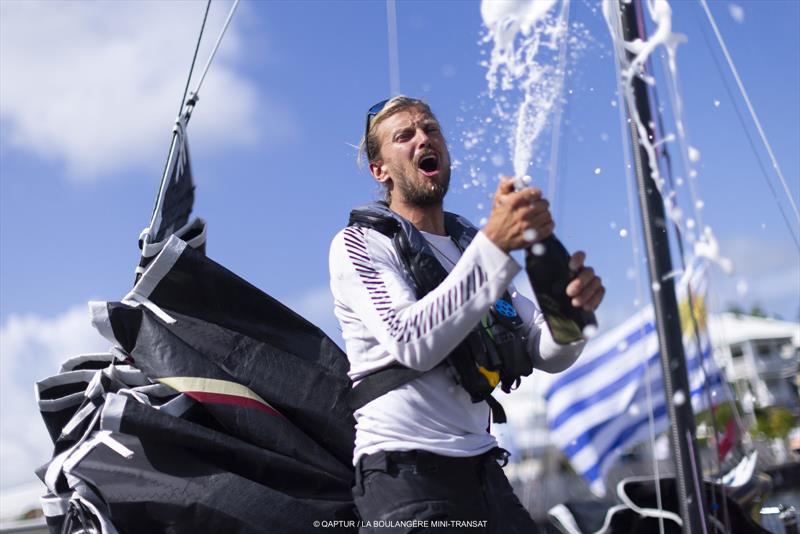
Federico Waksman © Qaptur / La Boulangère Mini Transat
After a historic victory in the 2023 Mini Transat, Uruguayan sailor Federico Waksman is continuing his offshore racing journey with a new challenge: the Globe40. He has just pre-registered for the third edition of the round-the-world race, which is scheduled to start in 2028-2029.
He has just finished 4th in the Mixed Doublehanded Offshore World Championship in Marseille, missing out on the podium by just eight seconds. Another strong performance that demonstrates his consistency at the highest level and his ambition to take the next step in his career.
He talks to us about his journey, his victory in the Mini Transat, his recent experience in Marseille, and the outline of his new round-the-world project.
To start with, could you tell us about your sailing background and how you got into offshore racing?
I started sailing at a very young age in Uruguay, mainly in Optimist. I took part in all the competitions a young sailor could compete in, all the way up to the World Championships. I also sailed in the Snipe class, a two-person dinghy that is particularly popular in South America, and I had the opportunity to represent Uruguay in many competitions.
A few years later, I moved to Barcelona to work as an engineer in the superyacht industry. That's where I really discovered offshore racing. Barcelona has a major training centre, one of the largest in Spain, and I quickly became attracted to this world.
At the time, I started helping a friend who owned a Mini 6.50, a Pogo 2. I sailed with him and, quite quickly, he offered me the helm. He had realised that I was much more passionate about offshore racing than he was! That's really how I got started in the Mini 6.50, including taking part in the 2021 Mini Transat. That experience was an important step in my career and confirmed my desire to continue in offshore racing.
In 2023, you won the Mini Transat in the Proto category. What does that victory represent in your personal and sporting journey?
I spent almost four years training, preparing the boat and making a lot of sacrifices to achieve that victory in 2023.
The beginning of the adventure wasn't easy. I had to move, and for almost three years I slept in my van so that I could dedicate as much time and resources as possible to my project. As a South American, embarking on this kind of project in Europe wasn't necessarily easy. I didn't always have the same opportunities or resources as some of the other competitors.
That's also what makes this victory particularly important to me. After all those years of work, the sacrifices and the difficulties I faced just to get to the start line, winning the Mini Transat was an immense satisfaction and a great source of pride, both personally and as an athlete.
You became the first South American to win the Mini Transat. What does this achievement mean to you and to sailing in Uruguay and Latin America?
This victory had a big impact in South America. The fact that a South American won the Mini Transat for the first time generated a lot of interest, particularly in Uruguay, but also in Argentina, Brazil and Chile.
I received a lot of messages from people who had followed my project and told me that my journey had inspired them to take up sailing themselves.
That means a lot to me. Beyond the sporting victory, I'm very happy to show that it is possible to start an offshore racing project from South America and make it all the way to the highest level. If my journey can inspire young sailors to get started, that's a real source of satisfaction for me.
Is there one particular moment from the 2023 Mini Transat that stands out in your memory?
There are many moments that will stay with me, but some are particularly special.
Before the Mini Transat, I trained a lot with my friend Carlos Manera. We both had the same goal: to win. Obviously, that created a bit of rivalry between us, and we couldn't tell each other everything, especially when it came to our settings or strategies, so as not to give too much information away.
During the race, we found ourselves both leading in the middle of the Atlantic. We communicated a lot over VHF and, despite the competition, it was a very special and really enjoyable moment. We had both ended up exactly where we had dreamed of being.
I also have very strong memories of the ten days spent under spinnaker. I sailed with the biggest spinnaker, day and night, in 25 to 30 knots of wind. It was physically and mentally demanding, but at the same time incredibly exhilarating. Those are the moments that really stay with you — the feeling of speed and being completely alone in the middle of the Atlantic — and they remain among my best memories.
On the eve of the Mixed Double-Handed Offshore Racing World Championship in Marseille, how is the regatta going for you?
It's going well! We qualified for the next stage, the final, so that's already a good result. We actually had very little time to train on the boat, just three days, but despite that, the feeling has been very good and we quickly found a good rhythm together.
The forecast for the final is looking quite strong, with plenty of wind, and that's something we like. So we're pretty happy with what's ahead.
We're not putting too much pressure on ourselves before the final. The goal is simply to do better than last year, sail at our level and enjoy the race. We feel ready and we're looking forward to it.
You have just pre-registered for the third edition of the Globe40. When did the idea of sailing around the world start to become a concrete possibility for you?
I've been thinking about doing a round-the-world race for a long time. Ever since I started developing my first professional projects, that ambition has always been somewhere in the back of my mind.
Over the past few years, with family and the arrival of our baby, it was more difficult to imagine taking on such a big project. Today, we're settled and in a situation that finally allows me to devote myself to this dream. I feel ready to take the plunge.
I have already secured several partners, although the budget still needs to be completed in order to be able to start in the best possible conditions. I'm confident that it will come together.
At the same time, I'm developing a project around Uruguay, particularly with sailing clubs in Punta del Este. The possibility of having a stopover in Uruguay has generated a lot of enthusiasm locally and gives the project another dimension.
I'm also working with the Make Them Sailors association, which works with children and sailing schools to make sailing more accessible and introduce the sport to as many people as possible. There is already a lot of enthusiasm around this project in Uruguay, and all this momentum makes me even more motivated to take part in the Globe40.
You represent a nation that is still relatively underrepresented in international offshore racing. What does it mean to you to carry the Uruguayan flag around the world?
It's fantastic. I'm really very happy to be able to represent Uruguay on a project like this. Carrying the colours of my country around the world is obviously a huge source of pride.
Through this project, I'm also open to the idea of having a mixed crew, perhaps with an Argentinian or another South American sailor. It could be interesting to create something around South America.
But whatever happens, we will be carrying the Uruguayan colours, and that is something that makes me really proud.
What particularly attracts you to the Globe40 and to the format of this stage-based round-the-world race?
I've wanted to do a round-the-world race for a long time. A format like the Solo Global Challenge, where everyone starts on different dates, doesn't really interest me. That's not my vision of competition.
I want to race against the others at the same time, in the same conditions, with the same wind and the same sea... Starting together and fighting to be the first to arrive — that's what really attracts me.
The Globe40 is growing with every edition, with more and more professional skippers taking part. I want to compete against the best and see how far I can go against them. It's something I'm really excited about. I can't wait to get started.
If you had to sum up in a few words what the Globe40 represents for you today, what would you say?
It's a new stage in my life as a sailor. Having my own boat and my own project is really important to me. I've already sailed a lot on Class40s, but never with my own boat and as part of my own project. I really want to embark on this adventure.
It's also an opportunity to showcase my project and share it with schools and sailing clubs. Through this boat and this race, I would like to help promote sailing in Uruguay and more broadly in South America. That's very important to me.
I've already shared a lot of sailing videos from Uruguay to show people what the sport is about and encourage them to discover it. We also recently sent a container of sailing equipment to Uruguay thanks to a donation and the support of a partner and the La Grande-Motte sailing club. The equipment is no longer necessarily brand new, but for Uruguay, it's a great opportunity.
That's really the idea behind my project: by having my own boat, I'll be able to play a more active role and help show that sailing can be a popular and accessible sport.
I have the opportunity and the ability to do it, so I want to do it. I won the Mini Transat after a lot of hard work and sacrifices to get there. Today, I want to put that experience into this project and help introduce more people to sailing in Uruguay.
The organisation has announced the course for the third edition. What do you think of the route?
I think it's a really great course, I like it a lot. The possibility of having a stopover in Uruguay, in Punta del Este, is particularly exciting for me. Historically, it's an important and almost unavoidable stop when sailing back up the Atlantic, so being able to stop there would be very special.
The fact that people will be able to come on board during the prologue is also very interesting. What was done in Cádiz looked like a great spectacle, so I'm really looking forward to experiencing it and, hopefully, seeing something even bigger for this third edition.
And then, of course, I dream of the Cape Horn. Being able to round Cape Horn and then head home to Uruguay would have a very strong impact on me. It would be a truly symbolic moment in this race.
The Globe40 represents a major step up from the Mini. What do you see as the main challenge today in moving up to the Class40 and taking on a round-the-world race?
The main challenge today is to finalise the budget and secure the partners we need to take the project all the way.
We can see that the current situation is complicated. Even some IMOCA projects have been put on hold, so it's not necessarily an easy time to find funding. But I remain confident.
For me, a Globe40 project isn't simply about putting a logo on a sail. The race gives partners the opportunity to travel around the world for seven months, create content and experience a real adventure with the project. It's a great opportunity for a company to get involved in something like this.
Have you already started thinking about your team, both onshore and at sea?
I already have a shore team that I've been working with for a long time, including Hernan Mazzeo, as well as someone who handles communications.
For the sailing side, I already have a list of potential sailors in mind. We will obviously think about it depending on the partners and how the project develops. So we're staying fairly open: perhaps a skipper could also come on board with a partner or a particular opportunity.
I do have a fairly precise idea of what I want, though, and I already have a little list of potential skippers... (laughs).
What will your sporting programme look like between now and the start of the 2028-2029 Globe40?
It will depend a lot on whether we can acquire a Class40 quickly. There should be quite a few boats for sale after the Route du Rhum, so that could be a good opportunity to launch the project.
There is also the possibility of taking part in the Transat Paprec in the Figaro with a friend, a Mexican skipper. We're currently looking for partners to make that project happen.
The programme will therefore depend on acquiring the boat and on the schedule. The idea is to find a Class40 quickly so that we can launch the project, start training and gain as much experience as possible on the boat.
The Transat Café L'Or could in particular be very good training for the Globe40. After that, we'll adapt the programme according to the opportunities and the timing.