
America's Cup Exclusive: All is not Quiet on the Western Front – Part 2
by Richard Gladwell Sail-World NZ 2 Oct 00:27 BST
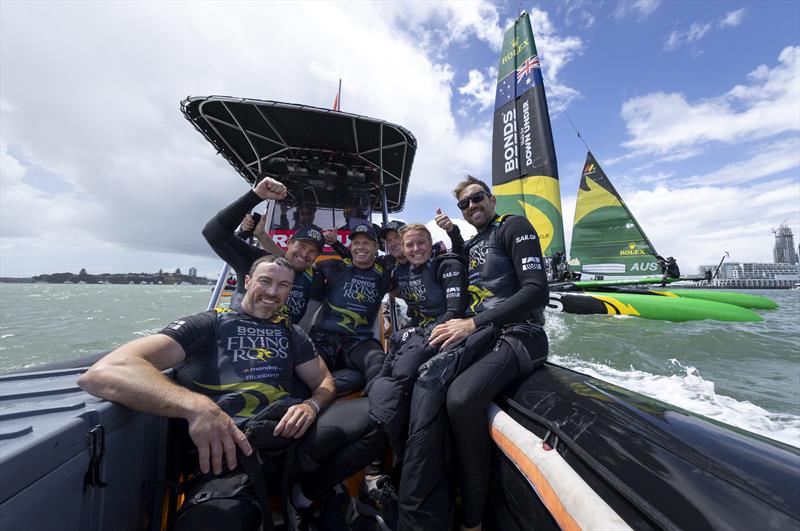
The crew of the Bonds Flying Roos, the dominant crew in Sail GP Season 6 have all gone in to Team Australia' s AC75 sailing squad.(L-R) Kinley Fowler, Tom Slingsby, Sam Newton, Glenn Ashby, Tash Bryant, Jason Waterhouse, plus Luke © Felix Diemer/SailGP
With the clock now counting down on the official America’s Cup website – and showing 230days until the start of racing in Naples, newcomers Team Australia seem to be in a confident, if hectic place at the moment.
“We've certainly got our nose to the grindstone at the moment,” says Glenn Ashby, Head of Performance and Design. “There’s lots of plates spinning in the air,” he adds, mixing his metaphors. But you get the picture.
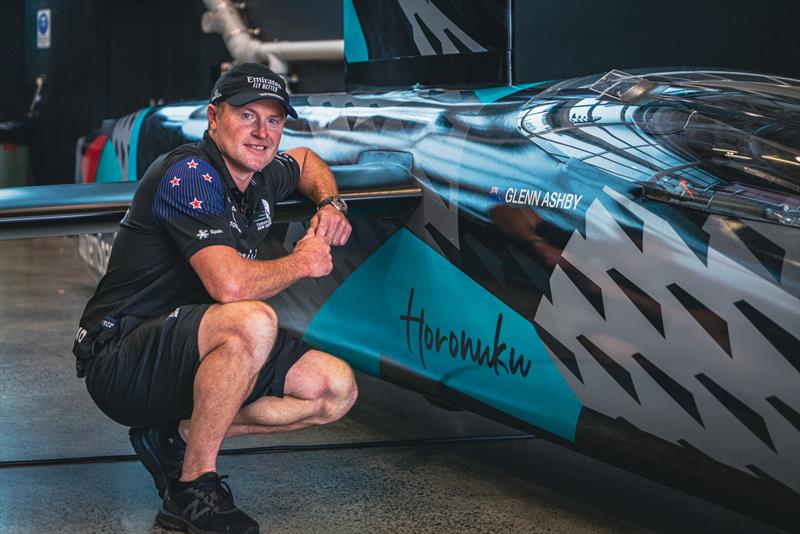
Glenn Ashby's last project with ETNZ was leading Project Speed - which set a new wind powered landspeed record in South Australia - photo © Hamish Hooper / Emirates Team New Zealand
“For me personally, I'm enjoying the challenge of taking on a whole lot of different things that I've never taken on before.”
“Personally, I've not really been in this role before, technical director and head of performance. So I’m learning new skills and rounding out my America's Cup experience".
Glenn Ashby’s last tour of America's Cup duty with Emirates Team New Zealand leading into the 2021 America’s Cup, sailing Te Rehutai, the AC75 now purchased by Team Australia. But in the 2024 Cup cycle he led the Speed project in which the Kiwi America's Cup team sliced over 20km off the 13-year-old record on Lake Gairdner in South Australia.
The 2021 Cup cycle was when the America’s Cup champions formed their relationship with McKinsey & Co. The leading international management consultancy helped the America’s Cup adopt artificial intelligence for performance modelling and crew sailing strategy.
Glenn Ashby doesn’t let much go when asked how much reliance Team Australia will be placing on the use of Artificial Intelligence on their repurposed AC75.
“There are aspects of AI that we are definitely involved with the team as we go forward.
“I think there's no doubt that all teams are utilising AI in this world, as in all industries.
“There are certain things that AI can be helpful with, but also things that it doesn't know either, because we don't even know yet as humans what we can do.
“You’ve got to be a little bit careful that you don't go down the wrong path until you've actually got some experience in it as well.”
Previous design partnerships
Team Australia has a close relationship with the America’s Cup Defenders Emirates Team New Zealand, who have formidable expertise in design and foiling America’s Cup Class race boats - going back 15 years to the first AC72 wingsailed foiling catamaran in 2012. Ashby is credited with that foiling innovation, which changed the face of sailing, based on his experience using foils on Int A-class catamarans, of which he is a 10-time world champion.
In the 2013 America’s Cup, Emirates Team New Zealand formed a design partnership with Italian team Luna Rossa, who came late into the world of foiling wingsailed catamarans. Their fast-track entry strategy was to buy a design package from another team, an unprecedented move in the America’s Cup. They built in Italy, launched in Auckland, trained with the Kiwis, and made the final of the Challenger Selection Series in San Francisco. Along the way, they were summoned to appear before the Arbitration Panel, which clipped their wings over training together and information exchange.
The Kiwis did a similar but different deal with Alinghi in the 2024 Cup, selling the Swiss-based team their prototype AC75 from 2021 as a trial horse while the Swiss developed their own design. The late-starting French team in the 2024 America’s Cup, like Italy in 2013, purchased a design package from Emirates Team New Zealand and built their own boat. They paid the price for a limited campaign and were the first to be eliminated from the Louis Vuitton-sponsored Challenger Selection Series, after just nine days of racing.
For the 2027 Cup, to be sailed in repurposed AC75s, the French La Roche-Posay Racing Team has continued its relationship with Emirates Team NZ to upgrade its AC75 and looks to be in a strong position, as are most of the Class of 2027.
Team Australia purchased Emirates' 2021 America’s Cup winner Te Rehutai, a 2027 AC75 design package, and engaged ETNZ’s in-house construction team to refit the AC75, alter the deck and hull shape, reduce weight, replace the manually pressured hydraulic systems with battery power, and upgrade systems to a 2027 specification. To comply with 2027 Cup rules 2.7metres of bow section had to be laminated in Australia, flown to New Zealand and laminated onto the AC75.
“We purchased a design package from Team New Zealand, and that relationship has been fantastic. Without that relationship, Team Australia wouldn't exist. We wouldn't be able to get on the water next year."
“It has been a really great relationship. Very much a collaborative approach. The communication side of things between all the different departments, whether it be electronics or hydraulics or the boat building side of things, has been great.”
After three America’s Cup campaigns with Team New Zealand, plus the 2024 land yacht speed record project, Ashby knows the people and the processes and is the perfect interface between the two teams, who each think of him as one of their own.
“Obviously, the relationship that I've had with a lot of the guys has been very helpful in knowing the ways that we can wobble through some of the scenarios and the communication side of things.
“It’s not like you're meeting new people for the first time, for example. I think that's been a big key for us is having that relationship, and I hope that can be something that we take into the future, and into subsequent America's Cups.”
However, other teams view these partnerships askance, as was the case with Oracle Racing and SoftBank Team Japan in the 2017 America’s Cup.
At some stage of the 2027 campaign, Team Australia will have to cut its design ties with Emirates Team New Zealand.
“It's a bit open-ended that question,” Ashby says. “Realistically, we'd like to be very much on our own two feet. By the time we get to Naples, we're setting up our operations to be exactly that. That umbilical cord will be cut by the time we get to Naples, all going well.”
Asked whether their AC75 came with its 2021 America’s Cup winning performance database, Ashby described the information as “a fairly simple setup, initially.”
“We've got our own team working behind the scenes on developing the boat as well. We're under no illusion that we weren't going to get the latest design from Team New Zealand that they're going to launch with for the America's Cup in Naples.
“We’ve got a great package, but we know that we have to develop and build on that, which we're able to do. But we’ll still be relying on the connection with Team New Zealand as well as setting up a standalone team in Naples, doing our own development, and moving forward as our own entity.”
AC40 program
The good news for Team Australia’s Youth and Women sailors is that the team will be getting its own AC40, instead of sailing borrowed boats as in the 2024 events.
“We will be getting an AC 40 for the Women and Youth events in Naples,” he says. “That's still getting put together at the moment. But we will definitely be doing the AC40 program, probably around May next year, and we'll be getting those teams on the water.
“That's definitely a work in progress behind the scenes at the moment for the women's and youth program, which we'll set up over the next couple of months here in Australia.”
“It's certainly discussed at all the management meetings, as we're going forwards, and making sure that we do that as best we possibly can - like all the teams are - to maximize the value out of that event, and also build talent and future pathways for the for the for the big team.
“It's a big focus, particularly now, on talent identity.”
With the tight commissioning and workup timeframe for AC75, how will that work with the availability of an AC40? Will the two programs be dovetailed together, or are Youth/Women and the AC75 programs quite separate deals?
“That’s a really good question – there’ll definitely be some overlap,’ Ashby responds.
“We're trying to work out the best way to do that because they end up having to be run in parallel. That said, there will be some overlap.”
“I think we will probably be very similar to all the other teams where there is some dovetailing. But ultimately, those two programs are - two separate programs, but there'll definitely be some resources that will cross over.”
“Ultimately they'll be in the same location and very much operating in amongst and underneath our umbrella.”
Chase boats and base in build
The team is also well advanced in assembling its on-the-water support assets, such as chase boats and other support boats.
“We've purchased two second-hand chase boats, which has been great. And we've also got two new chase boats in build.”
“We're actually getting our main chase boat built down in Tauranga at the moment. We wanted a Catalyst 45, which is very similar to what a lot of the other teams use – like Luna Rossa and Team New Zealand.”
“We know the Catalyst design very well - we know the design well that's very much a fit for purpose operational vessel - so we're getting that built at the moment”
“That'll be getting shipped across from New Zealand later in the year, and we also have another chase boat being built over in Europe. Hopefully our chase boat fleet will be up to spec with the telemetry and the things that we need.”
“Our base is getting built as we speak over in Naples, and that's going really well. Again, it’s a purpose-built base. We didn't have any infrastructure - we didn't even have a set of screwdrivers when we started this team. So we've basically had to start from scratch, and it's been a big operation getting put together.”
Ashby says the Australians have opted for a prefabricated base approach – “we want something that we can actually move down the track - a little more than just tents, on containers.”
“We'll have workshop containers inside the building.”
“Certainly Andrew Henderson's put a huge amount of effort into the design of that building. He knows them well, and they do have a life going forward. It was really important for us to know that we could do that going forward.”
Strong sailing squad combination
In mid-May 2026, Team Australia named a squad of seven sailors. Three, plus Glenn Ashby, are previous America’s Cup winners. Several also compete on the SailGP circuit alongside many others from America's Cup teams.
Essentially, the squad is the Bond Flying Roo’s SailGP crew, with the addition of Luke Parkinson and the subtraction of Iain Jensen. The former sailed the last two America’s Cup campaigns for the Brits, and the latter is sailing with Emirates Team NZ.
Asked if this group of four Cup winners would form the nucleus of the AC75 sailing squad, Ashley replied: “We haven't decided exactly who's doing what role on the boat. In some positions, we've got a pretty good idea of what we're wanting to do. But ultimately, we need a sailing team that can back each other up and actually do multiple roles.”
“We're still learning what roles suit different people and the way we're actually setting the boat up as well.”
“We will be slightly different than other teams on how we actually set up the sailing of the boat. A lot of the team have sailed together previously (including with the comeback win with Oracle Racing in the 2013 America’s Cup). Currently, they are all sailing in SailGP, which I think is a really big advantage.”
“We’re coming in late, but having that communication pathway and performance analysis already formed means that there is some good advantage there.
“I also think that having a mix between America's Cup experience and knowledge, and new talent coming through, is really important. And I think we've got that balance right. So excited for the guys for the future, and hopefully we can provide them a package that they can go sailing on. That's going to be quick enough to make them look good.”
Ashby says they expect to wind up with a team of “around the 90 mark by the time we get to Naples. We're around 60 now at the moment.”
“We are building the team slowly, and every week there seem to be two or three contracts coming across the desk to be put together."
“When we pulled the trigger on this, in March, it was just me. And now we've got to 60, with some fantastic people around and growing. It is a lovely feeling.”
“It's quite daunting, as well. But in all departments, we're slowly growing, and we know that when we get boots on the ground in Naples, there will be a little bit of a spike, and that will take us probably to around that 90 mark.”
“We’re very much an Aussie team. We do have a few internationals, which I think is really great for culture and balance. But largely we're an Australian-based team. Operationally, we’re largely Australian. So culturally, that's great.”
Building on SailGP
Meshing an America’s Cup testing program with SailGP commitments for the whole squad will be a significant scheduling task given that the SailGP program is rather uncompromising towards other events.
“Every team involved with the America's Cup has the same issue to deal with,” Ashby said. “So largely we've based our testing and development program around a couple of those events. I think it's really important that the guys and girls are still racing right through, and I think those little mini breaks have the advantage of keeping the sailing team sharp.
“But it also gives the shore team and the operational side a chance to do some upgrades and boat work as well.”
“You can quite accurately schedule upgrades and service work to be done on the boat,” he adds.
“You can look at it both ways and say, “it's not ideal that they're going away. They should be focusing on the Cup”.
Ashby says from experience: “It is really nice to have a break off one boat, go and race on another boat, come back, reset, and you often make gains in that period.”
“I see it from a positive sailing perspective - making sure our sailing team are sharp, leading into racing on the AC75, and working together closely in that racing environment is very beneficial. We'll make the best out of it for sure.”
Naples weather program
Surprisingly, one area where Team Australia will be independent of the New Zealand team is weather analysis and forecasting.
“We actually have our own completely separate team.”
“As much as Clouds (Roger Badham, top Australian long-time Team NZ forecaster) and I are great mates and have worked together for a long period of time, it probably wasn't quite right that we used that same resource for both teams.”
“As much as I would have loved to have worked with Clouds, and we will do in the future, I'm sure - but we have our own standalone team, and are very much focused on our own weather program.
“It also allows us to explore different pathways and things for ourselves as well, and I think that relationship for future building, is important.”
Turning to the condition in Naples, Ashby says, “for the time we're racing, in theory, it's supposed to be a knot or two windier through the earlier part of the Challenger series versus the later period when the actual America's Cup is sailed.
“But we're planning on winds around that 10 -12 knot mark, which is what everybody says it's going to be. But like every regatta you go to, it's always different than what you expect. So we're keeping open-minded.”
Ashby has previously sailed in Naples and says it “can get quite choppy, but in general, we’re gearing up around a slightly flatter water venue than Barcelona.”
Australians outside sail patent dispute
As a top high-performance sailmaker and designer by trade, plus four America’s Cup campaigns in the heart of the sail and rig design team, Ashby is in a unique position with Team Australia.
“We’re definitely collaborating very heavily with Norths, and we have our own sail design program as well.
“I think we're actually in great shape there, and we've got a lot of accumulated knowledge over the years. We're in good shape.”
The Australian team are outside the Sail Design Patent scrap between Team New Zealand and North Sails. The Australians, as do the French team, have a Design Agreement in place with Team New Zealand.
“We have been in discussions with Team New Zealand on a lot of the sail programs.
“I've worked with a lot of the North designers previously in other projects, so there's a lot of accumulated knowledge there. As part of the design package, we have got an agreement with Team New Zealand, as part of our sail program. So I've worked with those guys for a long time now, and there's been a lot of coffees going into where the sails are currently. So, I think we're in good shape.”
Even after two operations on a broken leg following a SailGP accident, and under doctor’s orders to rest, Melbourne-based Ashby is working across multiple locations - Sydney, where the team is based, and Auckland, where the AC75 rebuild is underway in the Team NZ build facility.
“Some weeks I might be in New Zealand for two or three days, and others two or three weeks might pass without a visit.”
“Obviously now with Zoom and phone calls, you don't have to jump on a plane every two minutes to go and have a conversation with someone. But I'm trying to minimise my travel as much as I possibly can, because I am up and back to Sydney quite a bit as well.”
“We've got some great boots on the ground over in Auckland within the team who we talk to, at least daily and often two or three times a day. So we feel very connected to what's going on over there. But it's always nice to go over and see the boat in the flesh, too. That puts it all into perspective. We can see that it is real and that it is all happening.”
“Our main office is up in Sydney, so that's basically where we do a lot of the heavy lifting, from an administration perspective up there. But again, with advances in Zoom and Teams meetings now, we don't all have to work out of the same office. With a lot of our sailors being overseas and doing different events, as long as you have time management and you're effective with your scheduling, you can actually get through a huge amount of work, which is great.”
Ashby says Team Australia has a core of five to six people in Sydney, which may grow to 20 depending on what is going on with Simulator Camps and bringing the Performance and Sailing teams together.
“We have our simulator based in Sydney, and hopefully that'll be something that we can keep rolling along, over the next few years.”
To read Part 1 of this interview, published last week click here