
An interview with Michaella McCloskey about SailGP's F50 license program and demerit point system
by David Schmidt 16 Jun 16:00 BST
June 16, 2026
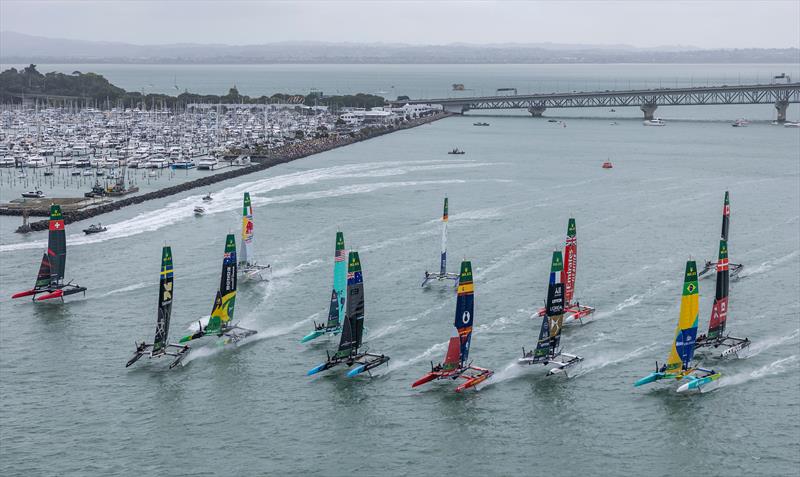
The SailGP F50 catamaran fleet sailing past the Auckland Harbour Bridge, on Race Day 1 of the ITM New Zealand Sail Grand Prix in Auckland, New Zealand © Simon Bruty for SailGP
Without question, SailGP offers some of the world's highest-performance on-the-water racing, with the professional sailing league's wingsail-powered and hydrofoil-lifted F50 catamarans regularly ticking speeds in the 40- and low-50-knot range. While this is fast by anyone's yardstick, the risk-reward ratio is further compounded by the league's success and growth: Season 1, which began in Sydney, Australia, on February 15, 2019, saw six teams competing, while Season 6, which began in January in Perth, Australia, on January 16, 2026, features 13 teams. Factor in the short racecourses and tight starting lines that the league has long used, and the objective risks are hard to ignore.
Granted, the league also features many of the world's best sailors, but this presents its own double-edged sword: While there's no lack of expertise involved, SailGP athletes like to win.
If this sounds like sailors playing for keeps on congested racetracks at near-highway speeds, you just nailed a foiling tack.
Google "SailGP crashes," and you'll find plenty of fodder, including an official SailGP video montage (from December 2022) of some wild high-speed collisions.
The 2026 season has been no exception, with three major crashes to date.
The first happened on January 16, 2026, in the first race of the season-opening Oracle Perth Sail Grand Prix presented by KPMG, when the Explora Journeys Swiss SailGP Team crashed into the Black Foils New Zealand SailGP team. Fortunately, no injuries were reported.
The second—and by far the worst—happened on February 13 in Race 3 of the ITM New Zealand Sail Grand Prix in Auckland, when the Black Foils New Zealand SailGP team crashed into DS Automobiles SailGP Team France. This collision sent two sailors to the hospital, one with double compound fractures to his legs, and the other with abdominal injuries.
The third happened on May 31 in Race 3 of the Mubadala New York Sail Grand Prix, when there was a three-way crash between Mubadala Brazil SailGP Team, the U.S SailGP Team, and the Red Bull Italy SailGP Team. While no injuries were reported, the Americans and Italians were penalized for this crash.
In an effort to bolster safety, SailGP announced on February 12, 2026, that the league would require sailors to earn and hold either a provisional or full license to race (or even train) aboard an F50. Provisional license holders must pass exams, complete safety training, undergo a medical screening, and put in time on the simulator and aboard F50s. Full licenses require "significant" time in the sim and onboard F50s, with specialist requirements for each onboard role.
(Here's a link with the full details: sailgp.com/news/26/f50-super-licence-what-it-is-why-it-matters)
While the league wisely views racecourse time as more valuable than simulator or practice time, SailGP also instituted a demerit system, where teams are penalized for "safe or unprofessional conduct". If an individual sailor racks up 15 demerit points, they will be suspended; entire teams can also face suspension if they hit cumulative limits that are based on the size of the crew.
I checked in with Michaella McCloskey, SailGP's Director of Programs and Technologies, who works on the F50 license program, via email, to learn more about the professional sailing league's new F50 licenses and demerit system.
What was the impetus for creating SailGP's F50 license and demerit system?
The creation of the F50 license and demerit system was driven by a generalized, proactive incentive to increase safety and standardize professionalism across the fleet. As the F50 platform continues to evolve in speed and complexity, SailGP established this framework as a baseline assessment.
The program is systematically designed to ensure every athlete on the water possesses the technical skill, theoretical knowledge, physical capability, and safety compliance required to operate these high-performance foiling catamarans safely, professionally, and competitively.
Can a team compete in SailGP events if they have only earned their provisional license, or is a full license required to race? Also, do you imagine that all athletes on a given team will earn their licenses at the same time, or do you expect that teams could be comprised of athletes with mixed-level licenses, based on previous experience?
A team cannot compete in a SailGP event with an entirely provisional crew; however, a 100-percent fully licensed crew is not required either. The regulations establish a hybrid baseline designed to balance safety with athlete development.
To be eligible to compete in an official SailGP event, a team must meet the following minimum on-board licensing criteria:
—Three fully licensed athletes: There must be a minimum of three fully licensed crew members on board the F50 during racing.
—Two control roles covered: At least two of those fully licensed athletes must occupy critical F50 Control Roles (defined as the driver, wing trimmer, or flight controller).
—Provisional baseline for remaining crew: All other crew members on board must, at a minimum, hold a valid provisional license.
This structural framework guarantees that high-consequence control positions are managed by fully certified athletes, while safely opening the door for developing talent to gain elite racing experience under direct supervision.
I understand that earning full licensure for drivers requires five hours of simulator time and 15 hours of on-the-water time, including in airs exceeding 14 knots. Are drivers required to log time using all the different wing and foil combinations, or is this not part of the license process?
Drivers are not required to log hours across all the different wing and foil configurations to obtain their full license. Given that configuration changes are driven universally by the daily event conditions rather than athlete preference, forcing individual logging for every configuration is not a component of the licensing process.
Why are wing trimmers and flight controllers required to log an additional hour of simulator time over drivers? Also, are there wind-range requirements for the 15 hours of on-the-water sailing time that wing trimmers and flight controllers need to log, or—theoretically—could these athletes satisfy the on-the-water requirement over a few days with very similar airs?
Wing trimmers and flight controllers require an additional hour of simulator time (six hours total versus the driver's five [hours]) to ensure familiarity with the multiple command inputs.
Athletes cannot satisfy their 15-hour on-the-water requirement in easy, identical conditions. The regulations require athletes to log hours in a range of conditions:
—The 14-Knot Rule: Driver, wing trimmers and flight controllers must log at least 4.5 hours of their on-the-water time in wind speeds of 14 knots or more.
I've been told that F50s are very different animals in 20 knots of breeze and waves than in 20 knots and flat water. Is there any requirement to log time in different sea states?
Currently, there is no requirement for athletes to log training time in different sea states to obtain their F50 license.
Let's say that a new team wants to join the league but plans to race with a driver and crew that haven't had much (if any) F50 experience. Roughly how long do you envision it will take for the driver and crew to earn their full licenses? And do you think this will affect the amount of runway/build-up time that a new team needs before joining the league compared to teams that joined prior to 2026?
The total elapsed time required for a new SailGP team to obtain the necessary licenses depends heavily on their crew composition. Under the SailGP license guideline rules, a team does not need every single member to be fully licensed to start racing, but they must meet strict foundational minimums.
To compete in an official SailGP event, a crew must have at least three fully licensed members on board. Crucially, two of those fully licensed members must occupy "F50 Control Roles" (driver, wing trimmer, or flight controller). All remaining crew positions can be filled by athletes holding a provisional license, provided they meet basic training requirements.
The licensing process follows a strict two-step progression, optimized by the Weighted Training Time Principle (where high-intensity sessions like actual racing count more heavily than free training time).
Step 1: Provisional license (immediate)
—Requirement: Completion of all pre-sailing administrative requirements and a comprehensive role induction.
—Estimated Elapsed Time: Administrative (one to two weeks prior to getting on the water). This allows developing athletes to participate in races under the direct supervision of fully licensed crew members.
Step 2: Full license (role-specific)
—For example, driver requirements: A minimum of 15 hours of sailing time and five hours of simulator training.
—Elapsed Time: Roughly six days of active on-water sailing, plus additional structured time dedicated to simulator training.
—Outcome: Upgraded to a full license upon completing all practical, simulator, and competency verifications.
Total estimated elapsed time: For a developing control-role athlete (e.g., a new driver), a realistic runway is two to three weeks of dedicated, intensive preparation (combining simulator weeks and a six-day on-water training block) to achieve full license status, assuming ideal weather and simulator availability.)
Can you please walk us through the demerit system? How many points do you think will be administered for a minor infection? And what about medium- and high-level infractions?
The demerit system acts as a transparent safety and behavioral compliance mechanism governed by the F50 License Panel. Incidents range from tether infractions to boundary and collision breaches, and all issued points carry a 12-month expiration date.
Points are administered based on three distinct levels of severity:
—Minor = 1 point (minor unsafe action)
—Moderate = 2 points (unsafe action)
—Serious = 3 points (dangerous acts, major safety breaches)
The system also prevents a team from racing with a dangerous or undisciplined crew. The combined demerit total of all athletes currently on the boat cannot exceed a strict cap, which scales depending on the persons on board (POB) configuration required by the wind/wing day:
—6 POB: Combined crew total cannot exceed 30 points
—5 POB: Combined crew total cannot exceed 25 points
—4 POB: Combined crew total cannot exceed 20 points
—3 POB: Combined crew total cannot exceed 15 points
If a team's active crew list exceeds these cumulative caps, they are unable to race.
To clear the block, the team must physically substitute a disciplined athlete out for a "cleaner" athlete to bring the boat's total back under the threshold. If they cannot manage this, they forfeit the regatta.
The 15-point suspension threshold is designed to catch a pattern of cumulative behavior, mixing minor operational slip-ups with moderate or serious safety breaches.
Will demerit points be assessed in real time by the umpires, or is this determined ex post facto?
Demerit points are not assessed in real time by the umpires; they are determined ex post facto by the F50 License Panel.
What do you see as the most dangerous moment (or moments) of a SailGP race? Also, is the new license process and demerit system specifically aimed at reducing risks during these critical times, or is it more focused on bolstering safety, writ large?
The start-to-mark-1 provides an immediate, highly visible justification for these regulations, whereas the F50 license program and demerit point System serves as the overarching system that controls the broader operations. It establishes an uncompromised, professional baseline for technical skill and regulatory discipline from the moment the F50s leave the mooring field until they return to the tech site.