
An interview with Peter Gibbons-Neff about his 2027 Mini Transat campaign
by David Schmidt 6 May 16:00 BST
May 6, 2026
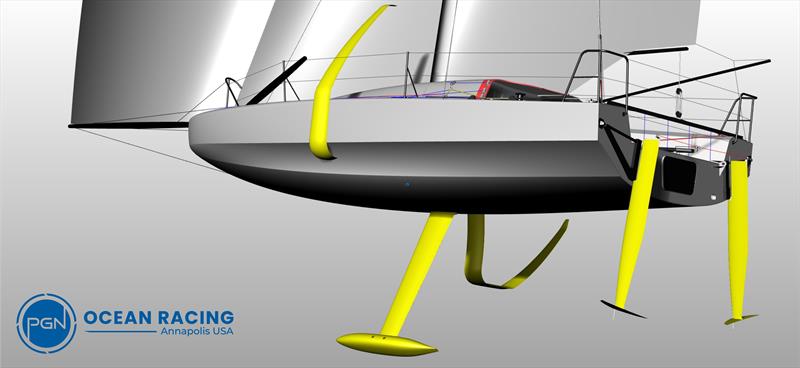
A rendering of Gibbons-Neff's new Sam Manuard-drawn Classe Mini prototype © Images Peter Gibbons-Neff Collection
In 2023, American singlehanded sailor and U.S. Marine Corps Reserve officer Peter Gibbons-Neff raced his 21-foot Classe Mini across the Atlantic Ocean in the storied Mini Transat race. His goals were twofold: to raise awareness for U.S. Patriot Sailing, which is a volunteer-run 501(c)(3) non-profit that helps U.S. military veterans find new horizons, and to become one of only a handful of American sailors to complete the 4,050 nautical mile course.
While the race's first leg, which stretched from Les Sables D'Olonne, France, to the Canary Islands, went well, Gibbons-Neff lost his crucial port rudder while hand steering Terminal Leave six days into the second leg, which took the fleet from the Canary Islands to Guadeloupe.
"It was the rudder I really needed to go 2,000 nautical miles west!" Gibbons-Neff said.
For some sailors, this would have been a crisis, but Gibbons-Neff had the right background—including years spent as a skipper for the U.S. Naval Academy's varsity sailing team, and ten years spent as an active-duty U.S. Marine officer, where he was deployed in Afghanistan's Helmand Province (amongst other deployments)—to handle the situation calmly.
Survival skills, after all, die hard.
Gibbons-Neff diverted some 300 nautical miles to Cabo Verde, where he effected repairs and then continued on to Guadeloupe.
Now, years later, Gibbons-Neff is preparing for the 2027 edition of the Mini Transat, which he plans to contest aboard a brand-new prototype Classe Mini that was drawn by Sam Manuard (if you followed the 2026 RORC Transatlantic Race, you're likely familiar with Manuard's scow-bow Palanad 4, which took the overall win), and which is being launched in France this month.
Unlike his old ride (a series RG 650 Classe Mini built of fiberglass with a fixed keel), Gibbons-Neff's new prototype build is constructed from carbon fiber and carries a scow bow, full boat-lifting foils, a rotating wing mast, and a deck-plated mainsail.
If this sounds like a steep learning curve, you're on the right track.
That said, Gibbons-Neff has clearly demonstrated the kind of personal drive, ambition, and at-sea survival skills needed to pull off ambitious projects.
I caught up with Gibbons Neff, via email, to learn more about his 2023 Mini Transat, his new Classe Mini build, and his plans ahead of the 2027 Mini Transat.
What were the biggest lessons that you learned about racing Classe Minis across the Atlantic in 2023 (aside from rudder-breakage issues)? Also, how do you plan to incorporate these lessons into your 2027 campaign?
There was a tremendous amount of learning leading up to the 2023 Mini Transat and throughout the race itself. This was both expected and one of the parts of the campaign I really enjoyed most. Looking back on that experience, the most significant lessons were centered around mindset.
That was the first time I had truly set off to cross an ocean. Even though I ranked high in the fleet for offshore miles raced in my boat and felt well-prepared, there were still major unknowns in actually crossing the Atlantic. The extended time at sea, completely alone, and in new waters added a different level of challenge on top of the competition itself.
Along the way, I learned that I had to trust both myself and the preparations behind me. By the time I crossed the finish line in Guadeloupe, after thirty days at sea between the two legs, I no longer had any doubt in my ability to make it across an ocean.
Another major lesson was understanding the importance of mental resilience while offshore. After one of my rudders ripped off, I was able to stay focused on solving the immediate problem and made a quick technical stop in Cape Verde for repairs.
The harder challenge came afterward—recovering mentally from the feeling of failure while watching the fleet sail away. Even though I never let off the gas pedal, it took a several days to process the setback and reset mentally. I realized my resilience offshore came from the clarity of my mission and the "why" behind my campaign: raising awareness for U.S. Patriot Sailing. Even while chasing back toward the fleet, I was still accomplishing that goal.
Finally, I learned how much consistency and attention to detail matter every single day. From sleep management and navigating to sail changes and risk management, there are countless small decisions offshore that create a cumulative effect over a race as long as the Mini Transat. The ability to keep the boat moving fast, in the right direction, and to stay ahead of maneuvers and changing conditions makes all the difference.
For the 2027 campaign, all of those lessons carry forward. The goal is not simply to return—it is to compete at the front of the fleet. That means starting with the right platform, focusing on mindset, and approaching preparation with even more precision. Experience taught me how to finish; now the focus is learning how to win.
Last time you raced in a production Mini—what inspired you to switch to a prototype this time? Also, what drew you to hire Sam Manuard to design you a brand-new fully foiling, scow-bow Mini?
The first campaign was all about learning the fleet, and a series boat was the right platform for that. It is an excellent way to enter the world of French solo offshore racing, learn the class, and build experience. After finishing the 2023 Mini Transat, I felt I had left too much on the table in terms of performance. I knew I wanted to return but [I] did not yet know how or when.
Since I first discovered the Classe Mini 6.50, I have always been fascinated by prototypes—the innovation, the experimentation, and sometimes the radical nature of the designs. I quickly decided if I was going to come back, I wanted to do it in a prototype that had a real possibility to compete at the front of the fleet.
That decision quickly led me to Sam Manuard. I saw the potential in his designs, most notably 1067 Nicomatic-Petit Bateau, which launched in 2022 as a fully foiling Mini. It was not the first foiling Mini, but it was the first to demonstrate consistent offshore foiling over real race distances, which fundamentally redefined expectations for the class. He also designed other highly successful Minis, including a semi-foiling option that proved competitive with a second place in the 2023 Mini Transat.
I started working with Sam around the time when Nicomatic was really getting dialed in and foiling more consistently. By the end of the 2025 season, [skipper] Benoît Marie had gone into the Mini Transat undefeated in all seven offshore races he sailed that year. That was an incredible achievement and a clear signal that the concept was working.
Following those performances reinforced my decision. I wanted a boat that was both competitive and pushed design development boundaries. I also admire Manuard's passion for both sailing and yacht design. With his experience, we set out to design the next evolution of his fully foiling platform. This is not a repeat of a successful boat, but a refined new prototype built for the 2027 Mini Transat.
A lot of people are familiar with Manuard's work on Paland 4—does your new boat share some of this DNA? If so, can you please tell us about this?
Yes, absolutely. While I do not want to speak for Manuard's design philosophy, you can definitely see some similar elements in the overall approach. The most obvious connection is the scow bow. Increasing hull volume forward helps create a more powerful and stable platform offshore, especially when sailing off the wind. Manuard has been at the forefront in refining that concept across multiple classes, from Minis to Class40s, and IMOCA designs.
There is also a direct connection through the builder. Palanad 4 was built at JPS Production in La Trinité-sur-Mer, [France], the same yard currently building this Mini. When I first visited JPS to discuss the project, Palanad 4 was still under construction there, which gave me a lot of confidence in both the builder and the design process.
Do you have much experience on foiling boats?
Honestly, no—I do not come from a foiling background.
These platforms were still fairly rare when I came up through junior sailing, and I missed much of their rapid development while I spent ten years serving in the Marine Corps and stepped away from competitive sailing for periods of time. My experience is much more rooted in offshore racing and keelboats, so I am definitely playing catch-up and approaching foiling with a lot of respect.
I spent some time in a Waszp this past winter, which was a humbling-but-valuable learning curve, although I know this Mini will sail very differently.
The transition to a fully foiling Mini is a major step, which is exactly why we are launching soon and building two seasons of training and racing before the 2027 Mini Transat. Foiling is also becoming far more accessible across the sailing community, and if this campaign helps show that progression and inspires others to get on the water, that would be a great outcome too.
How much boat/foil/sailplan development do you and your team foresee happening between now and the start of the Mini Transat? Also, are there any specific projects that you have in mind, or do you need more time on the boat to sort all that out?
The launch is just the beginning, and yes, the goal is continuous development to optimize performance.
The first priority is understanding the baseline of this new boat—how it will behave in different conditions, sail crossover development, autopilot tuning, foil control, and overall power consumption. Balancing speed, stability and reliability will drive much of our early development.
We are also building a completely new sail inventory with Quantum Sails specifically for this platform. They have invested significant time and resources into the development process, coordinating closely with Sam Manuard, JPS Production, Heol Composites for the mast, and Light Speed Rigging to optimize the sail plan for this new boat.
Right now, the focus is less on major design changes after launch and more on learning the boat. Once we have real offshore miles logged, we will have a much better understanding of where the biggest gains can be made. Development always comes with cost, so the priority is making smart, targeted improvements.
Can you please tell us about your sailing program for the next year or so? What are your goals and ambitions with the boat for the next 12 months?
The main goal for this first season is to get the boat launched, tested, and on the starting line for the Mini Atlantique this July. It is a solo race from Les Sables d'Olonne, France to the Azores and back—about 1,300 nautical miles each way with a quick stopover in between. To make that happen, we need to launch soon, complete the initial testing phase, and build enough confidence in the platform through qualification races and offshore training by July.
These initial races are less about results and more about validation by earning qualification miles, understanding the boat offshore, and building reliability. From there, the focus shifts to a full winter and spring training program to optimize the platform and be truly competitive heading into the 2027 Mini Transat.
Do you plan to move to France and take a deep dive into the French solo sailing culture in the lead up to the race? Or, do you expect to do most of your training Stateside?
Yes! My partner, Jane Millman, and I moved to France full-time in March to be a part of the boat building process as everything comes together.
While we spent a lot of time in France during the last campaign, this time we were able to secure long-term visas and fully commit to being here. That matters, because being immersed in the French solo offshore scene is essential for development, training, and building relationships.
The U.S. connection remains a huge part of who I am and of this campaign, and we will absolutely make trips back to Annapolis throughout the year. But this new prototype and the level required to compete at the front of the fleet demand more focus here in France throughout the campaign.
Where and how does U.S. Patriot Sailing fit into your new campaign?
U.S. Patriot Sailing is the reason behind this campaign. [My] first Mini Transat campaign was about raising awareness for this non-profit organization because it helped me personally during a difficult transition after returning from deployment and leaving active duty in the Marine Corps. It gave me a community, purpose, and a way to reconnect through sailing when I needed it most. U.S. Patriot Sailing supports veterans through sailing across multiple locations throughout the country.
I also believe these campaigns provide something beyond direct participation on the water. They offer perspective, inspiration, and a sense of adventure for veterans who may not be able to sail themselves, as well as for those who are on active duty at home or deployed overseas. Following a challenge like this over multiple years can be a reminder that new horizons still exist, and [that] can make a real difference.
This new campaign builds on that success and is taking the support a step further. The goal is to help expand opportunities for veterans by generating more funding, partnerships, and visibility for the organization.
Since the last campaign, U.S. Patriot Sailing has grown significantly with more members, more locations, more donated boats, and greater national reach. I believe this new prototype campaign, and the visibility that comes from competing, can help accelerate that growth even further.
Performance matters because visibility drives mission. Racing well creates attention, and that attention helps create support for veterans. That is what makes this campaign purpose-driven for me—it is about much more than just crossing a finish line.
Is there anything else about your campaign or your new ride that you'd like to tell us about?
The Mini Transat is raced solo, but getting to the start line is never a solo effort. This project is only possible because of the incredible network of partners, supporters, donors, friends, and family who believe in the mission behind it.
The returning sponsorship from Fawcett Boat Supplies helped kick-off the initial build, and we have outstanding technical partners helping bring this new prototype to life and up to speed.
With that said, we are actively seeking a title partner and additional sponsors to power this campaign to the 2027 Mini Transat start line.
What excites me most is that this is a full commitment to competing at the highest level while using that visibility to create something bigger than the race itself. Performance and purpose go hand in hand in this campaign. I am proud of what we are building—not just one of the most advanced boats in the fleet, but a platform with a clear mission behind it.
Editor's Note: To learn more about Gibbons-Neff's campaign, or to help him achieve his goals, visit: www.pgnoceanracing.com/