
UK Musto Skiff Training Weekend at Ullswater Yacht Club
by Euan Hurter 22 Apr 19:40 BST
18-19 April 2026
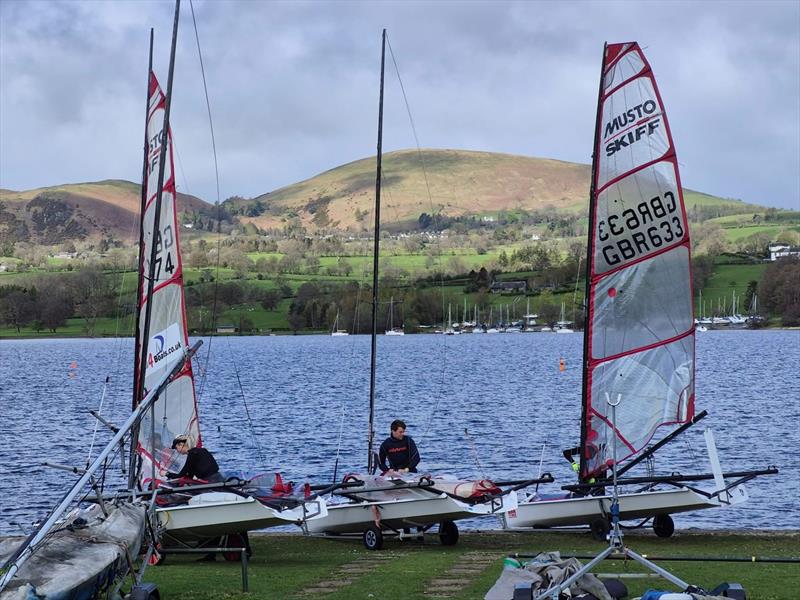
Boats rigging up before training © Brennan Robinson
The UK Musto Skiff Class Association has made structured training a real priority for 2026, and with Noble Marine Insurance continuing their support, the class is well placed to deliver solid coaching opportunities right through the season.
There's been a noticeable influx of new sailors lately, and the Mainsail X rig is gaining traction, so sharing knowledge across the fleet has become more important than ever - both to help newcomers get up to speed and to keep the whole fleet competitive.
The season's first organised training session was held at Ullswater Yacht Club in the Lake District over the weekend of 18-19 April. Fourteen sailors made the trip - a healthy 50/50 mix of new and experienced faces, which was exactly what you'd hope for. Three of them were on the X rig, making it one of the first proper attempts to work through setup and tuning for that configuration as a group.
Coaching was in the hands of Rob Richardson, who has back-to-back second places at the last two World Championships to his name, so there was no shortage of talent to share.
Saturday: On-Water Training
Beginning the weekend with an overly eager start of 10am on the Saturday, many brushed off the winter cobwebs for the first time this year. Conditions were 8-15 knots from the southwest - enough to keep everyone honest. Given it was late April and many sailors were getting back on the water for the first time since last season, winter wetsuits were non-negotiable and capsizes were plentiful.
The format centred on short-course racing with two starts per race, which kept things fast-paced and repetition-heavy. Rob and the coaching team shadowed the fleet closely, feeding back in real time, which turned out to be one of the most valuable parts of the weekend. Getting that immediate input meant sailors could act on it straight away, rather than trying to piece together feedback hours later over a cup of tea.
After a tough day on the water, the group came ashore for a debrief before a well-earned social hosted by the Shelley's, which wrapped up at a very sensible hour...
Sunday: Tuning and Light Wind Racing
Sunday started a little earlier, at 9:30am, with a detailed look at sail trim and rig tuning. Two boats were laid on their sides so the group could get up close to both the X rig and the standard square-top mainsail and actually see what was being discussed - batten tension, sail controls, how different adjustments affect shape, and useful visual cues to take onto the water.
Racing followed, and a lighter breeze of 4-8 knots came as a welcome relief after Saturday's workout. Capsizes still happened with some regularity, but that was more from the large shifts rather than extreme conditions... After the morning session and a break ashore, the wind eased off further and roughly half the fleet decided to call it a day rather than head back out for the afternoon.
What's Next
The following weekend (23-24 April) sees the first round of both the Northern and Southern circuits - the Ullswater Daffodil Regatta and the Stokes Bay Open, respectively.
After that, the next training session is on the Friday (8 May) before the Weymouth Open (9-10 May), coached by Adam Bowers.
Key Takeaways
Boat Handling
- Stay on the wire as much as possible in light-to-medium conditions as it makes movements smoother and transfers weight through mast (further forward).
- Keep crew weight further forward than you might think, especially in flat water.
- Don't trapeze too high as you risk instability and falling over. High enough so your bum doesn't hit the rack is about right.
- When tacking, let the boat fully pass through the wind, then make a big commitment to the new rack - getting flow back over the foils quickly is the priority.
Starting
- Work on holding station near a mark; batten orientation is a useful tool here - normal battens push the bow to windward, inverted push it away, and mixing them (bottom inverted, rest normal) gives a near-neutral position.
- Pull controls on around 15-10 seconds before the gun, leaving 5-7 seconds to build up to full speed.
Rig Setup & Sail Trim
- X rig: move the mast step two holes back from standard to improve balance, keeping rake the same. Leach is smaller so need to compensate for change in centre of effort
- The new sail wants more kicker - often fully on in strong winds.
- The mainsheet generally needs more tension than you think (upwind and downwind). Want to squeeze the sheet on in puffs and ease in lulls. You should not be able to get block-to-block unless the kicker is fully on.
- Apply Cunningham until the top of the sail just starts to blade off from the 2nd top batten, but don't overdo it - too much makes the sail not work anymore and only produce drag.
- Square-top mainsail setups are trending towards flatter spreaders and less lowers tension (6-10 on loose gauge) - the goal is to add fullness to top of the main.
- In shifty conditions, be wary of pulling the Cunningham - the sail may not recover its shape fully (not enough "elasticity"); set up for the lulls and manage through the gusts.
- Outhaul: aim for roughly 3-4 finger widths between sail and end of boom.
A big thank you to Noble Marine Insurance for their ongoing support, Ullswater Yacht Club for hosting, Rob Richardson for the coaching, and the Shelleys for their hospitality. Events like these don't just happen, so thank you to everyone for making it worth the effort.
All in all, a strong start to the season - good coaching, great social, and some genuinely useful technical work, particularly around the X rig.