
Should have been called Supertramp
by Pantaenius Sail and Motor Yacht Insurance 26 Mar 21:51 GMT
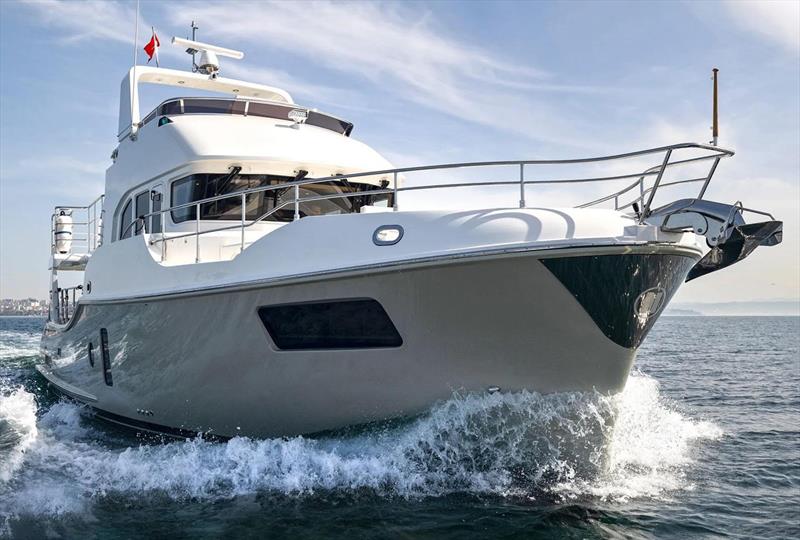
Awanui NZ in The Dardenelles © Awanui NZ
The Nordhavn 5101 could well have taken the famous band’s name simply because Mark and Fiona Rammell have elected to, Take the long way home.
As it stands, the deeply symbolic and personal choice for, Awanui NZ, is that she draws her name from the Maori word meaning, big river, which is a phrase Mark believes captures the way the world’s oceans connect. “All the oceans flow together,” said Mark. “So, we’re travelling on the big river back to New Zealand.”
Additionally, their property near Wellington, Aston Norwood Gardens (aka Blossom Valley), contains many flowering cherry trees that bloom spectacularly each Spring, and attract tens of thousands of visitors. There are over 300 mature cherry blossom trees there, named Awanui, amongst a zillion other species. So, there is a definite link between their life ashore, and their life at sea.
However, the whole thing is that this particular journey is so much more than name. It’s about what is arguably the ultimate expression of a desire, a pathway, and not just living a life, but the irrefutable passion for not merely seizing the day, rather than it is in the grabbing and running with it like you stole it.
Their initial inspiration has not only reshaped how they travel, but how their family of one daughter and three sons thinks about time, adventure, and the idea of home. If it all began as a dream, then it has really set in now. They are over 8000nm and two years into what will be at least a 22,000nm voyage by the time they make New Zealand later this decade, and they are not even at the furthest point outward bound, as yet. That is still to come.
Distance alone is not the measure of this adventure. The real story lies in the way the journey has transformed two relatively casual boaters into dedicated long-term liveaboards, and how their boat has become the hub around which family life now revolves.
Awanui NZ is a 34 metric tonne, fully displacement hulled, Nordhavn 51 designed for comfort during ocean passages, and efficiency. At six knots she will burn just six litres per hour, combined, making that the fabled one litre per nautical mile. Her twin 160hp John Deere diesels double that when you go to seven knots, and double it again when you go to eight, so you instantly get the measure of where you’re going to be at with regards to transoceanic voyages from her total of 5,000 litres on board.
They are now in Holland, and have not bunkered since the Channel Islands, and since leaving the yard in Turkey over two years ago Awanui NZ has been cruising coastlines much more than broad open seas per se. That is to come, clearly, but it is also something Mark, especially, is very keen to do, as he is about checking in with things, not blasting around the globe at a thousand kilometres an hour. As we’ll find out, he’s already done that…
Lofty Considerations
Whilst the Rammells might have been boating for nigh on six years now, the master plan had its origins not so much in the clouds, for one could not have seen the coasts, but very much from on high. For four decades Mark worked as a pilot, including 35 years flying for Air New Zealand. Over the course of that career he flew a wide variety of aircraft, from the Fokker Friendship to the Boeing 737, many Airbus jets, and onto the 767, the 787, and finally the Boeing 777.
“I used to fly from Los Angeles to London, and we’d go over Newfoundland, Greenland, Iceland and Scotland. Those long-haul flights across the North Atlantic often passed over remote and rugged landscapes and coastlines. In the Summer it often looked beautiful down there. Sometimes the ocean appeared completely calm from that altitude,” said Mark.
“I found myself imagining what those places might look like from the sea. I remember thinking, ‘I wonder what it’s actually like down there?’ I’d love to go and see it.’ At the time it was simply a thought. A passing curiosity that comes easily during long flights, but the idea slowly took root. Years later, it would become the basis for the route that Awanui NZ now follows.”
Now whilst the Rammells might not have been boating all their lives, it meant they could tick the navigation box, as too checklists, process, maintenance, watches, provisioning, and so on…
A home, not a house
This mobile home has already taken Mark and Fiona, as well as their daughter, and friends, far and wide. Alas, that was the plan, and Mark has often continued on solo whilst Fiona has returned back to New Zealand.
“I’m really hoping one of the kids develops the passion for it as well,” says Mark. “Maybe one day they’ll take the boat out with their own families.” The idea that the boat might eventually remain within the family is part of what drives the project. Rather than seeing it as a temporary adventure before returning to a conventional life ashore, and Mark imagines Awanui NZ becoming a long-term part of the family’s story. He admits he may well choose to still live aboard the boat when it makes it back to New Zealand.
Mark will be the first to admit that there is never a dull moment, as there is always a task, a repair, or something else to attend to, including their burgeoning YouTube channel, which mark happily shows as a ‘warts and all’ experience when it comes to being a liveaboard.
The real impetus!
Like many ambitious plans, the dream might easily have remained just that if not for a deeply personal moment. One of Mark’s close friends, someone he had spent years boating with, became seriously ill. During their final conversations the two men spoke again about the idea of travelling the world by boat. Before he passed away, the friend asked Mark to promise that he would still go and do it.
Needless to say, the request lingered. Soon afterwards Mark and Fiona sat down together and confronted the question that many people avoid for years. Were they actually going to do this? According to Mark, that moment of commitment was the most difficult step in the entire process. “The hardest thing to do is make the decision. Once you’ve made the decision, everything else just becomes how you’re going to do it.”
It was this shared ownership arrangement with a Salthouse Motor Yacht that piqued Mark’s curiosity with long range, expedition type vessels with displacement hulls and their philosophy of slow, efficient passage making. It was at this time that he discovered the Nordhavn brand. “I remember seeing a Nordhavn and thinking, ‘That’s the boat I love.’” When Nordhavn introduced the N51 model, Mark immediately recognised it as the ideal platform for their plans. The opportunity to purchase hull number one soon followed, and Mark and Fiona took it.
The final price ended up around NZ$300,000 higher than they had originally expected, but by that point the decision to pursue the voyage had already been made. “So, it was just a matter of finding the money. Sadly, Dad passed away at about that time, which helped with the finances, and most certainly added to the desire to make it happen. All the money is in the boat now,” Mark adds with a laugh.
The only way is up?! (and over…)
So, with memories of the North Atlantic, and a real commitment to do this glorious lap, it is of no surprise that Awanui NZ did not leave Turkey and head through the Suez Canal and across the Indian Ocean on her way back to NZ. Rather, they had eyes much farther North. Another element to all of this is that Fiona has Dutch heritage. “Fiona has never really spent much time there,” Mark says. “So, it’s been a really special experience for her.”
The route ahead still stretches across several years and thousands of nautical miles. From Northern Europe the plan is to spend the coming Northern Summer cruising Scotland and its surrounding islands. The rugged coastline that once passed beneath Mark’s aircraft will now be explored slowly by sea.
The following year the voyage continues North to the Faroe Islands, Iceland and eventually Greenland. From there Awanui NZ will cross the North Atlantic to Newfoundland and Nova Scotia, before working its way South along the Eastern seaboard of North America toward Maine and eventually Florida.
By around 2027 the boat is expected to reach the Caribbean and transit the Panama Canal. Once through the canal the journey finally turns west across the Pacific. From Panama the route will likely pass through parts of the Pacific such as the Marquesas or possibly via Hawaii, before continuing through the South Pacific island chains toward Fiji and ultimately New Zealand. If everything goes according to plan, the boat will return home around 2030 or 2031.
Steep
Despite decades of aviation experience, Mark says boating has required him to learn an entirely new skillset. “Pleasure boating is something you really learn as you go.” In aviation, every action is supported by training, procedures and a crew of professionals working together. On a boat, especially when cruising alone, it’s the skipper that carries responsibility, personally. You don’t have someone sitting beside you. You’re it! The learning curve has been steep.”
Mechanical issues, navigation decisions, weather patterns and marina manoeuvres all demand constant attention. “There’s not a day that goes by where I don’t learn something. Maintenance alone is effectively a full-time job.” He performs most of the work himself, from servicing engines and troubleshooting systems to repairing minor cosmetic damage. “Hiring professionals for every task would dramatically increase the cost of operating the boat.”
For many people the idea of travelling the world by boat conjures images of tropical anchorages and leisurely days at sea. Mark is quick to point out that the reality is far more practical. “I think people imagine beautiful blue water and cocktails, but the reality is that with a complex global boat you’re looking after the vessel day after day, after day.”
Keeping costs manageable is another important part of the equation. One of the simplest strategies is anchoring instead of staying in marinas whenever possible. In one recent year Mark estimates he spent around 300 nights at anchor. Yet the appeal of anchoring goes beyond the financial savings. “When you’re in a marina, you’re looking at another boat and another boat. When you’re at anchor every time you look out the window it’s different.”
Memories? What memories?
Perhaps the most surprising part of long-term cruising is how quickly extraordinary experiences can begin to feel routine. “When you wake up every day on the boat, if you’re not careful it becomes your new normal,” says Mark. This is undoubtedly the primary driver for the creation of their YouTube Channel, and the dedication to making regular episodes, so it does not all end up on hard discs never to be turned into anything. In this way it is not only the recording of memories, but a very constant reminder of how truly remarkable the journey really is.
Every so often he stops, looks around and reminds himself where he is. “You have to pinch yourself sometimes.” Just think of some of the remote and beautiful coastlines of the world they will have seen and explored…
Now perhaps the greatest achievement will not be the miles travelled by Awanui NZ. It could well be the life they built along the way. A life centred around curiosity, family and the quiet satisfaction of choosing a different path. Hhmmmm. Does that remind you of anything?
So, if it is all about the memories of a glorious, expansive, and often remote expedition around this here globe, then you would want a cast iron insurance policy with flexible cover for all the locations you intend to go to. That can only really come from a company like Pantaenius Sail and Motor Yacht Insurance.
What then if you had a slightly public grounding, and the Police impounded your boat? Before releasing Awanui NZ, they demanded an inspection of the underneath of the hull, which was a 2,500 Euro affair. Around a month after that little incident, Mark had to go through the renewal of the boat’s insurance, and thought he had better read it. The excess is NZD17,000, but in a grounding, this is waived as Pantaenius want the hull checked just as much as you!
Mark concluded by saying, “I wrote to Pantanius, and within two weeks, the money was in our bank account. I just sent them the social media reports from Portugal, the documentation, and our YouTube clip. They just came back, and said, ‘No problem at all.’ It also did not affect the next year's premium either. That builds a lot of loyalty for me to Pantaenius. Big time!”