
Class40 reduces its carbon footprint and strengthens commitment to more sustainable offshore racing
by Class 40 17 Mar 15:59 GMT
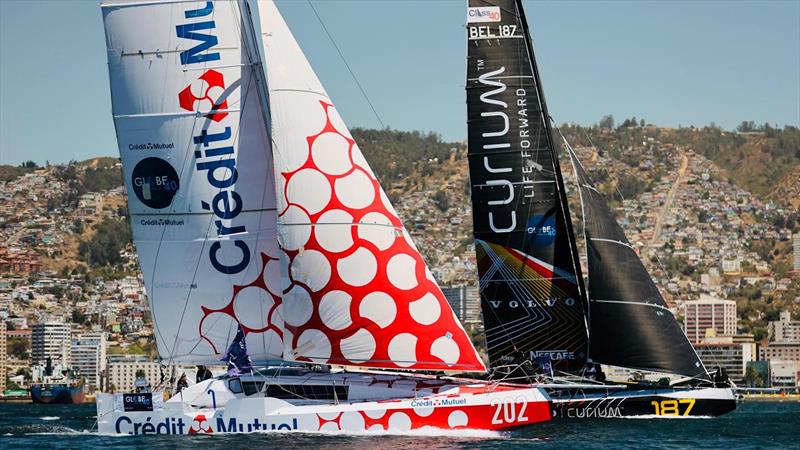
Globe40 Leg 5 © Sirius Events
Since its inception, the Class40 has championed a unique model in offshore racing: reconciling sporting performance, accessibility, and environmental responsibility. Designed to control costs, foster a diverse range of professional and amateur sailors, and encourage boat longevity through a regulated rating system, the class naturally aligns with a logic of resource optimisation. This philosophy is the very DNA of the Class40.
In this vein, Class40 publishes its Carbon Footprint 2025, carried out with the support of the firm Green You Up according to the methodology developed by ADEME.
A decreasing carbon footprint despite growing activity
The Class40's 2025 Carbon Footprint stands at 1,780 tonnes of CO2e, representing a 6.26% reduction in two years. This progress is consistent with the objectives set by the Paris Agreement to limit global warming.
Several indicators can be used to understand the class's footprint:
- 8.39 tCO2e per member
- 28 tCO2e per active team
- 98.9 tCO2e per trip on average
- 61.5 tCO2e per race excluding Transat Café L'OR
The uncertainty rate for the balance sheet is 11.3%, reflecting improved data collection and traceability. Furthermore, the fleet continues to grow, with 62 active teams projected for 2025 compared to 50 in 2023, demonstrating the class's dynamism.
Boats, sails and travel: the main sources of emissions
As with all offshore racing, the majority of greenhouse gas emissions are concentrated in two main areas:
- Boats and sails, which account for nearly 45% of emissions, with an average annual footprint of 8.6 tCO2e per boat.
- Travel, which accounts for approximately 38% of emissions, is mainly related to the travel of teams and visitors to race villages.
A notable development concerns the significant decrease in the use of the aircraft by the teams, whose carbon footprint has fallen from approximately 600 tCO2e in the previous assessment to less than 100 tCO2e today.
Another important development: the 2025 assessment now includes the footprint of villages and visitors, estimated at 563 tCO2e, which was not taken into account in the scope of the previous assessment.
With constant scope, the actual reduction in emissions has reached more than 30% since 2023, reflecting the efforts undertaken by the entire ecosystem of the class.
A class committed to a decarbonisation trajectory
For several years, Class40 has been committed to a voluntary approach to better measure and reduce its environmental impact. Several concrete actions have already been implemented:
- Elimination of ship returns by cargo ship, in order to limit emissions related to maritime transport
- Raising awareness among teams about the challenges of decarbonisation
- Improvement of environmental data collection
The class also fits into the trajectory defined by the National Low Carbon Strategy, which aims for carbon neutrality by 2050.
Goal 2027: Reduce the carbon footprint per team
To continue this momentum, Class40 has set itself a new objective: to reduce emissions per team by 7% by 2027.
Several levers for action have been identified:
- the implementation of a carbon footprint monitoring tool for teams,
- the study of return routes to limit air travel,
- the development of sails with a lower carbon footprint,
- disseminating these good practices to other offshore racing classes.
Towards a more responsible offshore racing
By publishing this new carbon footprint report, the Class40 confirms its commitment to reconciling sporting development and environmental responsibility.
In a context of growth in offshore racing, the class intends to continue its efforts to better measure its impact, support its teams in the transition and contribute to the evolution of practices within the entire nautical sector.