
America's Cup: Emirates Team NZ relaunch their AC75, Taihoro
by Emirates Team NZ 9 Mar 06:28 GMT
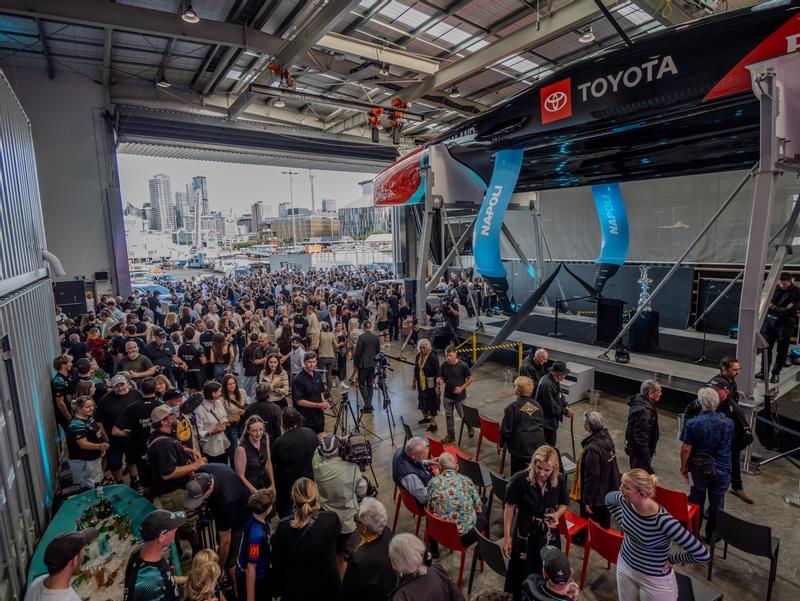
Emirates Team New Zealand - AC75 - March 9, 2026 - Auckland © James Somerset / Emirates Team New Zealand
Emirates Team New Zealand officially relaunched their AC75, Taihoro in front of friends, families, sponsors, and long-time supporters, gathered at the Wynyard Point base in Auckland.
The occasion marked the next big step forward in the team’s Louis Vuitton 38th America’s Cup campaign with Taihoro set to sail again as a high-tech evolution from when the team last sailed in Barcelona, now focused at securing a historic fourth consecutive victory in Naples in 2027.
The relaunch served as a dual celebration between Emirates Team New Zealand and Toyota—a celebration of engineering, teamwork and commitment, as Toyota officially announced the continuation of its partnership with Emirates Team New Zealand—a relationship that has now spanned 34 years, and 10 America’s Cup campaigns. Since first joining the team in 1992, Toyota has remained a cornerstone of the Kiwi campaigns, evolving from a brand on a sail to a deep technical collaborator.
Toyota New Zealand announce their continued commitment to Emirates Team New Zealand – 34 years of support, and counting.
Emirates Team New Zealand CEO Grant Dalton was hugely proud of what the occasion meant for the team on a number of fronts, “So much hard work goes on behind the scenes at Emirates Team New Zealand from the design office to the build facility and in the shed here at our base that it is really important to mark these milestones. To outsiders, there may not be a huge amount that is apparently different, from the outside it looks similar, we are proud to have the same sponsors Emirates, Omega, and of course, Toyota announcing they are back onboard. 34 years now, which I think must be the longest sponsorship in New Zealand sports,” said Dalton.
“Internally, our philosophy is to always drive innovation and technology, so we think Taihoro ‘2.0’ will be a great step on from what we saw in Barcelona,” said COO Kevin Shoebridge who has been building the strength of the team since 2024 and now looking ahead to what needs to be done over the next 16 months.
“There is a long way to go until the 10th of July 2027, so there is a lot of relentless development that will continue all the way until then. And that starts this week.”
Toyota New Zealand Chief Strategic Officer, Andrew Davis said the renewal reflects a shared mindset that has defined both organisations for more than three decades. “We see something of ourselves in this team,” said Andrew Davis. “They’re relentless about improving, brave enough to try what hasn’t been done before, and proud to represent New Zealand on the world stage. For 34 years we’ve backed that spirit, and we’re just as committed as ever as they head into the 38th America’s Cup.”
The relaunch ceremony was centred around the cultural traditions that have come to define the team’s identity with Iwi Manaaki Ngati Whatua Orakei presiding over the event, blessing Taihoro once again with a Karakia and mihi. The blessing reconnected the vessel with its name, meaning "to move swiftly as the sea between both sky and earth".
While Taihoro is the same vessel that dominated the waters of Barcelona, it has undergone a significant refit to meet the new Louis Vuitton 38th America's Cup rules. Under strict cost-containment measures, teams are restricted to their legacy hulls used in the 37th edition. To remain compliant, Emirates Team New Zealand’s designers worked within razor-thin margins, limited to three specific modification categories:
Cockpit Reconfiguration: Extensive work to transition the deck layout for the new crew requirements.
Structural Rebuilds: The team was permitted to rebuild up to 4sqm of the hull using the same shape but different materials, allowing for localised strengthening or weight optimisation.
Functional Rebates:
Modifications were made to add rebates to maximize aerodynamic efficiency.
Despite the same hulls being used again, the rules still allow for some significant technological developments and improvements in the AC75s said Dan Bernasconi, Head of Design for Emirates Team New Zealand.
“The hulls have always been one of the most noticeable features on an America’s Cup yacht, but because the hulls spend so much time out of the water, there is actually not that much difference in the performance of hulls, maybe 5 seconds around the racecourse across all of the boats in Barcelona. So the Class Rule and design parameters still allow for important gains and difference in performance from the foils, sails and control systems for example. As with every iteration of the same class of boat, there is no doubt the racing will be a lot closer this time around between all teams. So as always winning will be a massive challenge for the whole team.”
The most radical visual transformation lies in the crew pod on either side of the AC75. In a fundamental shift for the class, the iconic cyclors, the leg-powered athletes who provided hydraulic pressure have been retired as per the Protocol of the Louis Vuitton 38th America’s Cup.
In their place sits a standardised battery system for use across all teams. This high-capacity battery is now the primary source of power for the yacht’s complex foil and sail control systems. This technological leap has direct consequences for the crew, moving the challenge from physical exertion to digital discipline, as sailors must manage finite battery limits throughout the race.
The removal of the "engine room" has allowed for a streamlined crew, but one that carries significantly more individual responsibility for those onboard. With an odd number of crew (five), roles are becoming more fluid, or roles like flight control and sail trimming may be further consolidated. The change in number of sailors onboard are a hot topic of discussion with regard to how the teams will split the five roles most effectively.
Skipper Nathan Outteridge acknowledged, “There is a lot of anticipation around what the roles of the five sailors will be and in fact when you look across all of the teams, the question is who will be in the different positions. For us, we have a fresh new team which is an exciting mix of young talent and experience so what that eventually looks like in July next year we don’t know right now. That’s part of what the next block sailing Taihoro is about.”
One certainty in the coming days is Olympic gold and silver medallist Jo Aleh is set to become the first woman to crew an AC75 as a new rule introduced to extend the pathways beyond the AC40s and the Women’s America’s Cup to the America’s Cup itself.
“I can’t wait to get out there sailing on Taihoro. Seeing the boat in the shed, just illustrates the scale of the AC75 and the step up from the AC40s,” explained Aleh.
“It’s a really positive step in terms of completing the pathway for women in the America’s Cup and at the pinnacle of our sport. It’s a step everyone is really excited about and I’m excited about bringing my experience to strengthen the new sailing team we are putting together.”
A notable addition to the new layout is a dedicated guest racer pod, designed to allow a non-crew member to experience the raw G-forces of an AC75 at full flight, a feature not seen since the days of the version 5 IACC boats in 2007. Emirates Team New Zealand will be utilising the guest racer spot throughout their sailing block in Auckland over the coming weeks.
Aucklanders and America’s Cup followers won't have to wait long to see Taihoro in action. With the AC75 ready to go sailing, the first seen in the 38th America’s Cup cycle, the team will begin an intensive testing block immediately. Over the coming weeks, Taihoro will be a regular fixture on the Hauraki Gulf, flying across the water as the crew acclimates to the new dynamics of the freshly evolved AC75 before the team refocuses on AC40 racing at the first Preliminary Regatta in Cagliari, Sardinia on 21–24 May 2026.