
SailGP: No changes to collision avoidance rules after Fremantle fracas
by Richard Gladwell/Sail-World NZ 12 Feb 11:19 GMT
13 February 2026
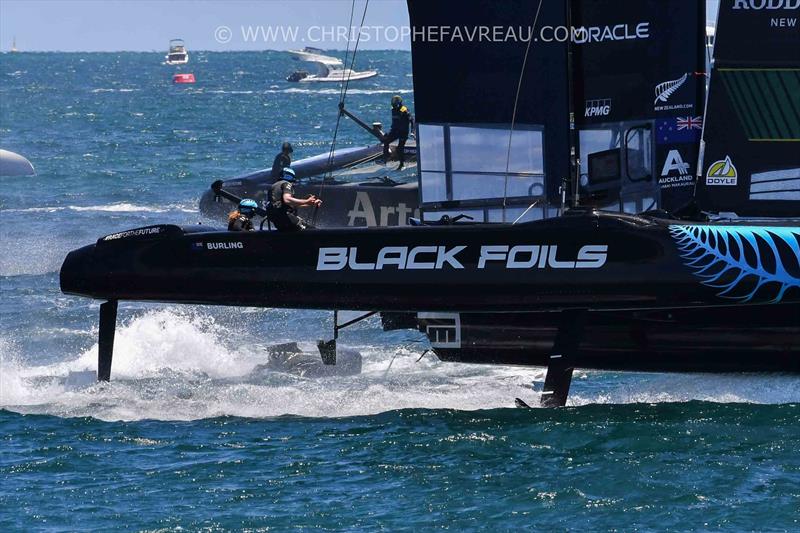
Black Foils stern damage, Race 1, Race Day 1 - Oracle Perth Sail Grand Prix. January 17, 2026 © Christophe Favreau/SailGP
New Zealand's Black Foils are one of three teams to start this weekend's second round of SailGP Season 7 with zero points, following incidents in practice and racing in the opening round in Fremantle last month.
All three F50s have been repaired in a herculean effort by the shore team working in New Zealand, Australia and England.
The damage to Los Gallos (Spain) occurred during a training session, and they did not start in the main event.
The Swiss and New Zealand teams fared little better, after a spectacular collision, 90 seconds into Race 1, where the Swiss sliced the Kiwis' stern section off just behind the aft crossbeam, missing helmsman Peter Burling by just a metre. In human terms, the incident was a "near miss".
Despite two review sessions with the umpire team following the Swiss-Kiwi incident, no changes have been posted in the Umpire Calls section of the official SailGP Noticeboard.
In a media session last week, Burling accepted the Booth Umpires' decision. However, he made it plain he was uncomfortable with how rules are applied in situations where collisions are likely.
"For us, we still don't really agree with the call, but you've got to live by what the umpires say. So, tough break in that regard. But I think also, we're really hoping the league can learn from the incident in terms of how we can keep the boats apart, how all the teams are interacting with one another," a still-shaken Black Foils skipper explained.
The Umpiring in SailGP is run out of a facility in Ealing, UK, with the umpiring team following the racing via UmpApp - a piece of software that produces a graphical representation of the boats using real-time data from the race boats.
The umpiring team may be up to 12,000nm away from the racing action, but they will be on deck and ready for the start of racing at 3.00am local time. They have access to more video feeds than fans see on YouTube. However, there is no on-water umpire to advise on off-camera action and give input to the Ealing team.
A key to Burling’s view of the Fremantle incident, and who was right and wrong, hinges on how much time the Black Foils had to respond once the Swiss had established right of way.
At first, the Swiss changed course toward the Black Foils. When the boats overlapped, the Swiss became the windward boat and had to keep clear. After the Swiss gybed, they were on starboard tack and had right of way over the Kiwis.
From the time the Swiss actually gybed onto starboard tack, about 4 seconds elapsed (Burling claims it is less).
From the image below, using UmpApp data and a generative AI calculation, the two F50s were closing at 33 kts. They were five boat lengths from collision. They were even closer when the virtual or ghost boat was included, which UmpApp places three seconds ahead of each competitor.
"From my point of view, we had a good vision of them. You're always keeping a good eye on all the boats around," Burling explained.
"We tried to match their turn as quickly as we could. Obviously, it changes from us having right of way when they're the windward boat."
"That right transitions to them when they get to starboard. But they have to give us room and opportunity, while they're turning, and then once they straighten up, we've got to avoid."
"So there's a lot of changing and rules going on in those kinds of situations. And we've had a lot of discussion with the umpires over the previous events," Burling added.
The term "room and opportunity" referred to by Burling was removed from the Racing Rules in a 1996 rewrite, when the phrase "ample room and opportunity" was used.
Instead, it is now referenced in the Definitions section of the Racing Rules. The word 'opportunity' has been dropped altogether, but is still frequently used in discussions about a team's expected reactions when confronted with a competitor who suddenly tacks or changes course and becomes the right-of-way boat.
The Definition of "Room" now includes the phrase “the space a boat needs in the existing conditions… while manoeuvring promptly in a seamanlike way."
"Seamanlike way" is defined in the Rules cases as "boat-handling that can reasonably be expected from a competent, but not expert, crew of the appropriate number for the boat." With professional crews involved in SailGP, that reaction time would be reduced.
The question previously raised in SailGP racing, in the situation in which the Black Foils found themselves against the Swiss team, is whether a newly obligated boat can be expected to crash gybe, even if its new foil is not "on the lock" (locked in the down position).
The SailGP Umpire Team covered off this point in a Q&A published 18 months ago, in June 2023, which stated that the umpires considered it seamanlike for a boat to tack or gybe before her windward foil has been lowered and locked into position.
The likely consequences of a partially lowered foil, required by the ruling, would likely be that the F50 would lose its grip on the water and come off its foils.
In the Black Foils situation, they would have conceded their place to the Swiss, and any others closely following, which was indeed the case less than two minutes after the start.
In the Fremantle incident, the collision put the Swiss out of racing for the rest of the day. While they were able to get an overnight repair done and raced the next day, they were out of the top ten in the event and scored no points.
Three teams failed to earn any Season points from the Fremantle event, and will start on 0pts in Auckland, while their likely rivals for the $2.5million Grand Final at the end of the season, have got a good points jump and momentum from the "get-go".
The Fremantle incident was discussed twice with the umpiring team.
Firstly, in a review called by the Black Foils after the incident.
And, it was discussed again with all teams during the usual debrief between the Umpires and Team, held on the next race day. It seems there will be no change to the rules or their interpretations for Auckland or beyond.
"Obviously, we chat to the umpires a bit," Burling said. "I think it's part of the on-water umpiring. The call they make instantaneously carries a lot of weight. We've got to stand by that decision. It's part of the sport. You don't always agree with the decisions that get made."
"But for us, we really just want to make sure that we learn from incidents like this and try not to happen again in the future."
"I think a lot of people share our view of the situation. We're just hoping we can learn from it and move forward and keep the boats further apart," he concluded.
Additional Images: