
OpenSkiff Youth Sailing - 2026 Class rules approved with the return of on-the-water umpiring
by Elena Giolai 4 Feb 15:52 GMT
Openskiiff RS Aero Number 1 - 2025 Marina di Camerota © Elena Giolai
The 2026 season of the OpenSkiff Class opens with very positive news: the Italian Sailing Federation has officially approved the new Class Rules, restoring on-the-water umpiring and fully reaffirming one of the founding principles of the OpenSkiff, both in Italy and internationally.
A return to the roots that will be experienced immediately on the racecourse, starting with the first National Regatta scheduled in Taranto, with the awareness of having rediscovered what has always made this class unique in the landscape of youth sailing.
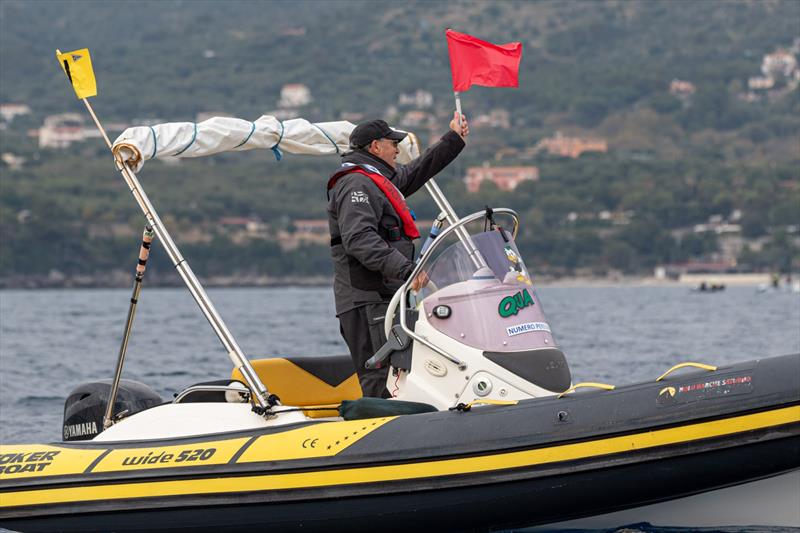
On-the-water umpiring, a distinctive feature of the OpenSkiff
Since its launch in 2008, the OpenSkiff has represented a laboratory of educational and sporting innovation. Direct on-the-water umpiring has always been one of its defining features: immediate decisions taken on the racecourse, penalties applied in real time, and results published as soon as sailors return ashore.
Umpires observe the boats during the race and, in the event of an infringement, immediately apply a penalty, usually a 360-degree turn including tacks and gybes, thus avoiding the need for post-race protests ashore. This system makes racing smoother, clearer and, above all, more educational, allowing young sailors to fully enjoy the sporting experience on the water and to devote their time ashore to socialising and sharing moments with their peers.
The 2025 rule change: a transition season with "observed racing"
With the start of the new Olympic cycle, World Sailing published a new edition of the Racing Rules of Sailing, introducing significant changes also to the appendix dedicated to direct umpiring. From March 2025, Appendix UF became applicable only to very small fleets, requiring a particularly high ratio between umpires and competitors, approximately one umpire for every three or four boats, a condition that is difficult to sustain for a class that typically fields large fleets.
As a result, the OpenSkiff found itself unable to continue applying its traditional umpiring system. To address the 2025 racing season, a temporary solution based on so-called "observed racing" was adopted. While this format introduced monitoring tools on the water, it left open the possibility of protests ashore. For the first time in over fifteen years of the class's history, some results began to depend on protest hearings, introducing an element of uncertainty that was not fully aligned with the educational and sporting philosophy of the OpenSkiff Class.
International cooperation and the new policy
This situation led to a broad and constructive international dialogue, developed with the contribution of members of the World Sailing Racing Rules Committee and in close cooperation with the Italian Sailing Federation. The outcome is a new umpiring policy, first published in English at international level and subsequently translated into Italian, fully consistent with the current regulatory framework.
The document addresses exclusively those rules that may be modified by the classes and therefore does not require formal approval by World Sailing.
What really changes
The new Class Rules place on-the-water umpiring back at the centre of racing action and significantly limit the use of protests ashore, which remain possible only under clearly defined circumstances. This represents an effective balance: on the one hand, it ensures fast and stable results; on the other, it maintains an educational function by introducing young sailors to protest procedures, preparing them for progression to classes where this system is an integral part of competition.
"I would like to express my sincere appreciation for the excellent work carried out by the federation's offices and by the race officials who contributed to this project. From today we have a clear and shared set of rules that allows us to stabilise on-the-water umpiring, while at the same time preserving the educational value of protests in those cases where they are genuinely necessary," commented Guido Sirolli, President of the Italian OpenSkiff Class and Vice-President of the International Class.
Satisfaction was also expressed by International Class Secretary Piotr Oleksiak, with whom dialogue and cooperation were constant throughout the entire process.
With the approval of the 2026 Class Rules, the OpenSkiff Class is ready to open the new racing season with renewed enthusiasm at the first National Regatta, scheduled at the Lega Navale Italiana - Taranto Section, from 27 February to 1 March. This event marks the beginning of a season that will soon see the "OpenSkiff caravan" move on to its first international events, some of which will take place in Italy, including the first EuroChallenge round at Easter in Porto Rotondo, Sardinia, and the OpenSkiff European Championship at the end of July in Calasetta, Sardinia.
Open Skiff Umpiring Policy 2025-2028 [PDF]