GLOBE40 Leg 4 Start: The Pacific Ocean to cross as a start to the New Year
by Sirius Events 1 Jan 06:48 GMT
1 January 2026
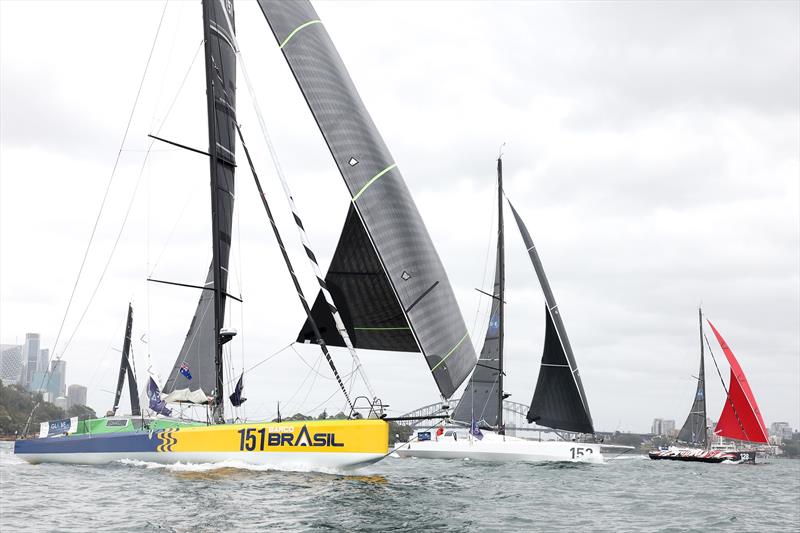
The GLOBE40 © Sirius Events
On this day, January 1st, the competitors of the 2nd edition of the GLOBE40, barely recovered from the New Year's fireworks, set off at 3:00 PM local time (4:00 AM UTC) from Sydney Harbour for their 4th leg towards Chile and Valparaiso. From one legendary destination to another, the skippers will have 6,400 nautical miles to cover as the crow flies, a course that will take them once again to the lowest latitudes on the planet, with a limit of 50 degrees South as set by the race rules.
The Class40s will have to cross nothing less than the entire Pacific Ocean, from the Australian shores to the Chilean coast, with New Zealand as the last landmass before the great leap into the ocean void. A formidable adventure, but also a fierce competition, since this second and final leg, with a coefficient of 3, is likely to give a decisive advantage to those aiming for victory, both in the overall ranking, dominated by the latest generation Class40s known as "scows," and in the ranking of the classic Class40s known as "pointus."
A remarkable stopover in Sydney
The halfway point destination, Sydney, was truly a remarkable moment in this second edition. Firstly, of course, because of the satisfaction of having been able to take the race to the other side of the world with only one Class40 missing, the young Germans of NEXT GENERATION, who will join the race at the Brazilian stopover in Recife. While the "sharps" (sharp-rigged boats) had proven their ability to circumnavigate the globe in the first edition, for the "scows" (sharp-rigged boats), the series of stops from Lorient to Cadiz was pioneering, doubling the distance of traditional transatlantic races for the first time. Secondly, it was remarkable for the incredible charm of this city and this bay where everything revolves around the sea and where every sailor feels at home, surrounded by a knowledgeable, supportive public, appreciative of the maritime achievement accomplished on this voyage. Finally, the event was remarkable for the warm welcome, which could be described in the same way, from the two largest clubs in the region: the Royal Sydney Yacht Squadron (RSYS) in the north of the bay, which spared no effort in organizing our arrival in Australia, and the Cruising Yacht Club of Australia (CYCA) in the south of the bay, which was also in the midst of organizing the legendary Sydney-Hobart race. Harbour Bridge (the famous bridge that spans the bay), the Sydney Opera House, the New Year's fireworks—the skippers will have no shortage of powerful memories, while also remembering the victims of the Bondi Beach attack.
A Pacific crossing as a New Year's wish
Competitors are offered a free course between Sydney Harbour and Valparaiso Bay. New Zealand is the first obstacle on the route, with three options: the northern route, the Cook Strait between the two main islands, and the southern route, the most likely at this stage. The routing then takes the courses down to the southern limit, set at 50 degrees for most of the crossing, before heading back up towards Chile. What can be said about this vast expanse to be crossed? While the previous legs had similar or even greater overall distances, as in leg 2, this leg involves crossing the ocean from west to east, and far from everything, as the passage around the famous "Point Nemo" (supposedly the point on Earth furthest from any land) has made famous. This will undoubtedly be a leg at least as challenging as the previous ones, very close to the major depressions of the Southern Ocean, and in low temperatures. A new challenge for the competitors, who are now on their third passage through the Southern Ocean after South Africa, the descent from Reunion Island to the Great Australian Bight, and this new leg; a fourth remains with the passage around Cape Horn in the leg between Valparaiso and Recife. Like the crew, the boats and equipment serviced in Sydney, which has all the necessary nautical professionals, will have to hold up, and this technical challenge will be no small feat. Finally, the forecast is for around three weeks at sea for this third leg.
A crucial stage for the overall standings...
We remember the brilliant victory of the BELGIUM OCEAN RACING - CURIUM team in Reunion during the previous stage with a coefficient of 3, followed by the equally brilliant finish of CREDIT MUTUEL in Sydney Harbour; and currently, only two points separate the two rival teams since the start. Both teams have undergone significant changes, with Djemila Tassin joining Benoit Hantzperg, who has been on deck since Cape Verde, for the Belgian side. Meanwhile, the rival French team has seen a complete overhaul, with Ian Lipinski handing over the reins for this stage to Antoine Carpentier and Alan Roberts. In the top-of-the-range class, the podium places remain to be decided between BARCO BRASIL (26.5 points), FREE DOM (31 points) with the return of project manager Thibault Lefevere accompanied by Nicolas Guibal, and WILSON (34 points), a stable team with Lisa Berger and Jade Edwards-Leaney still on board. As for JANGADA RACING, with the same crew since the start (Richard Palmer - Rupert Holmes), they are separated by a mere 0.5 points from WHISKEY JACK, with Mélodie Schaffer still at the helm, joined since the last leg by her fellow Canadian, Colin Campbell.