
Quentin Debois in the starting blocks in Cadiz for his attempt to break the Transatlantic record
by Laurence Hannon 30 Dec 2025 16:07 GMT
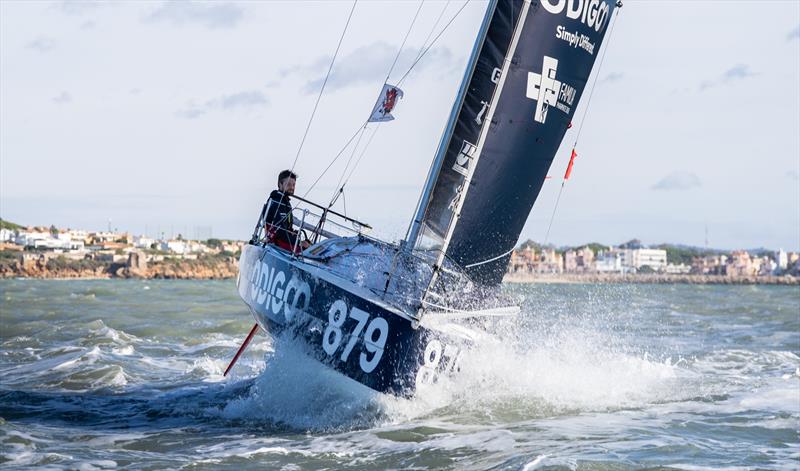
Quentin Debois in the starting blocks in Cadiz for his attempt to break the Transatlantic record © Jean-Baptiste D'enquin
Belgian skipper Quentin Debois is ready to set sail in his attempt to break the world record for a solo east-west Atlantic crossing. On standby in Cadiz, he is waiting for the right weather window to set sail.
He will have to cover 7,200 km to the island of San Salvador in the Bahamas in less than 30 days to become the first Belgian record holder for a solo Atlantic crossing on a Mini 6.50.
Spirit of adventure and flexibility
Quentin Debois is preparing to take on an unprecedented challenge: to break the world record for crossing the Atlantic from east to west on the smallest ocean-going racing boat, a 6.50 m sailboat.
A spirit of adventure and a great deal of flexibility are needed to succeed in this extraordinary challenge. And it all starts well before the crossing, particularly during the technical preparation of the boat to increase its performance and resistance, or to transport the boat to the starting line. At each stage, the team adapts.
The boat was initially planned to be transported from Nieuwpoort to Cadiz by road, but this was ultimately done partly by sea. On December 5, the boat was launched in Argelès-sur-Mer near Perpignan. After eight days of sailing in good conditions, Quentin arrived at the port of Cadiz on Saturday, December 13.
Quentin Debois: "My navigator and I took advantage of this voyage to put ourselves in the conditions of the record attempt. This experience was particularly valuable for testing the new equipment (autopilot, wind sensor, sails, etc.), fine-tuning the settings, and validating the technical choices. This full-scale test gave me the opportunity to get a feel for the boat, get into race mode, and made me want to set off again very soon to take on this challenge."
Since arriving in Cadiz, Quentin has been finalizing the technical preparation of the boat and fine-tuning the new autopilot system, a key element in solo sailing. An official commissioner from the World Sailing Speed Record Council (WSSRC) also inspected the boat and verified the installation of the official Black Box: a GPS device that is essential for the record attempt to be certified.
In search of the ideal weather window
From Monday, December 22, Quentin entered a standby phase. The priority will be to closely monitor the weather in order to identify the first favourable weather window for the start of the record attempt. The adventure will begin as soon as the conditions (wind and sea state) are deemed favourable by Basile Rochut, the router. As with any record attempt, Quentin and Basile are working with a code system:
Code red: Departure impossible in the short term
Weather conditions do not allow for a departure in the coming days.
The priority is to wait, analyse, and monitor the evolution of weather models.
Code orange: Departure possible in the short term. A window could open within 72 hours, but this remains to be confirmed. The situation is being monitored very closely and may still change rapidly.
Green alert: Departure window identified. Conditions are right for a departure within 24 hours.
Boosted by the trade winds
When Quentin crosses the starting line off Cadiz, he will head south towards the Canary Islands to take advantage of the trade winds. These winds blow from east to west, generally between 15 and 30 knots, and promote relatively stable and continuous sailing towards the Bahamas.
Quentin Debois: "I will check in every day with my router Basile Rochut, who will be my co-pilot from land. His role will be to analyse the weather conditions in order to find the best route to arrive as quickly as possible. Given the size and speed of my boat, we can only forecast conditions 15 days ahead. The goal is to get off to the best possible start because we don't know what lies ahead."
Basile Rochut: "Every day, I will send Quentin routings and comments on the strategy for the day, the next day, and the medium and long term. Quentin will be able to view them, give his opinion, and make his choices. It is always the skipper who makes the final decisions on board."
Quentin Debois: "To succeed in this challenge, we want to stay close to the areas of strong wind, but always within reasonable limits. Every decision is made by weighing up the benefits and risks. It's the good sailor who has the final say over the competitor. The first thing I have to think about is the safety of the boat and myself."
He adds: "I'm going to give it my all to break the record. I'd like to do it in 27 days, but success depends on four major factors that I'll have to deal with: technical issues (breakages, wear and tear, boat failures), the human factor, routing strategy, and finally, luck. At sea, I know I can count on the support of my shore team, especially my coach Quentin Droneau, and my sponsors who will be following my progress on social media: ODIGO, Pharmacie Familia, Accountable, Teasio, THG Liège, IDEATEC, Perfecty, UK Sailmakers, Nieuwpoort Marine, BSTOR, KBC Brussels, Novadvice Belgium, and KYCN. It is thanks to them that this adventure is possible."
A team victory
Quentin: "I'll be alone on the boat, but ocean racing is a real team sport. You're never really alone. I have a whole team that has been preparing the project with me for a year and will offer me support and advice when I'm sailing. If we break a record, it will be a team victory."
Regardless of the outcome of the east-west crossing, Quentin will attempt another world record in June 2026: crossing the Atlantic from west to east, from New York to Lizard Point in England. This 5,300 km route, which is generally faster and more demanding, will test his ability to adapt to weather conditions and optimize every mile traveled to set a new record time of less than 17 days and 9 hours. After that, Quentin would like to continue his career as an offshore skipper.
Quentin: "For me, it's important to keep challenging myself, to push my limits. There are a few legendary races that I dream of, but for now I'm taking it one step at a time."
Quentin Debois, offshore skipper
Quentin Debois (38) grew up far from the sea, in Marchin in the province of Liège, and nothing predestined him for offshore racing. He discovered sailing late in life, at the age of 31, thanks to a friend who invited him to sail in the North Sea. He was immediately hooked and took his first lessons the following week on the Belgian coast. The open sea was calling him.
From 2021 to 2023, Quentin is undergoing intensive training at the offshore racing training center in La Turballe, in the Loire-Atlantique region.
In 2022, he bought his first boat, a Mini 6.50, the smallest racing boat in the world capable of crossing the Atlantic. His ambition was already clear: to compete in ocean racing. In November 2023, Quentin completed his first solo transatlantic crossing, without assistance or means of communication, in 28 days.
Basile Rochut, router
Basile Rochut (27), from Morbihan, is an engineer specializing in data and decision science and artificial intelligence. Passionate about ocean racing since childhood, he specializes in maritime routing. In 2023, Christian Dumard (router for the biggest names in ocean racing) and he founded Marine Weather Intelligence (MWI). They create cutting-edge maritime weather routing tools. Artificial intelligence allows them to automate the calculation of satellite, meteorological, atmospheric, and oceanic data to reduce the uncertainty of forecasts and offer more accurate routing.
Basile is also an independent router and weather trainer, notably for the La Turballe offshore racing center. He trained Quentin in weather and strategy before advising him ahead of his first Mini Transat in 2023.
www.oceansailing.be