
Globe40 Leg 3 Update: An unforgettable week in the Roaring Forties
by Sirius Events 5 Dec 2025 05:32 GMT
5 December 2025
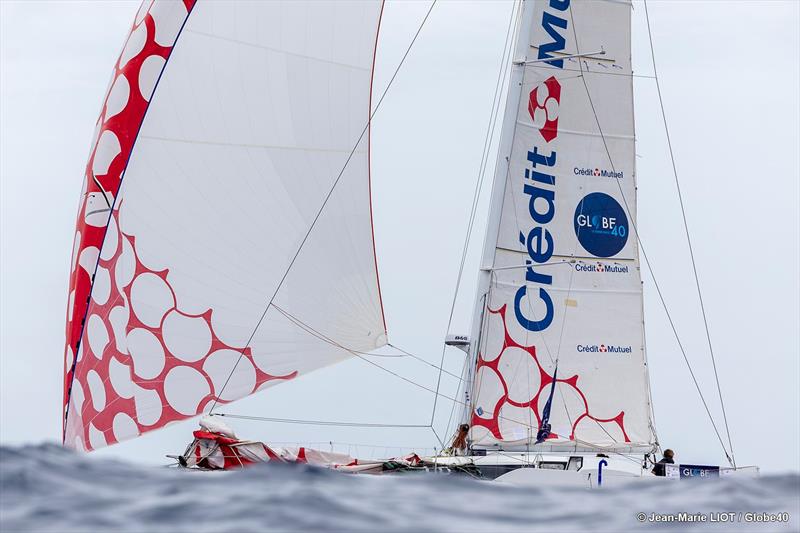
GLOBE40 Leg 3 © Jean-Marie LIOT / Globe40
Having set off on their third leg on November 22nd from Saint Paul Bay on Reunion Island, the eight competitors in the second edition of the GLOBE40 were initially confronted with the calms of the Mascarene High, which they had already encountered on their way up from South Africa.
This period lasted about a week to readjust to life at sea, but it was nonetheless faster than the outward journey. Then came the quest to head south to find the westerly depressions, the "highway of depressions," as it's known in sailing jargon. By seeking them out, the skippers eventually found them, and for the past week, the face of the race has changed as the latitude number has blinked southward. 35 degrees, then 40 degrees, and now close to 45 degrees South, with the understanding that the course is limited by a "barrier" set at 46 degrees South and then 48 degrees South under the Great Australian Bight.
The start of this phase last weekend unfortunately saw the German crew of NEXT GENERATION BOATING AROUND THE WORLD have to withdraw from this leg. A mechanical failure in the rigging (breakage of the spreader bracket and breakage of the intermediate cable D2) could have immediately caused the mast to fall, but the quick reaction of Lennart Burke and Melvin Fink prevented the worst at this stage. After two days of reflection and consultation with partners, insurers, and the race organizers, the young Germans chose to return to Reunion Island for repairs, with the firm intention of rejoining the race as soon as possible, most likely not in Sydney but at a later leg. Continuing their slow climb at an average speed of 5-6 knots, they should reach the island within a week. The first serious incident in 10,000 miles of racing for the entire fleet, fate has unfortunately struck a brilliant crew who had demonstrated their full potential with their second-place finish in the major Cape Verde/Reunion leg.
For the other crews, the past week has been all about the Southern Ocean, the one they anticipate, the one they seek in such a race, the one they dream of, the one they fantasize about. Long, exhilarating runs with the speedometer climbing wildly (the current record is 30.8 knots for the Belgian team), cold and gray skies in this otherworldly realm, and the great albatrosses standing guard in these inhospitable yet unforgettable waters. Most of the skippers, seasoned competitors on the European circuits and transatlantic races, find here a challenge and a culmination of their offshore racing careers. But this culmination comes at a price: fears when the boat stalls in the troughs, the cold, and the fatigue of both crew and equipment. It's a constant reminder that this is a "mechanical" sport, meaning that every component is pushed to its limits and can break regardless of mathematical certainties. Beyond the competition, they all share a common experience that forges strong bonds between the crews. As Amélie Grassi aboard CREDIT MUTUEL told us in a message this week: "I've once again realized how lucky we are to be racing around the world, tirelessly gliding through the waves of the Southern Ocean. We must cherish these precious moments. Few people have the chance to live this experience."
In terms of pure racing, the pace hasn't slowed, with the leaders having covered 3,500 miles at an average speed of nearly 12 knots over the surface. This represents 61% of the theoretical distance covered so far, with almost 2,000 miles still to go on the direct route to Sydney. The lead changes are continuing at their usual rate, with 29 in the last two weeks, and rarely lasting more than a few hours for a single leader, a position that has alternated between BELGIUM OCEAN RACING and CREDIT MUTUEL. Hampered by several breakdowns, not critical but penalizing for performance, the Belgian team nevertheless found itself, for the first time, about fifty miles behind CREDIT MUTUEL as they approached Cape Leeuwin at the southwestern tip of Australia, the second major, legendary cape of the course. The classic Class40s, known as "pointus," were not far behind, about two days at sea adrift. FREE DOM continued its excellent performance, building a small lead of 50 miles over its direct competitor, BARCO BRASIL. WILSON remained close behind, about thirty miles from the Brazilian competitor. JANGADA RACING and WHISKEY JACK were also within fifty miles of each other, with JANGADA holding a slight advantage. The leaders are expected in Sydney around December 11th/12th and December 15th/16th for the Class40s, also known as "pointed" boats. However, the passage up the Great Australian Bight and through the Strait remain challenging stages that could prove difficult.
Race map: To follow the race: www.globe40.com/cartographie.
www.globe40.com