
Meet the 29er team: Isabella Calzadilla and Diego Power were 2nd in 2025 Open European Championship
by International 29er Class 27 Jul 12:49 BST
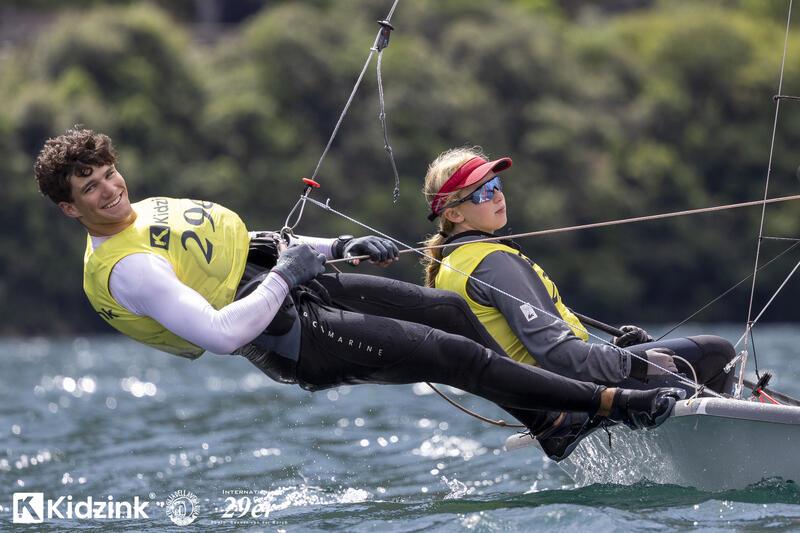
Isabella Calzadilla and Diego Power at 29er European Championship Riva del Garda © Sander van der Borch
When and how did each of you first get into sailing?
Isabella: I started sailing at the age of 7 in the Optimist class in a summer camp at Club Náutico de San Juan in Puerto Rico. I live very close to the club, and with a summer camp happening every year, I naturally became interested and decided to give it a try. I'm really grateful to the coaches who taught me the basics and helped me fall in love with the sport.
Diego: I first got into sailing through a small sailing summer camp in Gran Canaria, in Optis. At first it was great, more of a game but rapidly shifted to the competitive side of it. Which was very fun in a different way. This summer camp introduced me to the incredible world of sailing, which I enjoy to the point that now I am studying yacht design in Solent University to try to make a living off the sport.
How long have you been sailing together as a team? What brought you together?
Isabella: We've been sailing together for about a month and a half. Our coach, Oxi, brought us together specifically for this event, and I think it turned out to be a great fit. Even with limited time, we were able to build a strong connection on and off the water, and we both learned a lot throughout the training process. It was a memorable experience—it showed me how quickly a solid team dynamic can develop with the right mindset and support.
Diego: I met Oxi, our current trainer, in the last 29er Worlds. A year later, I got a call from him asking if I was available to sail with Isa, which I didn't know at the time. As most opportunities I get I said yes with no hesitation. We first sailed together at Carnon Eurocup, but I got really ill and we didn't have the chance to perform, but I new the team would work, specially with the guidance of Oxi. And so we did. After around a month of training in Garda and participating in the Natzionale Regatta, we had very good preparation for the European championship, which was our main goal the whole time.
What has your training and preparation looked like leading up to this championship? Was this your first international regatta together? If so, what was that experience like?
We arrived at the venue about a month before the championship and trained five days a week for 2-3 hours each session with Oxi as our coach. One of the most valuable parts of our preparation was training alongside Gino and his team from Fraglia Vela Riva. We focused on short, high-intensity drills that really sharpened our maneuvers and mark roundings. That helped us get faster at making decisions under pressure, which made a big difference in racing. This wasn't our first international regatta together—our first was the Eurocup in Carnon, France. Unfortunately, that event was tough. Diego got sick and couldn't sail with me one of the days, so our overall result wasn't great. Still, it was a big learning experience, especially in boat-to-boat tactics in the 29er, which helped me improve a lot. Since then, we've also competed at the Italian Nationals, so the Europeans were actually our third international event together.
What were the biggest challenges you faced during the regatta, and how did you overcome them?
Isabella: One of the biggest challenges we faced during the regatta was the days with light winds and shifty conditions. There were three different courses, and on all the qualifying days, we were in Course A, which is very close to the land and becomes unstable when the wind comes from the north, due to the mountain between Riva and Arco. These conditions were quite different from what we had trained for. Even so, we managed to stay consistent enough to qualify for the gold fleet.
Diego: For this championship we came to Garda a month prior to the championship to get used the conditions and most importantly eachother. It was a great feeling noticing huge progress day after day. How the little things started coming together. We also had great sparring partners like the Brazilian team of João and Zion, other amazing teams like the Suis and the Italians. Everything contributed to our progress and us being fast and confident going into the championship. Also a big factor was food and recovery, and we where dialed in eating homemade food daily thanks to Isa's mother and grandmother. Id say our biggest challenge, other than waking up at 5.30am for some races, was adapting to the conditions and maintaining focus throughout the longer days, it was more mental than physical at some points, but we managed to push through and give it our all in every race
How did it feel to finish second in the mixed category of the gold fleet? What does that result mean to you personally and for sailing in Puerto Rico?
Isabella: I'm proud that we finished second in the mixed category—it's a strong result, especially at this level of competition. At the same time, I felt a bit frustrated because we started the day in first place and slipped to second. Credit to Giulia and Pietro—they sailed an excellent final day and deserved the win. Both our teams had a 1st and a 2nd in the gold fleet, but their consistency gave them the edge. Overall, I'm really happy with our performance. This was a big step forward for me as a skipper—it opened my eyes to the intensity and precision of elite racing and made me even more motivated to improve. I'm especially proud because this was Puerto Rico's first time competing in a major international 29er event. I hope this result inspires more Puerto Rican sailors to compete in this exciting class.
Diego: It was, and it was so great seeing the results the prior hard work was giving. How quality training teached us in one month what you would struggle to learn over a few years. We we're happy with the result even after loosing the first the last day. At the end of the day the position you come in the regatta depends of many external factors and a hint of luck, for me the hard work we put into the preparation of the regatta and seeing we had the level to compete with the best in our category was as valuable as any trophy.
What advice would you give to young sailors, especially those from smaller regions like Puerto Rico, who are thinking about getting into the 29er class?
Isabella: My biggest advice is: give it a shot. The 29er is a really fun, high-performance boat that teaches you a lot about speed, teamwork, and boat handling. It might seem intimidating at first, but once you start sailing it, you'll be hooked. For sailors in places like Puerto Rico or across the Caribbean, we actually have some of the best conditions for skiff sailing—steady breeze, warm water, and year-round opportunities to train. If more sailors in the region get into the 29er, there's real potential for the Caribbean to become a hub for skiff development, kind of like what Lanzarote has become in Europe. You don't need a huge fleet to start. Just a few boats, a solid support system, and a mindset to keep learning. I really believe we can build something great there.
Diego: The 29er is not forgiving. But overcoming the chaos and controlling the boat is the beauty of it, going through the learning process with the right partner, someone you trust and have excellent communication with is magical. The adrenaline this boat offers to the younger people is also great. If you like speed and adrenaline this is definitely the boat for you.
Are you planning to compete at the Worlds or other major events this season?
Isabella: Yes, I'm planning to compete in both the World Championship in Porto and the Youth World Championship in Vilamoura. I'll be sailing with Diego Marrero from Puerto Rico, who recently finished competing in the Optimist class. We're just starting to sail together now, and the World Championship will be our first international event as a team. I'm really excited to see how it goes. Diego is a very talented sailor and a fast learner, so I'm optimistic about what we can achieve. That said, our main focus this year will be the Youth Worlds, as I believe that's where we'll be truly ready to perform at our best.
Diego: Not me but Isabella will sure put on a tough fight.
Looking ahead, what are your goals as a team—short term and long term?
Isabella: Diego Power and I have finished sailing together for now, mainly because he's based in Spain. I'm now starting to train with my new crew, Diego Marrero, who I'll be sailing with at the Youth Worlds. For Diego Marrero and me, our short-term goal is to qualify for the gold fleet at the Open Worlds. Once we've had the chance to measure ourselves there, we'll be able to set realistic goals for the ISAF Youth Worlds in December.
Diego: Our team was a one time thing, but you never know maybe you see us around again.