
Good old Gilmac
by Graham Sharp 1 May 2024 12:00 BST
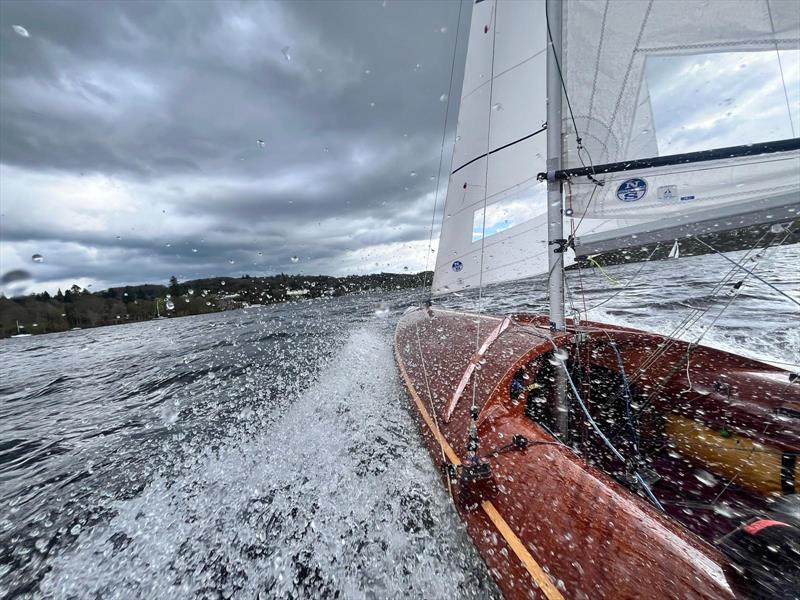
Flying Fifteen no. 485 ‘Gilmac' practicing ahead of the Royal Windermere Yacht Club Flying Fifteen Open - the boat was built by Chippendales in 1961 © Alasdair Sharp
For my 60th birthday my wife decided to buy me a Flying Fifteen which she had seen advertised on the internet. 'Gilmac' was built in Jack Chippendale's yard and coincidentally came into the world the same year as me, in 1961.
I have had four Flying Fifteens since the age of 15 - the first being no. 307, a wooden Tormentor; the second no. 3084, a carbon fibre/kevlar Windebank IV home-build by Gordon McGeorge; and the third an early Ovington IX. Without doubt Gilmac is by far and away the best of the four. Admittedly I am a sucker for a wooden boat, but in addition to looking good she sails very well for a boat of that age. Nobody I have spoken to knows where the name comes from, but the thinking is that it is a combination of names - perhaps those of the first owner's children.
Gilmac was first sailed at Loch Earn in Perthshire. Bobby Salmond from the Loch Earn Club kindly supplied me with photographs showing her arrival and first launching.
Note the tiny wheels on the road trailer and the fact that the boat is facing backwards!
The boat passed through several ownerships at Loch Earn before being bought by David Naylor (who built Flying Fifteens). She was apparently in a fairly sorry state at this time, with the hull sagging downwards where it met the keel flange. I'm told that this was remedied by placing sandbags on the upturned hull as it was dried out. Many of the wooden 'leaf springs' which spread the load of the keel onto the inside of the hull were largely rotten. David did away with these timbers forward of the mainsheet purchase, replacing them with a fibreglass floor bonded over the keelson. He also installed a laminated timber inside the hull connecting the chain plates with the new floor and keelson - so greatly strengthening the hull. Further stiffening was provided by a wooden cross member providing the anchorage point for the mainsheet purchase. This was epoxy bonded to the hull and the keelson with connecting uprights and a plywood semi-bulkhead. It has a nice concave profile which makes it easy for the helm to move their weight forward.
David Naylor then sold the boat on to John McMillan, who lived in Rothesay on the Island of Bute in the Clyde Estuary. As there were no other Fifteens at the Rothesay Sailing Club John travelled with the boat to the growing fleet at Holy Loch and to open events elsewhere - with Gilmac winning a good number of trophies. John added further stiffening with a half tank in the bow after nearly sinking off Largs when planing with the spinnaker in a heavy wind turned into an attempt by the boat to become a submarine. At the age of 83 John decided to pass Gilmac on to a new owner and so the boat came to me. I was in a similar situation to John, in that there was only one Fifteen being sailed occasionally at my home Club of Plockton in the Northwest Highlands, so I decided to base the boat at her first home of Loch Earn.
While David Naylor's restoration had left the hull improved and structurally sound I was keen to replace the decks. The foredeck had been replaced at some point with a ply which was showing signs of water ingress along the gunwhale edges, and which didn't match the aft deck that had been replaced at a later date. The original rolled veneer side decks had been fibre glassed over and this covering had turned milky. The stem had also suffered damage at some point, with a few dings on show. I contacted Adam Way in Lochgilphead, who I knew to have worked on other Fifteens, and booked Gilmac in to have the decks replaced over the winter of 2022-23. That plan nearly didn't happen. Whilst racing at Loch Earn in August 2022 on starboard tack we were rammed amidships by a First 20.7 which was sailing on port tack. The carbon fibre bowsprit of the First hit the boom, bending it like a banana, followed by its plumb bow ramming the port gunwhale. The wind was blowing a good Force 3 at the time, with both boats travelling at a good clip. I am sure that what prevented catastrophic damage was the laminated timber running between the chainplates.
Fortunately, we were able to complete the season and in October 2022 I delivered the boat to A & R Way Boatbuilders in Lochgilphead. Adam and his colleague Angus set to, with the fore and aft decks quickly removed and the mast partners replaced as some deterioration of these timbers was found. The side decks were stripped of their fibreglass covering and new veneers were vacuum bagged on top of the old surface.
I don't think that this added any weight to the boat given that the old fibreglass covering had been removed and because the new fore and aft decks are lighter than what was there before. In addition, I decided to do away with the centre console - which meant finding new homes for the various control lines. The clew outhaul was moved to the boom end at the gooseneck, with the Cunningham moving to a single central cleat on the forward face of the mainsheet cross member. The jib furling line and the spinnaker halyard were both moved onto the existing strut which was inside the console box.
Finally, I did away with the mast ram/puller in favour of simple chocks at the mast gate. I don't regret any of these changes and find that the chocks provide a good way of knowing where the mast bend is at. The Chippendale boats were built with very long aft decks which made their cockpits quite small - the difference with modern boats is quite marked. Taking out the console has provided more room in the cockpit and made it much easier for the helm to get across the boat during tacks and gybes.
The jib track arrangement was also changed from the old hole and pin style of track to the new Allen type which allows the car to be positioned anywhere along the track, and which also allows it to be moved inboard. New mounting pads were also made for new jib ratchet blocks to provide better control of the jib for the Crew.
The fore and aft decks were replaced in a lovely stripey sapele and by mid-December the bulk of the work had been done. The standard of workmanship was superb, and I can't recommend the firm of A & R Way highly enough.
In the New Year the hull was turned upside down to be scraped and sanded back to bare wood. I was somewhat apprehensive after having made this decision, as there was no way of knowing how many times the hull had been taken back in the past and whether the mahogany veneers were still thick enough to take another reduction in thickness. As it turns out, there was no need to have worried. The hull looks amazing and appears every bit as new as the decks.
The waterline had been some two inches higher than it should have been and I assumed that this was to hide some repairs to rotten wood. The original plan was to add a blue line along the actual waterline to break up the expanse of white underbody paint. However, when the scraping work began it was discovered that the hull was pristine all the way down to the correct waterline. This leads me to wonder if the entire exterior of the hull is still in good condition under that white paint. Perhaps at some point I'll investigate.
The hull was then turned again, and the decks varnished. Epifanes Wood Finish Gloss was chosen over traditional varnish. This is a one-pot product which provides a chemical cure with a fast build-up of coats and very good impact resistance. Eight coats were applied. I shall apply two coats of normal Epifanes High Gloss Varnish each year over this very good base.
The work was finished in early April when I took Gilmac back home to Plockton. Here are before and after shots:
I had just enough time to put all the fittings back on before taking her down to Windermere for their opening meeting. The boat acquitted herself very well, beating the other Classic and Silver boats as well as a good few Ovington 9s and 10s, although the lightish breeze probably helped with that. Good results were achieved throughout the rest of the season, culminating in the Polaris Regatta at Gilmac and John's old stamping ground of the Holy Loch. This was a great event for two reasons. Firstly, we were sailing against John's daughter Marion and her partner Chris Bowen, and secondly Adam - who had done such an excellent job over the winter - agreed to crew for me.
I'm very much looking forward to the new season, particularly the European Championships at Morgat-Crozon in May. It will be a long journey from Plockton, but I'm so glad to have the opportunity to go there and sail the best Fifteen I've ever had. Good old Gilmac!