
Andrew McDougall talks about the WASZP
by Jonny Fullerton 15 Jul 2015 15:26 BST
15 July 2015
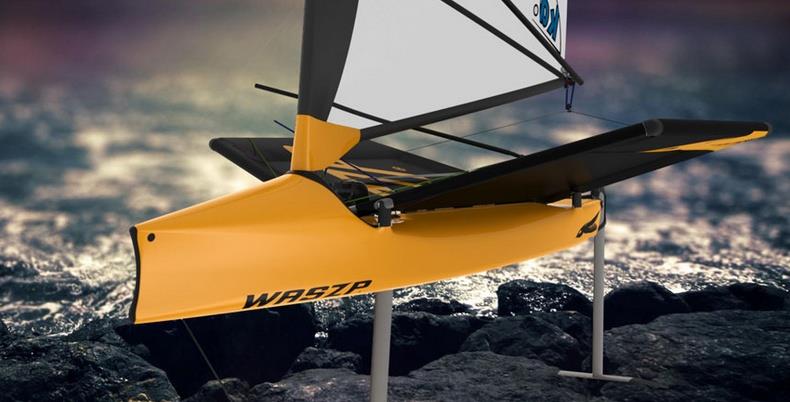
The WASZP © McDougall Creations
Jonny Fullerton interviewed Andrew 'A-Mac' McDougall on behalf of YachtsandYachting.com at Lake Garda during The Foiling Week where the WASZP foiling dinghy was launched.
Jonny Fullerton: Give me a bit of background on how you came up with the idea for the WASZP.
Andrew McDougall: I've been sailing a Moth for a very long time and foiling Moths for 10 years now. There's always so much interest on the beach; you get people coming up asking what it is and how does it work. Particularly you get kids coming up and they just want one and there's always a reason why they can't have it, why dad or mum won't buy it for them, and that's really what prompted the idea. Trying to get rid of all the arguments that people use not to get a Moth. It's been ticking away in my brain since 2007. It wasn't about making the Moth one-design, it was about getting rid of all the problems, and that's what I've attempted to do.
JF: What type of sailor is the WASZP aimed at and who are you expecting to be buying and sailing the boat?
A-Mac: It's aimed at a much broader range of sailor than the Moth. The Moth is always going to have the very high-end technical guys who want to play with things or have the latest cutting-edge design. The Moth is just a beautiful boat, it's so efficient and lovely to sail, but not everyone, in fact very few people, are prepared to put that level of effort and amount of money into staying at the top. The WASZP is aimed at those who like the idea of having a foiling single-hander but don't want to deal with all the other stuff that's involved with a Moth - people who want to go down on a Wednesday night and just go racing. It's trying to be the Laser or the one-design windsurfer of the foiling world.
JF: The boat you have at The Foiling Week is only in prototype form, but what are the key aspects and features of the WASZP?
A-Mac: The bow is finer than a Moth at the centre vertically, but slightly fuller at the bottom and a lot fuller at the deck. This came about from the experience of trying to make it low-ride well, with a big range of sailor weights, and it had to be efficient through the breeze as it lifts out. The whole bow design is about having a heavy sailor burying the bow and keeping the transom out, without having huge bow drag, and when a light person gets on it, still having the full waterline length and having a good low-riding shape. It's very full in the stern as one of the issues with the Moth is that you tend to fall over backwards when learning and you get into irons. The Waszp also has a rudder which you can push down, so you need to be able to lean over the back and do that, so a lot of things have influenced the design of the hull.
JF: The boat has no stays (shrouds) so you've got an unsupported rig. Is that an improvement for safety, launching and recovery?
A-Mac: There are so many reasons not to have stays - on my wrists you can probably see about 20 of them. There have been some pretty bad injuries from stays and I personally hate having that stay in front of me while I'm doing a manoeuvre and thinking if something goes wrong I'm going into it... But that's not the only thing, it makes rigging simpler, you just pop the mast in and it's done, with just the cunningham, mainsheet and outhaul keeping the mast in, it's all very simple. There are two more reasons for not having stays; getting into the boat after a capsize or getting into the boat in very light winds is much, much easier over the front of the wing bars. Lastly, in very light winds, you can let the sail out and head downwind efficiently.
JF: And the wishbone boom?
A-Mac: This really comes from having the main foil retractable; with the main foil sticking up in the boat, a boom would be very difficult to deal with. With the wishbone you've got a soft bottom to the sail and you can just let the outhaul off to allow the sail to flop over to the other side when the main foil is up. That was the major part of it, but having sailed with it now, not having the boom is a massive advantage and you can close the gap more (sail closer to the hull) as you're not worried about hitting your head on the soft sail. The final reason is that you don't have a vang, which takes the load off everything.
JF: On sails there is a choice of three - presumably this gives you a wider range of sailor and ability?
A-Mac: Yes, but it also means we can make a fairly full-on, high-performance rig for the biggest one without getting too caught up with how easy it is to put up. With the smaller one we're definitely going to have it so that you can put it up and down from the deck. I'm thinking there will be two versions of the middle sail; one with the bolt-rope for the bigger kids and another for the smaller high-performance people who want to go fast.
JF: You've gone for aluminium foils rather than carbon, mainly for cost I believe?
A-Mac: No, there was a bigger reason than cost. Cost is a massive reason but the biggest reason is that if the boat is going to be one-design, carbon is very difficult to deal with. You can never make a carbon foil where you say 'You can never do anything with this foil'. There will be blemishes from the factory so people will sand them, will finish them and will paint them. The aluminium foil is hard anodised so you can't do anything with it, so everybody's got the same thing. Also if you do damage it then it won't be that expensive to replace it. So from the one-design aspect and cost it was massively different.
JF: Weight-wise how does it compare with the Moth?
A-Mac: The hull is 16kg, which is slightly better than I'd hoped. It's about 5.5kg heavier than a Mach2, which is not too bad for a hull which is probably around five times more durable.
JF: You have this folding wing concept for transportation. Could you tell us a little about that?
A-Mac: It's more for storage in yacht clubs. At my club we have nowhere to put a Moth as slots are designed around boats that aren't as wide as a Moth, so being able to fold the wings up means you can top-to-tail several of them in quite a small space.
JF: I know you're only at the prototype stage, but everyone's asking what the cost will be.
A-Mac: Half the cost of the current base-model Mach2 is 100% our aim and I have no reason to doubt that we'll make that. It'll probably come out at around 12,000 Euros.
JF: A lot of people will look at this and wonder whether it'll be a competitor or a feeder class to the Moth. What's your view on that?
A-Mac: It almost has nothing to do with the Moth. The fact that they're the same length as the Moth is for the reason that the Moth happens to be the exact length at which air freight is still reasonably cheap. It's not going to be anywhere near competitive with the Moth - it'll go pretty well against a Moth upwind but it'll get caned downwind. In the end it'll probably enhance the Moth as there will simply be more people who catch the bug of this type of sailing.
JF: And in the long-term do you think there's a possibility of the WASZP becoming an Olympic class?
A-Mac: My focus is to get this boat right. We've done the website and we think we've done a good job of that. We're not thinking about the Olympics at this point but I am thinking about how we run the class, I'm thinking about what type of rules we'd like within the class and what type of restrictions, but I really don't want to make any decisions that are driven by the thought that we want to be an Olympic class. If that happens then we'll talk about it nearer the time.
JF: A-Mac, thank you very much for your time and we wish you all the best with the WASZP.
A-Mac: Thank you very much.
www.waszp.com