
Concern at larger ferries on the Lymington River
by Fred Forward, Lymington River Association 28 Sep 2007 19:12 BST
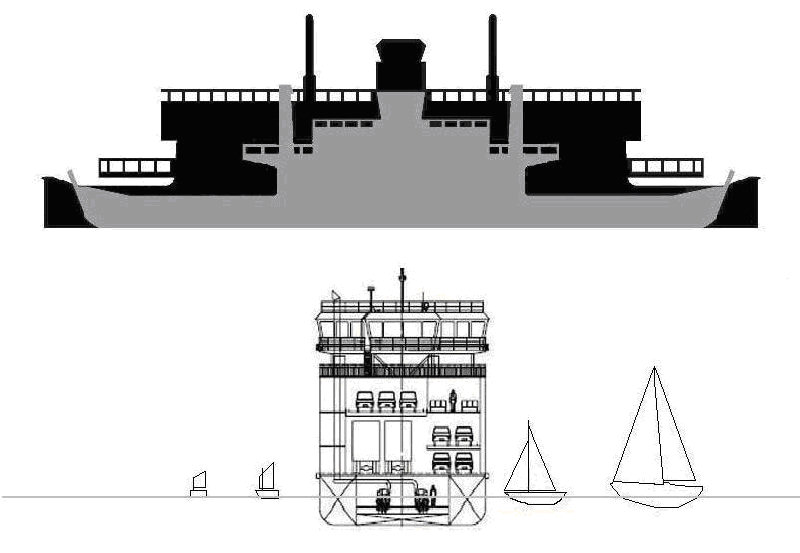
The proposed new Lymington-Yarmouth ferry compared with other river users (artist’s impression, approximately to scale) © LRA
The future of Lymington is essentially tied to the safe and harmonious use of the river. We believe that all approved users of the river should share it with mutual respect in accordance with section 33 of the Harbours and Piers Clauses act of 1847. The proposed ferries are longer, wider, higher, deeper, and more powerful with a massive increase in displacement. Their hulls more flat bottomed than the current ferries which will have a huge impact on the river bed. We accept that the LHC are acting with all due care and diligence regarding the new ferries. However it is imperative that there is a vigorous pre-assessment before any decisions are made to introduce them.
Lymington is intrinsically linked to the river that bears its name. Commonly known as a market town, it is actually Lymington’s unique location, nestled between the New Forest and the Sea that is the key to its character. This is reflected in the town’s motto “By Sea and Forest Enchanted”. Today Lymington River is home to a long established amateur rowing club, two successful sailing clubs and a large number of fishermen. The leisure marine industry is the key employer in the town which is currently recognised as a World class centre of water sports, as well as being a pleasant destination town. However there is a serious concern that the introduction of very much larger ferries will not comply with the Act of Parliament 1847. It is believed that the advent of the current ferries has led to a significant increase in erosion of the surrounding marshes and threatening the coastal lagoons] which can be demonstrated by aerial photographs of the Beaulieu and Lymington rivers taken twenty years ago.
Over the years the ferries have gradually increased in size. There is a concern that the existing ferries are already too large and are damaging the environment. These large ships scour the river bed especially at low water springs. Then the loose mud is taken in suspension by the tide, exacerbated by the ship’s flat bottom and displacement surge, consequentially the banks of the river cave in.
Lymington’s Community Sailing Programme for youngsters is one of the most successful in the country. This summer there have been fantastic results by our sailors in national and world sailing championships, plus a great track record, past and present, in the Olympics. Many sailors from Lymington have World and Olympic titles. The success of these sailors is based on the strong junior programme based around the Wednesday afternoon sailing session. There is the potential for young people’s sailing to be severely hampered by considerably larger commercial vessels operating in their training area. Any threat to Lymington’s Community Sailing Programme would be disastrous and totally unacceptable.
Small vessels can find the ferries daunting especially when they pass in Long Reach or negotiate the wave barrier. The extra superstructure will significantly add to the safety concern. The suggestion that the safety risk can be reduced by enforcing a lower speed limit may well increase the hazard posed by the ferries to small vessels.
We believe the existing ferries are above a size that is properly compatible with the 1847 Act. There have been a number of collisions including severe damage to moored yachts, with the course of the ferry through the wave barrier being particularly confusing to other river users. Whilst new ferries have obvious commercial advantages the attached list of key points needs to be assessed in order that all safety issues, environmental issues, without detriment to other small craft users in line with the 1847 Act.
This is a very urgent matter with enormous ramifications for Lymington. We seek support from the Royal Yachting Association, Natural England, Solent Protection Society, NFDC and SEEDA who have a duty (imposed by domestic and European law in the case of Natural England) to secure the safety of all river users and to protect the environment respectively. Moreover, we must point out that this proposed development (as it must be regarded in the legal sense given that the introduction of these ferries would constitute a significant change to the commercial operations carried out in the Lymington River) is likely to have an adverse effect on the integrity of the marine and tidal areas and coastal lagoons in the vicinity. As we assume you are aware, there are two designated SACs (the Solent Maritime (EU code UK0030059) and the Solent and Isle of Wight Lagoons (EU code UK0017073 and at least one SSSI that may be affected. You will also be aware that the possible adverse impact of larger commercial vessels on the salt marshes was specifically addressed in a report (dated 23 April 1991) produced by the then County Planning Officer and County Surveyor. The concerns about erosion identified in that report have proved entirely justified. The proposed development will further accelerate the degradation of the relevant areas. Given its potential impact on the designated areas, it will be necessary for the Secretary of State to commission a full and adequate Appropriate Assessment of the potential impacts of this development. So far as we are aware, that has not yet been undertaken.
| | C-Class | R-Class | % Increase |
|---|
| Length (metres) | 58 | 62.4 | 0.076 |
| Beam (metres) | 15.2 | 16 | 0.053 |
| Draught laden (metres) | 2.28 | 2.3 | 0.009 |
| Height from waterline | Unknown | Unknown | Unknown |
| Horse Power | 800 HP | 2360 HP | 1.95 |
| Max. Displacement (tonnes) | 850 | 1495 | 0.76 |
| Deadweight capability (tonnes) | 130 | 360 | 1.77 |
The existing ferries’ capacity 130 tonnes, proposed new ferries 360 tonnes... 230 tonnes extra.
The introduction of larger ferries is not a fait accompli as they will have to comply with the 1847 Act, the current safety code for trust ports and Natural England’s environmental conditions.
Bullet Points:
1. Size & capacity
1.1. The new ferries are longer, wider, higher and deeper with more powerful engines and seventy six percent increase in displacement. Their load capacity is increased from 130 tonnes to 360 tonnes.
1.2. The proposed ferries have the capacity to hold two decks of cars, five lanes wide and a third deck of three lanes. This is a massive increase.
1.3. The mezzanine decks on the present C class ferries were added after a carrying capacity had been agreed. What assurances do we have that Wightlink will not alter its new ferries in a similar way?
1.4. There is suggestion that the Lymington-Yarmouth ferries should be interchangeable with the Portsmouth-Fishbourne route. This is not a logical argument and should not be used as a reason for increasing the size of the Lymington Ferries.
2. Legal obligations
2.1. A harbour master may give directions prohibiting the entry into, or requiring the removal from, the harbour of any vessel if, in his opinion, the condition of that vessel is such that its presence in the harbour might involve a grave and imminent danger to the safety of persons or property or risk that the vessel may, by sinking or foundering in the harbour, prevent or seriously prejudice the use of the harbour by other vessels. He must have regard to all the circumstances and to the safety of any person or vessel. Such directions given by the harbour master may be over-ridden by the Secretary of State.
2.2. Existing ferries are known to flout the current speed limits. The AIS data recording the speed of the ferries and held by the LHC should be regularly made public including details of penalty notices and fines paid.
2.3. The Harbours, Docks and Piers Clauses Act 1847 clearly states the conditions to be complied with and the onus of proof is on Wightlink.
2.4. The harbour authorities should produce a statement which simply explains the position of the larger ferries in relation to the 1847 Act and their understanding of Natural England’s responsibilities. We need a common man’s guide to the 1847 Act.
3. Impact upon the Environment
3.1. Natural England has a duty of care regarding the protection of the environment and therefore the river’s banks and bottom, including flora & fauna. The environmental survey commissioned by Wightlink is controversial. The results have now been published and they indicate that there will be environmental damage. There should be an independent study possibly by Southampton University’s Oceanography Department who have the experience and equipment.
3.2. As the ferry transits the river it displaces an amount of water determined by its size and weight. The movement of the water is known as surge. Surge is a function of displacement and speed through the water. The proposed ferries with greater displacement will cause greater damaging surge. Wightlink’s intended larger ferry has a hull shape which resembles a brick unlike the existing ferries. A less hydrodynamic hull combined with the increase in horsepower required to correct windage a larger vessel will have an impact on the river. The river base will be churned up causing mud that stays in suspension to be pushed out to sea by the vessel’s flat bottom and displacement surge it is then carried out to sea by the tide.
3.3. As the ferries come in and out of the river the relentless disturbance to the river bed must have an effect on marine life and nature’s food chain. This is environmentally unacceptable.
3.4. Any survey to assess the impact of the new ferries on the river must include HW and LW springs and the state of the river bed. Any trials must also be conducted when all the river moorings and boats are in situ, and with wind strength of F3-4.
3.5. Public access should be granted to historical aerial photographs in order to compare the erosion of the river banks.
3.6. Depth gauges do not work after a ferry has passed because mud is stirred up. This proves beyond any doubt that the river bed mud is being disturbed.
3.7. Impact upon local business.
3.8. There are estimates that the leisure marine business in Lymington is worth £100 million a year. Any possible threat to its biggest industry should require significant consultation with the Town Council and S.E.E.D.A.
3.9. The C Class ferries should not be sold until a satisfactory arrangement has been agreed.
4. Impact upon traffic
4.1. Encouraging more HGVs to come to Lymington will have a serious impact on local roads with the only through route being the National Park and Beaulieu. There is more than adequate HGV capacity with direct access to motorways on the crossings from Southampton and Portsmouth. A discounted HGV night service would be exceedingly unpleasant.
4.2. A recent breakdown of an IOW ferry caused a massive traffic back-up in Southampton. Such an event in Lymington would quickly create gridlock on our roads.
5. Impact upon other river users
5.1. When the tide is low and the channel is narrow, it is likely that there will be a significant bow wave. Most sailing craft would be rolled by the bow wave and since the superstructure is larger, there is a risk of masts being hit by the ship.
5.2. Sailing craft in particular children’s dinghies are vulnerable to the sideways thrust of the Voith-Schneider propulsion units. Especially with the considerably larger wind shadow created by the extra height and length of the ship’s superstructure. Even with the existing ferries small craft are frequently grounded because of the ships down draft.
5.3. A lower speed limit to reduce environmental impact would be an unsatisfactory control measure which would drastically affect the other river users. Slower speeds would increase the ferries’ time spent navigating the confines of the Lymington River. This would effectively turn the river into a bottleneck, rendering sailing particularly racing impossible.
5.4. It is understood Wightlink have given a written undertaking that the new ferries have been designed to operate safety within the existing Harbour limitations this must include the moorings lay out and in particular the long standing traditional moorings along the east bank and opposite the Dan Bran pontoon.
5.5. At a minuted meeting with Wightlink at the Royal Lymington Yacht Club, Andrew Wilson their Chief Executive, stated that the ferries were being built to fit within the existing constraints of the river.