
A truly remarkable cruising dinghy goes on show at the RYA Dinghy & Watersports Show 2026
by Joe Murphy 16 Feb 09:42 GMT
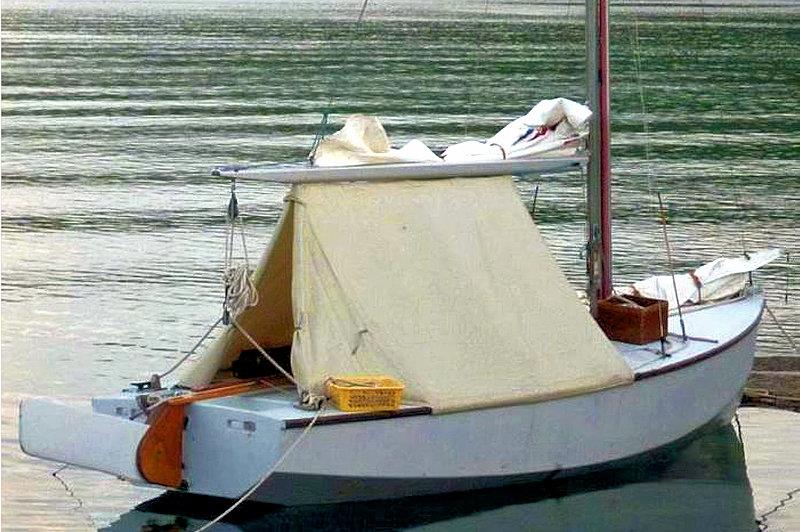
'The Grey Boat' with boom tent up, ready for camping on the Croation coast in 2018 © John Perry
One of the most innovative and successful small cruising dinghies ever built will be on display to visitors at the RYA Dinghy and Watersports Show this month.
Marking 50 years since engineer John Perry began designing and building his 15-foot sailing boat packed with cutting-edge features for safety at sea and convenience while camping, it will be proudly shown by fellow members of the Dinghy Cruising Association (DCA) at Stand M20.
Since its launch in 1978, the dinghy - unnamed by John, but widely known in the dinghy cruising community as "The Grey Boat" - has sailed thousands of miles. With partner Josephine Street, John has made the long crossing to the Channel Islands multiple times and cruised extensively off France, Spain and Croatia, the couple sleeping on board for weeks at a time.
Outwardly, The Grey Boat is deliberately modest in appearance, meeting John's preference to be inconspicuous. Beneath the low-key topsides, however, are features that would be associated with a much larger vessel. These include:
- A tensioned steering line encircling the entire cockpit permits helm adjustment from any position, including at the mast during sail changes.
- A gunter rig allows fast sailing in normal conditions and converts to a lower-aspect Bermudian rig for safer sailing in heavy weather.
- A hidden channel, protected by a gravity-closed flap, is designed to open if the dinghy is fully inverted, allowing water to flood one side buoyancy tank and assist the crew in righting the boat. It has never been needed, however, as the boat has not inverted despite John and Josephine coping in conditions that would terrify most yachtsmen, including beating against a Force 8 in the Solent.
- A 10 gallon freshwater tank under sole provides several days' supply via a pump and adds to stability.
- Some 35 cubic feet of storage space, including a pull-out galley, and myriad compartments.
Constructed from double chine plywood with glass reinforced polyester sheathing, the dinghy is self-righting, self-draining and unsinkable. It has 75kg of lead ballast, formed from roofing sheets, near the tip of the extra-wide, aerofoil centreboard.
John, who is chair of the Amateur Yacht Research Society, built the dinghy in his twenties during weekends in his parents' garage in Cambridge, while working as an engineer in London. Now 74, he said: "I wouldn't call it a very pretty boat, as it was intended to be purely functional. It has been a successful design and is usually one of the fastest boats. It is always satisfying to sail a boat that you actually made yourself."
Josephine, who will be chatting with showgoers at the DCA stand, is fulsome in her praise. "To me it is a wonderful boat, nicely balanced and everything works, everything is to hand."
John and Josephine have cruised The Grey Boat extensively in the UK. In addition, they have explored the Cherbourg peninsula, Brittany, Amsterdam, Friesland, the Venetian Lagoon and the coasts of Spain and Croatia. Their longest cruise began in Lechlade, Gloucestershire, and ended -some two and a half months later - at Schiermonnikoog, returning home to Devon by road.
Roger Barnes, the President of the DCA, has called the Grey Boat "a remarkably unremarkable, remarkable boat."
Graham Neil, DCA stand manager at the RYA Dinghy and Watersports Show, said: "We are thrilled to display The Grey Boat, which is rightly famous in dinghy cruising circles as one of the most successful self-designed cruising dinghies. I think show-goers will be fascinated by the range of innovations and useful features behind the plain grey paintwork. There will be nothing else like her at the show, and probably no boat with so many miles under her keel."
The second dinghy on the DCA stand is another unique craft, Lapwing, a beautifully made scaled-down Tancook Whaler measuring 14'10" overall. With clipper bow, raked stern-post and schooner rig, she has completed the demanding Semaine du Golfe festival twice with owner Tom Edom solo at the helm. Tancook Whalers, which measure around 32 to 35 feet in length, were working boats built in the late 19th century on Big Tancook Island, Mahone Bay, Nova Scotia.
Tom said: "Apart from being a seriously pretty boat, Lapwing is a good sailor, despite being only eleven feet on the waterline. She is also remarkably seaworthy and has taken me safely through some quite rough conditions both under sail and under oars."
DCA website: www.dinghycruising.life