
America's Cup: Kiwis have a ripper
by Richard Gladwell/Sail-World.com/nz 2 Nov 03:03 GMT
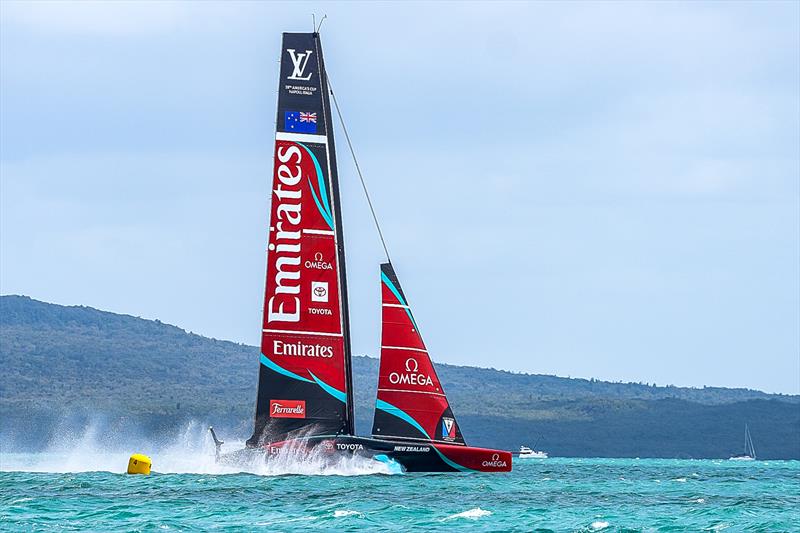
Emirates Team New Zealand - Sailing Day 31 - October 31, 2026 - Auckland © Sam Thom / America's Cup Recon
After losing Friday to strong winds, Emirates Team New Zealand grabbed the opportunity to sail for the second successive Saturday - in marginal racing conditions.
The Recon Unit team recorded winds of 18-20kts, while closer to Auckland they were independently measured at over 25kts in squirts. The maximum prestart wind limit, read over a 30-second "rolling boxcar" system, is 23.5kts.
The Kiwi team put on their smallest main and jib and stayed in that configuration all day.
As skipper Nathan Outteride has explained previously previously, when the small sails are on: "the boats really light up as soon as you put the small gear on. When you can get onto the little sails, the boats really come into another gear, and as you would have seen today, the boat was going pretty fast."
We've seen Emirates Team NZ sail their AC75, now sold to Team Australia, training alone in these conditions ahead of the 2021 America's Cup - and from the photoboat, it was an impressive display of speed and control.
Unfortunately, we never got these top-end conditions in the 2021 America's Cup, and couldn't tell how the Kiwis would have performed against Luna Rossa.
In today's video, we can see the AC75 going through a lot of manoeuvres with both foil arms extended, which, while adding slightly more drag, gives a lot more grip on the water before, during and after a tack or gybe - and those who follow F1 will know grip is all about control and fast exit speeds out of a turn, which holding your line on the track.
All told, Saturday was a shorter session than the usual 4-5hours, and sailed in conditions that are unlikely to be experienced on the Bay of Naples. However, such exercises do test the gear to the extreme work limits, and any shortcoming is vividly revealed.
The only casualty of the session appeared to be the deck fairing covering the jib sheeting, which, as can be seen in the photo, was removed and replaced. The trench in which the jib traveller is contained is visible in another shot - with a crew member standing in the trench.
For the first few weeks of this campaign, Emirates Team NZ used to have a lot of difficulty hoisting the mainsail. The issue seems to have been resolved, but one of the images from today's session reveals the massive battening in the headboard and the carbon reinforcing at the top of the sail to withstand the forces at the top of the fathead mainsail, and it is easy to understand why there were issues in getting the sail to lock in properly at the top of the mast. Don't forget we are only seeing one side of one skin of the double-skinned mainsail; the issues are replicated on the other side/skin, and hoisting the sail involves a team of support crew on both sides of the sail.
In another shot, the size of the jib battens can be seen. The two patent and design cases between North Sails and Emirates Team New Zealand revolve about the process of designing and implementing the sail structures that will allow the shape of the sail to be adjusted by luff tension. Pulling the shape forward in the jib and flattening the sail with this batten size is quite an engineering feat, giving rise to the New Zealand team's patent.
The other point that must be remembered in all recon videos is that we don't know whether the teams are running on automated flight control to give consistent test results, or if the AC75 is being flown manually - which is the only permitted system during racing. While the AC75s may look to be beautifully trimmed and fast, the near-perfect flight control could be attributed to a computer-driven system. Of course, the targets from that perfect flying session then become the targets for the manual flight controllers to achieve in racing or in race practice.
This was sailing day 31 for Emirates Team New Zealand of their 45-day quota allowed under the Protocol, a cost-reduction and catch-up measure for the lower placed teams in Barcelona. The Kiwi team now have just 14 sailing days left to be used over the next 11 weeks (including the Xmas break).
Recon Report - October 31, 2026 - Sailing Day 31 - Hauraki Gulf, New Zealand
- AM: Sunny. Wind: 18-20kts 180° (S)
- PM: Sunny. Wind: 18-20kts 180° (S)
- Sea State: Choppy (AM & PM)
Sailing Stats:
- Dock Out: 1000hrs
- Started Sailing: 1053hrs
- Stopped Sailing: 1339hrs
- Time sailed: 2hrs 40 mins
- Foiling time: Not reported
- Tacks: No data. Gybes: No data
Crew List:
- Port Helm: Seb Menzies (NZL)
- Starboard Helm: Nathan Outteridge (AUS/NZL)
- Port Trimmer: Iain Jensen (AUS)
- Starboard Trimmer: Andy Maloney (NZL)/Josh Armit (NZL)
- P5: Jo Aleh (NZL)
- P6: Josh Armit (NZL)
Recon Unit Report – October 31, 2026
Key Points:
- Upper wind range.
- Strong focus on boat handling and racing practice.
After a couple days lost to a strong SW system ETNZ rolled out Saturday morning at 0840 to a still breezy southerly. A lot of hands were involved to get the mast in and a level brought out to check the rig. A measurement of 84.9 degrees was recorded as seen in the photos of interest. Running foil tests and pushing off the dock at 1000, ETNZ had a long 20km tow down to the Back Paddock, their usual training grounds in a fresh southerly. The crew consisted of Nathan Outteridge, Seb Menzies, Iain Jensen, Andy Malone, Josh Armit, Jo Aleh.
Hoisting their heavy wind M3 and J5-0 they once again towed onto the foils at 1053. In a fresh 18-20+ knots southerly ETNZ then proceeded through a fairly standard shakedown of the boat up and down the smaller inner harbour between Waiheke and The Eastern Beaches. The session ended at 1124.
The buoys were then laid and at 1140 ETNZ towed up and went through a series of rolling prestarts. There was good movement of the boat in the strong breeze, the boat looked stable throughout and there was very few moments the boat looked unstable. As earlier in the week, there was a continued focus on port entry starts with the majority entering in on the pin. The session ended at 1200.
The next session started shortly after at 1214 and consisted of several prestarts but with a few laps adding in up and down. It looked like a 3 lap virtual race course probably due to the smaller training area. The session ended at 1246 after a couple of practice races. Several shore crew were seen jumping on board to work on the jib track system. It seems this is a known weakness of the jib track fairing system as it is the second time this training block it has happened to ETNZ and both times a spare fairing was on board Chase One and quickly on board to replace. There is a small chance based on recent behaviour from ETNZ that there was actually no need to swap the fairing and it was in fact a practice run for replacing the fairing quickly on the water, as at the end of the day there was no noticeable damage to the fairing as it was carried off of Chase One back at the dock.
The starting marks were picked up and the next session started at 1305. Consisting of a few more runs up and down the Paddock. At 1321 there was a short pause and Ethan Jones a team hydraulic engineer jumped on board the boat in the VIP spot for their blast back up the harbour to North Head. There was a couple small runs up under North Head before a big splashdown, possibly from hitting a UFO, ETNZ then ended their day shortly after at 1339. Dropping sails and towing back to base.
Overall, a shorter sailing day with a strong focus on racing practice in a fresh southerly.
Additional Images: