
Francesca Clapcich makes history in The Ocean Race live call
by Team Francesca Clapcich 7 Sep 17:37 BST
7 September 2026
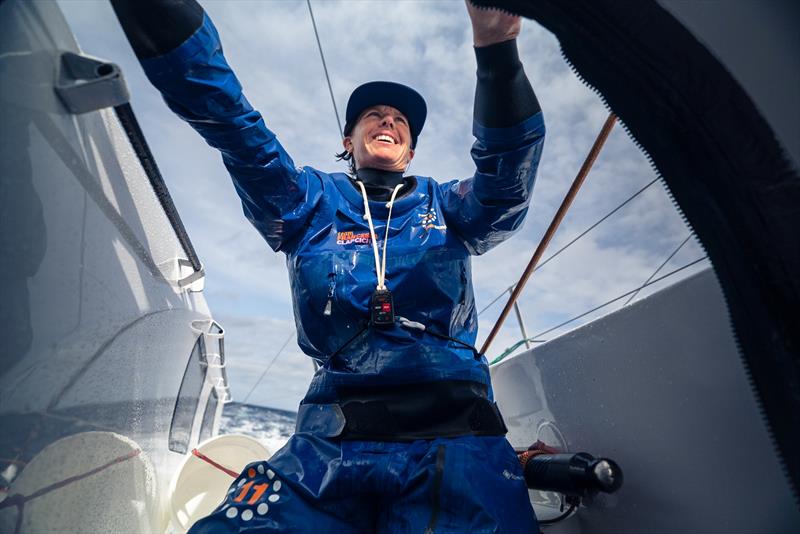
Team Francesca Clapcich - The Ocean Race Atlantic © Julien Champolion / polaRYSE / 11th Hour Racing / The Ocean Race
Francesca Clapcich onboard 11th Hour Racing joins first-ever live call with United Nation Secretary-General's Special Envoy for the Ocean, Peter Thomson, while racing in The Ocean Race Atlantic
- Francesca Clapcich, skipper of the 60-foot IMOCA 11th Hour Racing joined the United Nations Secretary-General's Special Envoy for the Ocean, Peter Thomson, for his very first call-in with a team during an offshore sailboat race.
- The pair discussed the changing weather conditions and sea state the team are encountering while racing in The Ocean Race Atlantic, the team's onboard citizen science program, climate data tied to a changing AMOC, and the team's marine mammal strike mitigation work.
- All the data the team collects during The Ocean Race Atlantic supports the Global Ocean Observation System coordinated by UNESCO's Intergovernmental Oceanographic Commission (IOC) and is freely available for science institutes.
Double Olympian, first Italian woman to win The Ocean Race, and outspoken advocate for ocean health, Francesca Clapcich (ITA/USA) joined Peter Thomson (FIJ), the United Nations (UN) Secretary-General's Special Envoy for the Ocean, during The Ocean Race Atlantic from her IMOCA sailboat 11th Hour Racing in the first ever live call to the UN representative. Clapcich was 200 nautical miles southeast off Nantucket Island, United States, and Thomson joined from Palau in the Western Pacific Ocean.
The fifteen minute conversation covered a wide range of topics including the onboard citizen science program the team is undertaking and its role in contributing to wider ocean knowledge, climate data tied to a changing Atlantic Meridional Overturning Circulation (AMOC), and the team's marine mammal strike mitigation strategy.
For more than a decade, The Ocean Race and 11th Hour Racing have worked together to embed ocean science in elite sailing, advancing onboard instruments and open-access data and building what the Race describes as the most comprehensive environmental data-collection initiative undertaken by any sporting event. With 11th Hour Racing now serving as Impact Partner of The Ocean Race Atlantic, this call is a natural fit for the UN's top ocean envoy.
Speaking in the cockpit of her 60-foot foiling race boat, Clapcich showed Thomson the conditions outside on day two of the transatlantic race - from New York, USA to Lorient, France - as they foiled along in 12 knots of breeze. Carefully moving around the boat she also pointed out to Thomson the science equipment the boat carries onboard: the Essential Ocean Parameter (EOP) Unit measures sea surface temperature, salinity, dissolved CO2, and oxygen - all key indicators of ocean health.
Thomson asked Clapcich what it means to her to contribute so directly to ocean science while racing in the very first edition of The Ocean Race Atlantic.
"We're just sailors, we are not that smart, but hopefully someone ashore who is smarter than us can analyze it!" she laughed. "It's not just about racing, it's what we can do also with our boats and our platform. It's a privilege to be out here - we want to keep our playground beautiful and clean and our planet a safe place for everybody."
Thomson spoke to the bigger picture: how this data is what scientists use to check the health of the planet. With the ocean covering more than 70% of the planet, regulating the climate, absorbing carbon dioxide, and producing around half the oxygen that we breathe, it's a reminder of how little of it has been observed, and how much still needs to be understood before it can be fully protected.
All six boats in The Ocean Race Atlantic fleet gather measurements from areas that would otherwise be difficult and expensive for scientists to reach. During The Ocean Race 2022-23, scientists found microplastics in every seawater sample collected, including near Point Nemo, the most remote point on Earth. A 2024 study also found that scientific observations from the boat currently sailed by Clapcich shifted regional air-sea carbon exchange estimates by around 20%, a sign of how valuable measurements from remote waters can be for climate science.
Once teams finish their race to France, the data they have collected will be passed on to the Intergovernmental Oceanographic Commission in Paris for further analysis.
Discussing the contribution the competing teams undertake in collecting ocean science data, Thomson shared, "Ocean observation is the key to it all because the World Meteorological Organization up in Switzerland, they're not out in the middle of the ocean like you are. You collect the data, as do others, and send it to the WMO, and then they can give predictions, and their predictions are just based on science, on facts."
Data gathered from the Atlantic Ocean also carries particular weight right now given the ongoing weakening of the Atlantic Meridional Overturning Circulation (AMOC). The AMOC is a massive system of ocean currents in the Atlantic Ocean that acts like a giant conveyor belt, moving warm surface water north and cold deep water south. It plays a major role in regulating global climate, and scientists have observed it weakening in recent decades, making real-time data from the Atlantic increasingly valuable to understanding how it may change in the future.
The conversation also touched on the work of the Marine Mammal Advisory Group (MMAG), which is working with The Ocean Race Atlantic organizers and competing teams to reduce the risk of ship strikes as boats cross whale migratory corridors. Francesca Clapcich and Emily Caroe, Director of Communications and Purpose for the team, are both ambassadors of MMAG representing the team's highest tier of commitment. Team Francesca Clapcich has also established a dedicated Marine Mammals Committee with three members from the team, one being the current co-skipper for Clapcich during The Ocean Race Atlantic, Alberto Bona.
"We are working in real close contact with the Marine Mammal Advisory Group, we are one of the teams that are really trying to do the work alongside them. This race for example didn't start right away in New York. We had to keep a speed limit below 10 knots all the way to the starting line, 100 miles away from land, just to avoid having high speeds really close to where these clusters of marine mammals are," commented Clapcich.
The 11th Hour Racing IMOCA has infrared cameras at the top of the mast to alert the team to obstructions in the water, and the team developed a detailed Nature Action Plan prior to departure.
As the call came to a close, Clapcich looked around her and commented, "It's beautiful out here. I wish more people could see this and then they will probably understand why we need to take care of it."
Peter's closing words captured why this work matters. "There's no healthy planet without a healthy ocean. The ocean's health is currently measurably in decline in all the relevant facets, but that's not a message of despair, that's a call to action. And in the decade or so that we've been repeating that mantra, the action has increased on all fronts."
Keep up with all the action from the race here and to see more content from Team Francesca Clapcich during The Ocean Race Atlantic, check out our instagram here.